


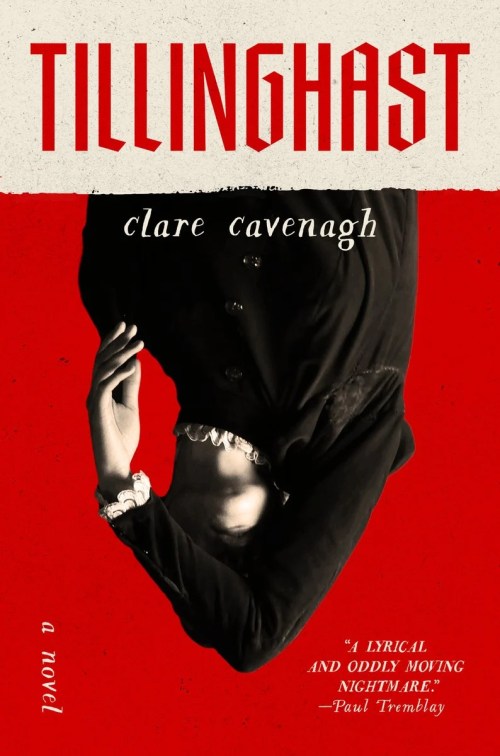
In a nineteenth-century land haunted by the fatal spectre of tuberculosis (“consumption” as it was then known), a young Rhode Island cleric falls prey one night to a neighbor’s fleshly seduction. An often-absent, mysterious woman, she will hold an eerie power over his fervid imagination for years to come: Stutley Tillinghast becomes a vampire (though, later, he is careful never to say or to write that word) and must now seek his sustenance in the murderous way of his kind. Eschewing the fanged bite, he learns to kill quickly and cleanly, dispassionately, with a blunt instrument, only afterwards draining his victim of blood.
Long-suffering decades pass, and Tillinghast thinks, with the fatigue of one unable to age or suffer lasting injury, that it is time to effect his own end, to consume himself and his decrepit family home beside the dark wood and the cemetery, in the cellar of which lie buried dozens and dozens of his victims’ corpses, with cleansing fire. Tillinghast is a good man; what must be considered a curse was mercilessly thrust upon him. Until he meets another young woman bearing an uncanny resemblance to his old love, an innocent who, to his torment, agonizes in the same gory way he does, redemption never seemed possible.
A work comprised of equal, successful parts Gothic fiction and psychological/spiritual character study, Tillinghast is the creation of first-time novelist Clare Cavenagh. Having spent her childhood in Australia and her adolescence in Switzerland, she read English and Renaissance literature at the University of Cambridge, and now lives in London. Recently, we had a pleasant conversation over Zoom, touching upon Twilight as well as what it means to be, vampire or not, trapped between contradictions. This conversation has been edited for length.

Ryan Asmussen
Before writing Tillinghast—even planning it—what had been your experience with vampire fiction? Have you always been a fan? Did you feel you needed to read deeply in the genre before beginning?
Clare Cavenagh
I was always a rather creepy child, very drawn to the morbid and macabre, much to my mother’s horror. I don’t really know where that came from; it seemed to be baked in. Then, when I was in my early teens in Australia, it was the height of Twilight fever. Everyone was obsessed with it. For all its shortcomings, I can absolutely see why it appealed so strongly to teenage girls. It entwines sex and death in a way that made intuitive sense to me at thirteen, when I was beginning to feel curiosity and fear at the same time, especially within a fairly conservative religious culture. Later I came to the classics, Dracula, especially, which I think is a wonderfully strange book. But when I began shaping this novel, I knew I had to do my due diligence.
Ryan Asmussen
A few years ago, in Cambridge Quarterly, you published a review of books about “the professor in children’s literature.” I wonder whether that academic concern influenced the novel in any way. There’s something faintly professorial about Tillinghast: aloof, thoughtful, shadowed by a certain darkness.
Clare Cavenagh
That’s really interesting. I don’t think it was consciously in the front of my mind, except insofar as I was already thinking of him as a cleric, both roles with potentially heavy pedagogical overtones. That review grew out of academic work I was doing on the representation of scholarship in Jacobean drama, and I can now see a connection. Those scholarly figures are often ridiculous, seductive, or dangerous, but they rarely end well. I also loved my time at university and once hoped to become an academic, so perhaps it’s simply a mode of thought that comes naturally to me.
Ryan Asmussen
You researched diligently into the historical New England vampire panic, read widely in vampire literature, and looked at the folklore of vampiric figures across cultures. Was there anything surprising in your research, anything you ultimately didn’t use that nevertheless stayed with you?
Clare Cavenagh
So much of it surprised me. I more or less stumbled across the subject by chance. The first thing I saw may even have been a YouTube video, and I was immediately fascinated. Part of it was the sheer horror: these grotesque, almost unimaginable encounters with decomposing bodies, not in fiction but in real life. But what moved me just as much was that the people undertaking these acts were often trying, in what they believed was the only way available to them, to protect their families and communities. So there was this extraordinary conjunction of violence and care. It feels like something that should belong to a very distant past, but in fact it happened surprisingly close to our own time. One aspect I thought a great deal about but used only indirectly was the history of Rhode Island itself: its religious difference from neighboring colonies, the relative privacy it afforded, the fact that people buried family members in their own yards, and the sense of it as a place where one could be somewhat eccentric or outside the norm. That atmosphere of privacy, strangeness, and tolerance was very compelling.
Ryan Asmussen
Did the project start with Tillinghast, his character, with a particular image or idea, or perhaps with your chilling opening scene?
Clare Cavenagh
It’s a good question. The answer is a little strange: the novel didn’t begin with him at all. In a very early, messy draft, the focal character was Sarah. That made sense to me; she was roughly my age, from London, and I thought she might be the point of entry into this world. But as I wrote, I realized that Sarah, and especially her mother, were much stranger and more opaque than Tillinghast. I began to think of them almost as plant-like rather than animal, which made their perspective feel too alienating to sustain the book. Shifting into Tillinghast’s point of view gave me a clearer structural way to bring in the historical material, and it made the emotional shape of the novel more accessible. Apparently, I find it easier to identify with a guilt-ridden nineteenth-century man than I first expected, which is probably something for me to think about.
Ryan Asmussen
Your protagonist is driven to prey upon others, but he is also genuinely sensitive. He does what he must, and over the years has found a way of living despite the cruelty he inflicts, despite the absence of the Christian God he once worshipped. He also takes responsibility for a suffering young woman who appears to be one of his kind. How difficult was it to live with him for a time and understand that depth?
Clare Cavenagh
I feel a great deal of affection for him. His anguish, the way he is compromised, never felt especially alien to me. In some way, I think many people feel something like he does. Old certainties have fallen away, and we are living in a world where the rules feel either changed or obscured. That seems analogous to Tillinghast’s loss of faith. He still knows right from wrong; he feels tremendous guilt about living in a way that violates his values. He knows that his continued existence causes suffering, yet he is unable, or unwilling, to do what might resolve that contradiction. That emotional knot felt very recognizable to me. In the novel, the material form of his predicament is fantastical, but the mechanism behind it, the experience of carrying contradictions one cannot fully escape, seems much more familiar than it might at first appear.
Ryan Asmussen
There is a great deal of psychological subtlety in the novel. We have access to Tillinghast’s thoughts not only through the narration but also through his own writing (a list of victims, an autobiography), and yet there is a strong current of violence and gore, real visceral horror. Was that aspect of the book challenging to write, or did you enjoy it?
Clare Cavenagh
Honestly, I probably did have fun with it. I’m very interested in funeral culture; it’s one of those private fascinations I keep returning to. Part of what compels me is precisely how hidden that world is, how little we ordinarily engage with it. So when it came to those scenes, I leaned heavily on my research and thought carefully about how to render them in a way that felt materially authentic. I was also interested in what you might call the logistics of horror. If the book was going to go to such extreme places, I wanted it to do so properly. Those scenes felt integral to the novel, and there were moments I simply could not push offstage without weakening the whole structure.
Ryan Asmussen

Tillinghast’s relationship to God feels central to the novel. What, if anything, would you want readers to take away from its religious—or simply metaphysical—dimension?
Clare Cavenagh
I don’t think I approached his faith primarily as an opportunity to express my own views. I was more interested, on a psychological level, in how a person who begins where he begins might respond to what happens to him. As with everything else in his life, he ends up in a state of compromise. I don’t think he loses God altogether. Rather, he comes to believe that there is some being or force animating the universe, but that its nature, intentions, and relation to him are ultimately beyond his comprehension. He is no longer in a position to judge whether that force is good or bad; it has become too remote, too inscrutable. And that is hard for him, because extraordinary things have happened to him, and naturally he would love to know why.
Ryan Asmussen
Time is one of the novel’s central motifs. Tillinghast has lived out of time and space, forging identities and avoiding modern conveniences, while clocks and watches recur throughout the narrative. The novel itself moves between past and present. What function is time serving in the story, and how conscious were you of that motif as you wrote?
Clare Cavenagh
Very consciously. I knew from the start that I was dealing with characters who had been alive far longer than people ordinarily are, so I was interested in both the psychological and structural consequences of that. I spent time thinking about time as a human habit, something that governs not only years but also days, seasons, and rhythms of ordinary life. I was interested in what happens when someone is partly detached from those instincts. More personally, I’m fascinated by the strangeness of continuity: the fact that we feel ourselves to be one person even though different periods of our lives can seem radically distinct. Sometimes it is hard to believe that earlier versions of oneself were truly the same self. In Tillinghast’s case, that estrangement is intensified by the length and extremity of his experience, but I also wanted his effort to gather those selves together to feel like an act of care and self-repair. At the same time, his relation to time marks his separation from the ordinary world, and part of the novel’s movement involves Sarah edging toward that estrangement herself. The recurring clocks and watches gesture toward that crossing, toward the sense that there is a diaphanous membrane between being fully in the world and standing just outside it.
Ryan Asmussen
Before we finish, is there anything “behind the scenes” about the novel you’d especially like readers to know?
Clare Cavenagh
One small detail is that some of the names on Tillinghast’s victim list belong to real friends of mine. I needed a fairly large number of names, so although many are fictional, a few are not. I asked people whether they were willing to be included, and many said yes, though some declined, perhaps out of a slight superstitious discomfort. I also briefly invited people to suggest their own “distinguishing marks,” but I had to stop doing that because they became a little too inventive.
HORROR
Tillinghast
By Clare Cavenagh
Viking Books
Published June 23, 2026


