I fell in love with creative writing during my first nonfiction class in college, taught by a plucky MFA student and convening during the unwanted hour of 8:00 a.m. How else could you enroll in a course you actually wanted to take? Before I read her novels, I knew Ann Patchett from her New Yorker essay “My Three Fathers.” It’s rare for the nuclear family to explode and triangulate in ways where relationships are maintained, but just look at the cover photo—Patchett establishes physical contact with each.
This craft essay served as a lesson for mining personal life for narrative and sifting through stories already played out that remained unwritten. One of Patchett’s fathers stated plainly this photo at her sister’s wedding was a future visual aid for when they’d all pass on and finally Patchett would write about them. Whistler, Patchett’s latest novel, is a story within a story; now an adult woman, narrator Daphne runs into her estranged stepfather at The Met, forcing her to revisit what fractured her family and to forge a new relationship during his final years.
English classes often include a discussion of what an author meant when they wrote something; what part of the story is them or loosely inspired by their lives? Eddie Triplett, a publishing honcho, in his dying days of leukemia tells his stepdaughter, “What if . . . you wrote it all down . . . Mary Carter, the raspberry farm, the car accident, the snow, the two of us. You could change the details. That’s how people do it.” The second of three fathers, Eddie remains the male figure Daphne is closest with during her upbringing and the one with whom she rekindles a relationship during adulthood. In a novel where the main character, Daphne, and sister, Leda, also share three fathers—one biological father and two stepfathers, with each sister closer to one over the other—disentangling this new work from Patchett’s New Yorker essay would be negligent.
Mary Carter, the main character in Whistler—a fictitious memoir embedded in Patchett’s novel—details the survival of a woman saved by her horse, which responds to a whistle long after Mary enters the liminal space of greeting the deceased. The on-the-nose literary acknowledgements from Eddie to his publishing background make this metaphorical story beg to be noticed for its weight and parallels to the night Daphne and Eddie faced death after a car crash.
Now reconnecting with someone as an adult cracks open new knowledge, from sexuality to the roots of family fissures. Similar to Martyr! by Kaveh Akbar, the narrator learns through Eddie’s latter-day retelling how little she knew about his marriage to her mother, and that the arrangement born from friendship forced him to forsake his sexuality, conditions with which he ultimately could not comply.
However, before this marital image came crashing down, the car Daphne and Eddie drove in while sister Leda was in the hospital tumbled off the road, leaving the two snowed in. Here is where nine-year old Daphne meets Whistler. Signature to Patchett’s style are anchoring the novel in a secret between generations where adults must grapple with facts hidden from them during childhood; just read The Commonwealth, whose complex coupledom unravels during a morning making orange juice, or The Dutch House, where marriage turned financial assets into weapons.
What’s unique about Patchett’s novel is the ending offers no resolution, but revisiting the parallel narrative strands of Daphne’s childhood self in the car and her developed relationship with Eddie as an adult—a fondness thawed after he disappeared without a trace. Eddie’s arrival in the Contemporary Met wing forces Daphne to drudge up the story of what happened that night and tell it to Leda, who, laid up in the hospital with appendicitis, only knew that her mother and Eddie were no longer. This narrative prompt gives agency for Daphne to revisit the story of the accident as her childhood self, with a cognitive priming from the present provided by her mother, Leda, Eddie himself, and even his friend and lover Skip.

The author and English teacher Daphne, and publisher Eddie, allow us to view the story of Whistler—a horse who revisited his companion—as a literary conjuring Eddie conveyed to get them through the night. Similarly, the novel as a unit achieves a kind of literary immortality as a result of the final conversation with Eddie the narrator allows us to have: both the debut and finale of their life’s work.
Overall, readers who enjoy a prodding into a scab with a secret at the center akin to Little Fires Everywhere by Celeste Ng or Signal Fires by Dani Shapiro will find similar plot architecture in Patchett’s latest novel—a story embedded within a novel, encased in an essay pouring into its center.
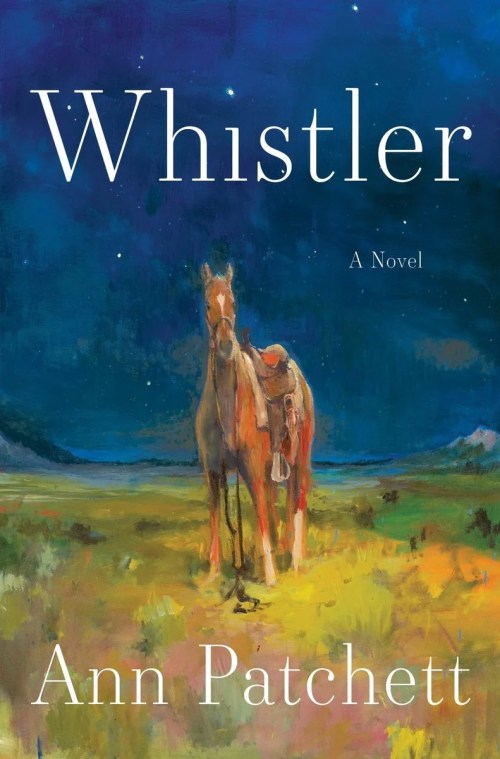
FICTION
Whistler
By Ann Patchett
Harper
Published June 2, 2026