


This month, I had the chance to speak with Mark Haber, author of the newly available Ada from Coffee House Press. A joy to read and an introspective, satirical look into our most privileged and wealthy members of society, Ada had me captivated from the first page to the last!
This interview was edited for clarity and length.
Madeline Schultz
I loved Ada! I thought it was such a fun book, and I’m so grateful I got to read it. This book could certainly be described as a “satirical romp” about an out-of-touch royal. Can you talk to me about what draws you to satire?
Mark Haber
I never actually set out to write satire! All of my previous books certainly have satirical threads, but Ada is by far the most satirical. I think what draws me to it is that naturally my brain goes to the humor and absurdity of things. I don’t go “I’m gonna write a satire and make fun of strong men and their delusions of grandeur,” but rather it all starts with the voice for me. Once I’ve got the voice, I’m off and running. I’d say that it kind of possesses me. I’m more interested in language and strangeness, with strangeness meaning things that are just a little bit off. I like weird works where it’s almost a traditional comedy but is just off-center enough to make it interesting. Following the voice, a simple plot emerges, and from there, things accumulate into that satirical piece.
Madeline Schultz
It’s so easy to see what you just said as I was reading it! The voice of Gerard is so strong and the real gem of this novel, to be sure. And then things like the “paisley inheritance” really did make me laugh but also made me wonder what amount of the book was real. I had just read Saint Sebastian’s Abyss and had similar curiosities emerge, so I really love how you take these rich historical periods but still make them your own.
Mark Haber
Thank you! That is really one of the things that I love to do. I see it all as a tapestry: I love seeing the real mixed with the fictional, the beauty of the imagined mixed in with the real. I always say that my books aren’t realism, but I think they land in realism-adjacent. Things that could happen in places that could exist…you recognize the world, but it’s not our world.
Madeline Schultz
And I think as writers those are sometimes the most fun fictional spaces to be in, when we can toe the line of real versus not real, and readers can find themselves in either space at any time.
Mark Haber
Absolutely.
Madeline Schultz
Speaking of the everyday, my second question, and you can answer this however you feel because you said you don’t set out to write satire, but what are you looking at in the real world specifically that you’re interested in critiquing, or maybe not even critiquing necessarily but looking at with a closer lens and challenging readers to do the same?
Mark Haber
I wish I were that conscious as a writer! The thing I’m looking at when I want to add some realism to the books, at the risk of sounding pretentious, is writing like painting. I’m writing something, and it becomes fantastical, but I want to add brushstrokes of truth that ground the reader and let the reader know more solidly where they are, despite the over-the-top or hyperbolic narrative. I want the world to have the feeling of authenticity without actually being authentic. I love the make-believe and pretend, and I embrace leaving those strokes of reality within a world that’s new. At the end of the day, it’s all artifice.
Madeline Schultz
Ada certainly toes that balance perfectly! I’m curious to hear more about your writing style too and how it came to you for this particular book. Were there moments where you wondered “does this style work”? The writing style is very clipped and fast-paced, with lots of run-on sentences and interjections, kind of mimicking Gerard’s pacing in the room throughout the story. All to say, I’m curious to hear more about your style in general!
Mark Haber
Ada is probably most similar to Reinhardt’s Garden in that both books feature a kind of unbroken narrative. All my books are pretty slim, but they’re less historical, comparatively. I wrote and wrote for years in my twenties, two books that are archived somewhere on a floppy drive, in hopes of doing the cliched “finding my voice”, but I really was. I was emulating these books that are little treasure chests, which I hope are what readers find my works to be. Finding my voice allowed me to discover the style that best complemented the story itself, but it’s also me still emulating works and writers that I love and finding a way to make it my own.
As I was writing Ada, I was thinking of it as a ninety-page sprint. It was meant to mimic Gerard’s pacing and his thinking, too. Ultimately, though, I wanted it to be readable. I’ve never tried to write anything too self-serious, but rather accessible to readers. I want them to come in and be taken away by the story.
Madeline Schultz
Accessible is a great way to describe this work, I think. A sprint is definitely the experience that the reader gets, but not in an unpleasant way! I found the pacing to be perfect. This man, “poor” Gerard, is kind of having a crash-out moment, and we really get to have a front-row seat to that in this style.
Mark Haber
You’re absolutely watching this man have an existential crisis!
I definitely am a stylist, so to speak. The voice drives this story, but I also think that a traditional novel that is broken up into chapters with your typical setup is, in one sense, more mannered than what I’m doing, but I want to kind of emulate the human brain and how the human brain thinks.
Madeline Schultz
Writing that style can be so much fun, too! But it’s amazing when you can take that fun writing style and make it into a great literary work, like you have.
Mark Haber
Thank you! The editing process was intense, editing out anything extraneous, but really, I love digressions. I tried to make sure that digression itself was a big part of this story. My favorite part of the book, and this goes back to adding those brushstrokes, is Gerard’s grandfather going back to the Americas and meeting a Mexican woman he has to marry. I love that because you’re in the world of either historical France or this fictional land, and this is giving the reader a glimpse of what’s actually happening in the rest of the world, the “New World” of America, for example. It’s a small digression, but I think it guides the reader contextually.
Madeline Schultz
Absolutely. And I think what’s going on in the background of this book is so important. Toward the end, we’re introduced, for better or worse, to muskets! I’m curious what drew you to wanting to write about this time period, just before or right as the Holy Roman Empire is falling. What about that time is interesting to you, and what kind of research did you do surrounding that time?
Mark Haber
For this, I did research, but I can’t say I’m great at it. It worked out perfectly; that gag of Gerard not really knowing which country he is in is really reflective of the difficulties of looking at those centuries in Europe when boundaries were so convoluted. A city in Poland, for example, had its name changed every forty years, which was something that I was playing on in Ada. The past, to me, is a lot richer in material as far as we as humans don’t change, and we still are good and bad and in a lot of ways the same people that existed back then. I live in the everyday, and it doesn’t speak to my imagination nearly as much as putting contemporary characters in historical settings. My imagination really is called to these previous times as opposed to our own.
Madeline Schultz
In a lot of ways, I think there’s so much more opportunity than in the time period we live in today because you also get to teach your reader some of what is going on. For example, the geopolitical conflicts that were ensuing and the muskets being newly introduced technology, and we have great scenes to read of what Paris was like at the time. All of that, I totally understand why that setting is preferred. I’m curious if Europe specifically is a preferred setting for you to write in.
Mark Haber

I love European literature, though I really am obsessed with Latin American literature. When I wrote Reinhardt’s Garden, it had one foot in Europe, but the narrative is also in the jungles of South America. People who love my books and my friends often ask me, “When are you going to get back to Latin America?” and I really want to write something soon that gets back to that passion of mine. But you know, when the muse calls, you don’t ignore it. Part of my intrigue is just the “foreignness” of these places. I grew up in Florida, and so for me, there’s so much joy in writing about a Prussian farmer whose wife died of the plague, not because I delight in causing pain for my characters, but because to me it’s so distant that it toes the line of fantasy for me in comparison to the palm trees and strip malls that I grew up with.
Madeline Schultz
It definitely does some of the work of grounding the reader, too. You can kind of skip over the world-building and get to the story you really want to tell, in this case of course, the story of Gerard Desacroux IV—which, I found so funny that he is a fourth because it’s so telling of how unimportant he is. To put it nicely, I’d call him self-obsessed, but his characterization is amazing and so entertaining. I’m curious what writing his character was like. Was it natural for you?
Mark Haber
I love that question! Sadly, it was pretty easy. But I think part of that is, as Paul Auster said, writing is a lot like acting. I really created this character and then sort of inhabited him, finding what he would say or do as I went. It’s pretty easy for me to write these atrocious men because it’s like I’m playing a character, but one that is both easy to poke fun at and also rich with material.
I do, though, want Gerard to have small sympathetic traits too. There’s that bit toward the end about him losing his mother when he’s young, and the flashbacks to his father as well as the portrait of his father kind of looming over him. I wanted to have these small threads that led the reader to some amount of sympathy and made them think about nature vs. nurture. It was fun to add those to give him some depth, but at the same time, he ruins every chance to be good at every turn. Gerard definitely takes the path of least resistance. For example, obsessing over this woman as opposed to dealing with anything going on around him. Gerard’s main weakness as a character is just taking the way he knows forward rather than ever looking for a new path.
Madeline Schultz
I definitely saw that push-and-pull with his servant, Hans! He would have these interactions with him where he was just awful, just so mean, and then have this internal monologue of “wait, I should be nice” over and over again. There’s, of course, the whole aside where he’s talking about books, how not only did his grandfather dare to have them but he actually read them, only for the very next digression to pivot to Gerard finding a useful book that could help him. It definitely seemed like he was always on the edge of making the right choice but just never could.
Mark Haber
Gerard and Hans are the trope of a comedy duo, for sure, and they are a mess.
Madeline Schultz
But such a fun-to-read mess! My last question is, how did you think about centering Gerard and his character around a woman? The titular Ada is really the only woman we see besides a brief aside about his mother, and she is certainly the central focus, if not the entire driving point of the book.
Mark Haber
Ada is definitely the catalyst of the book. Ada herself is kind of an excuse, almost. I wanted to write a book that had, in the most absurd way, a lot of lust. Over the top, ridiculous lust. He’s obsessed with a person he doesn’t even know, and I wanted the reader to not really know her either at the risk of not giving her depth, but rather I wanted the reading experience to be just as in the dark about who she is and really force the reader into Gerard’s perspective only. I wanted to write a book about lust in this absurd way, where he makes every excuse to see this person. All my characters tend to have some kind of obsession, and for Gerard it’s definitely a sexual obsession with Ada. It’s not love, to say the least, though he may think otherwise. Ada is directly and indirectly involved in every choice Gerard makes, but most importantly, she is his biggest excuse. He uses her to shift blame away from himself for how he treats the peasants, for example. I like the idea that Ada represents France for Gerard, or a place that he wishes were his home. He holds her as a symbol of “if I just had her,” he could make everything else right.
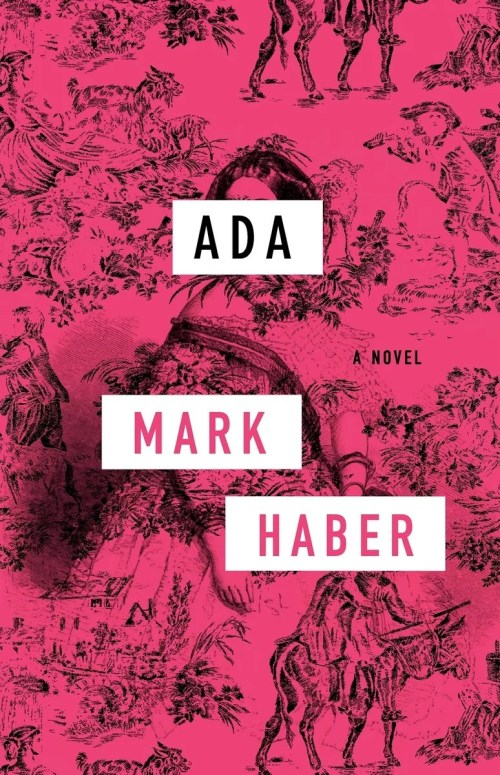
FICTION
By Mark Haber
Coffee House Press
Published July 14, 2026


