


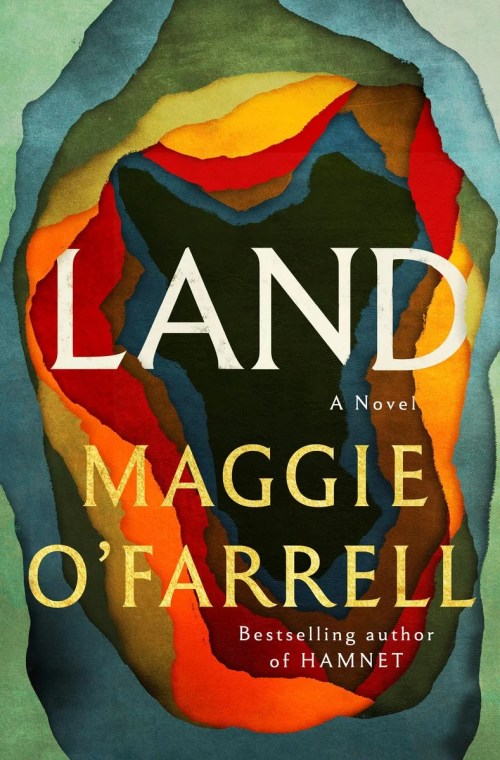
Maggie O’Farrell’s Land explores themes of endurance: survivors of famine, migration, superstition, grief, colonial violence, and time. Set mainly in nineteenth-century Ireland but spanning centuries and continents, the novel avoids a straightforward historical narrative. Instead, it reflects on inheritance and memory, suggesting that the earth retains the histories of those beneath it. Though its structure seems complex, Land is ultimately an ambitious, emotionally rich work that emphasizes the unseen bonds between people and their environment.
The novel begins in 1865 on a remote Irish peninsula scarred by the Great Hunger. Tomás, a surveyor, travels with his ten-year-old son Liam across the rugged landscape. O’Farrell creates a vivid atmosphere of coldness and unease that feels almost physical. Liam shivers in the Atlantic wind; readers feel it too. Her prose vividly depicts Ireland’s physical landscape and her characters’ emotional weather.
Tomás is one of the novel’s most compelling figures precisely because he is so emotionally restrained. He believes “it is always better to say too little than too much,” a philosophy that shapes his difficult relationship with Liam. He is stern, practical, and often frustratingly distant, yet O’Farrell never reduces him to a simple archetype of harsh fatherhood. Instead, she slowly reveals the tenderness hidden beneath his reserve. Some of the page’s most addictive moments occur when that briefly cracks: when Tomás comforts Liam after the boy becomes lost and frightened in a brush, or when he later breaks down in tears in front of his son. O’Farrell understands that love is not always expressed eloquently, particularly in lives shaped by deprivation and survival.
The father-son relationship forms the emotional center of the first section. Tomás brings Liam along not out of sentimentality but out of necessity; he wants the boy to learn a trade and build prospects in a brutal world. Liam excels at mathematics and draughtsmanship, but there is a sense that his mind and spirit strain toward something beyond surveying. O’Farrell captures beautifully the loneliness of childhood, especially a childhood spent trying to interpret an emotionally guarded parent. Liam notices tiny graves scattered across the landscape and wonders if they belong to children lost during the famine. Such moments quietly emphasize how death permeates the Irish countryside.
What distinguishes Land from more conventional historical fiction is the way O’Farrell blends realism with folklore, spirituality, and mystery. After Tomás disappears briefly into the woods and returns profoundly altered, the story slips into something almost uncanny. A priest performs what appears to be an exorcism. Tomás himself cannot fully remember what happened on the hillside. The ambiguity surrounding this event is one of the novel’s greatest strengths. O’Farrell never allows the supernatural to become simplistic or melodramatic; instead, it exists alongside religious fear, trauma, memory, and the psychological wounds carried by survivors of famine-era Ireland.
The novel’s second major thread goes further back in time, introducing Brith, a girl in ancient Ireland. Initially, this may feel disorienting, as the connections are obscure and the plot isn’t linear, which may frustrate impatient readers. However, O’Farrell’s detailed atmosphere pays off. Brith’s world is richly sensory: sunlight-dappled trees, bees among pollen, hidden creatures beneath leaves, creating some of the most beautiful passages.
Brith’s storyline also sharpens one of the book’s central themes: the cyclical violence inflicted upon vulnerable people in times of fear and scarcity. When famine returns to her community, the elders decide that somebody must make a sacrifice, and Brith, eccentric, observant, and therefore suspect, becomes the target. Her fate is devastating, particularly because O’Farrell frames it with such tenderness and heartbreak. Even buried alive alongside her loyal hound, Brith remains achingly human.
O’Farrell repeatedly returns to questions of land ownership, colonization, and displacement. Tomás’s work surveying and redrawing boundaries carries enormous symbolic weight. Maps become tools of power as much as instruments of measurement. The scars left by British colonial rule are present everywhere, from the lingering devastation of the Great Hunger to the fractured identities of the characters themselves. However, O’Farrell refrains from making the story a preachy political message. Instead, history is conveyed through personal human experiences.
The later sections expand geographically as Liam heads toward the priesthood and India, while his sister, Enda, journeys across the Atlantic to Quebec. Some may find these parts less cohesive than the rural Ireland sections. The scope widens, sometimes slowing the narrative, but O’Farrell’s emotional insight keeps the story grounded.
Perhaps the greatest achievement of Land is the way O’Farrell transforms landscape into something almost sentient. The forest, bogs, hillsides, and streams are not passive settings, but living holds of memory. Characters vanish into the land and re-emerge changed. Generations unknowingly inhabit the burial grounds of those who come before them. It suggests that history is always present beneath the surface, hidden until revealed.
Land is not a fast-moving work of literary fiction, nor is it interested in tidy resolutions. It asks readers to surrender to mood, imagery, and emotional accumulation rather than straightforward plot mechanics. For those willing to move at its deliberate pace, the rewards are substantial. O’Farrell has written yet another haunting and deeply humane story about survival, silence, and the stories embedded within the earth itself. By the end, Land feels more like an examination of a family’s trauma rather than a conventional historical novel.
FICTION

by Maggie O’Farrell
Knopf
Published on June 2, 2026


