


In the 1990s, a corner grocery store on Sheridan and Belmont in Chicago served me as a post office. Returning once from an early morning visit, I saw a young woman exit her highrise on Sheridan, dash on a locomotive pulse with her young daughter to a waiting schoolbus, and immediately after hop a city bus to work. She seemed dynamic, responsible, industrious, a grownup, unlike myself, trundling home, long past my sell-by date, eating twilight for breakfast. I was writing a life of Brahms, my favorite composer—but my exciting enterprise had dwindled after about 900 pages from doubt to despair. I had no publisher, no editor, no agent, and the queries I had mailed to potential agents, editors, and publishers had been returned with little enthusiasm (when they had been returned at all), saying in sum that there was no appetite for so very large a book about classical music in the US. It mattered little that it was also about love, insanity, suicide, revolution, politics, war. They couldn’t see past the conventional horizons and advised me to cut it to the conventional 300 pages—but I had come too far to turn back.
I lived then in a dark studio with a view of a brick wall amid books and music. My library included every book in the English language on Brahms (except the musicology), almost every book on the Schumanns, and just about all their music alongside innumerable other books and albums. I had a sofa that opened into a bed—and 2 pianos (an electronic keyboard atop an acoustic) against a wall plastered with a poster of the Beatles and a framed picture of Brahms on my desk. I persevered, finishing a first draft of 1,800 pages (about 80 floppy disks), read only by Diana Athill, my first editor, then retired, but still devoting time to her lifelong aspiration of helping struggling writers (though she had also edited John Updike, Norman Mailer, Jean Rhys, Philip Roth, V. S. Naipaul, Margaret Atwood, and Molly Keane among others). Andre Deutsch, her boss, after whom the firm was named, a Hungarian refugee running from Nazis during WWII, was her ideal partner. Faced with mounting bills, he once complained: “These idiotic printers and binders are trying to prevent me from publishing truly essential books which the world needs and which will end by making enough money to pay them all and to spare.” She also gave my book its title, TRIO, after I had consigned 50 of my own to the wastebasket.
Diana deserves a book to herself, maybe a dozen books, but let me dedicate at least a couple of paragraphs to this lovely woman. I credit her with saving my life and, during her tenth decade, visited her three times in London from my home in Chicago, afraid each time might be my last—but she outfoxed me, living to be 101, and publishing four memoirs during this time, for which she was knighted by Charles III (then still Prince of Wales). She had published four books earlier, each republished in that last and most glorious of her decades, including a novel and book of short stories which she dismissed as unmemorable. Biased though I may be, I disagree. She developed adult themes as transparently as if she were writing for children—but, as her public seems to acknowledge, her memoirs provide the mainstay of her writing career. Even more delightfully, as she let me know, not without pride, she had earned more in her 90s than in any other decade of her life—but let me begin at the beginning.
I had been working part-time at Sears in the Tower while pursuing my Bachelors, calling households across the US with surveys about merchandise they had purchased. Following graduation, the office manager, happy with my work, offered me a position as a market analyst trainee—but I turned her down. I had a novel to write. I continued working part-time until I had written a short novel, about 200 pages, but after it was declined by just five publishing houses, alarmed by contemporaries shooting ahead with their lives, I chose to grow up and joined the consumer research department.
Not much later, Sir Edmund Hillary became a consultant for Sears, heading an expedition of four boats from the mouth of the River Ganges in the Bay of Bengal to its source in the Himalayas. Sir Edmund was my earliest hero. I had been four years old when my family had holidayed in Darjeeling, just a year after he had scaled Everest with Tenzing Norgay. Sears was marketing the boats, we worked within two floors of each other, and I insisted on an introduction, prancing around his desk, giddy as a schoolgirl, to shake the great man’s hand. He could not have been more genial (or perhaps just amused by my giddiness).
The expedition was filmed and televised in the late 1970s on PBS, titled “From the Ocean to the Sky,” but not before it had been previewed in the Tower. Descending the elevator after the viewing, I found myself with just one senior analyst and wondered at his demeanor, thoughtful to the point of quandary. I knew him from his office on my floor, well enough to say hello and goodbye, but the floors were vast and everyone knew everyone by their appearance. Few had occasion to say more, but I felt impelled to ask if something were the matter. He smiled, shook his head, almost embarrassed, said it was nothing, just that he couldn’t help thinking about his life. Here was Sir Edmund, a decade older than himself, for whom everyday was an adventure, whereas his daily routine never changed.
I smiled, asking if he had wished to climb mountains instead, but he shook his head again, he was not that adventurous, but he wished sometimes he might have written one good book. I suggested he might still do that, but he shook his head yet again: there was no time, once married you had responsibilities, a family, a mortgage, and so on. Arriving at our floor, I persisted, perhaps after he retired? He smiled again. Yes, of course, everyone wrote books after they retired. He was then in his 50s. About six months later, he was dead of a heart attack.
My first thought was he was never going to write his book, my second that I might never write mine if I stayed where I was. I returned to the office manager, I wanted to work part-time again, I had a novel to write. She could not have been more solicitous: I would be demoted, meaning less money; I would work fewer hours, meaning still less money; I would lose benefits. I thought it over, I was 28, it was only going to get harder to give up the good life, but give it up I did.
It took another ten years before I published my first novel, The Memory of Elephants, but not before it had been declined about 40 times in the space of four months, precipitating a syncope and a ride to the hospital in an ambulance. I was too stressed, I was given two weeks from work to rest and recuperate. It was during this time that I wrote to Diana. I had read in an article that she had discovered and published V. S. Naipaul, and calculated that since she had published one Indian, she might publish another—also that the old colonial ties might stand me in better stead in the UK than in the US, and I was right. I sent her the prologue (about 25 pages) and she replied asking for the rest of the manuscript, and shortly after saying they wished to publish the book! I could feel myself rejuvenating, my eyesight getting clearer, my vision widening its horizon.

Flash forward to TRIO. It took 20 years from gleam in my eye to publication in a single volume. Brahms took 500 pages being born—and, realizing I was in it for the long haul, I quit Sears, fastened my money belt, lost 20 pounds (saving on groceries), and gained a ponytail (saving on haircuts). Sick of approaching publishers, I published the book myself, advertising in program booklets of symphony orchestras—only to find the book awarded the Kirkus star, listed among their Best Books of 2016, and hailed “A riveting dramatization of musical history … a magisterial work … clearly the work of astonishingly thorough research.” I received an email from a Harvard professor saying this was the book Tolstoy might have written had he chosen my subject. Zubin Mehta endorsed the book, inscribing my own copy with a Bravo! It was also transcribed to a chamber opera for 3 sold-out performances in Madison, WI during the same year. Additionally, it has now received 50+ reviews on Amazon (mostly 5-star), and I have received grateful emails from around the world (Brazil, India, China, Germany, Chile, Canada, Mexico, the UK, and US), thanking me for the book, making the book better-traveled than its author!
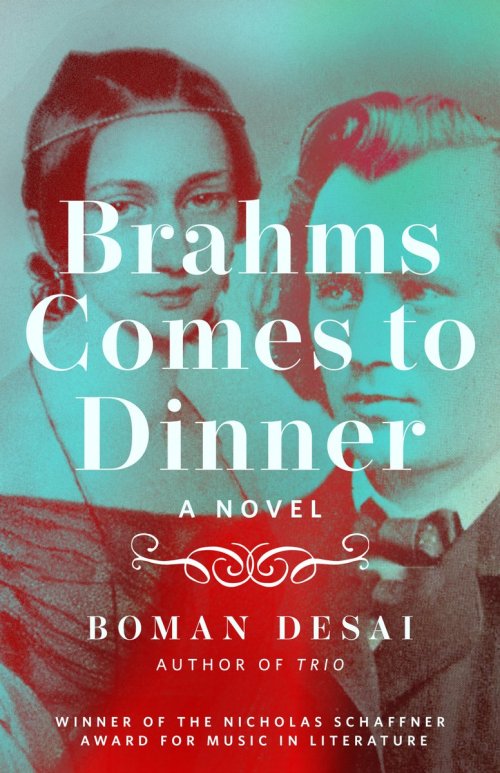
I didn’t understand it at first, but when I asked some of my correspondents how they had learned about the book I was told it showed up when they googled the Schumanns or Brahms. It seems my trio had been running a PR campaign for me for 200 years! It was a relief to know the struggle had not been in vain—but, even so, I was spending a great deal more on advertising than I was making in sales—and, recalling what many agents had advised, I shaped a 300-page adaptation of the book for readers daunted by the size of the original. Once the original had been published, I had no qualms about cradling its essence into a smaller book, and once the structure of a dinner-party presented itself I could no longer resist the call. It was a happy calculation: Brahms Comes to Dinner won the Nicholas Schaffner Award for Music in Literature last year and was published by the Schaffner Press this summer.
And I have moved from my dark studio to a one-bed with a view of a quiet street with robins, sparrows, and cardinals inhabiting trees outside my window, pigeons, starlings, and rabbits in the garden below, ready to embark on another book (just my way of squiring my daughter to her bus before catching my own to work).
FICTION
Brahms Comes to Dinner
By Boman Desai
Schaffner Press
Published June 9, 2026


