


When you cross a border, sometimes you leave something behind: family, friends, old jobs, belongings, and memories of a place you once called home.
In Isabel Kim’s debut novel, Sublimation, that loss is quite literal; you leave a copy of yourself behind. Crossing a border, for some immigrants, cleaves you in two, once you think your travel might be permanent. Its speculative world is more or less ours, but rewritten around one simple fact: immigration creates two people: one who enters a new country and one who stays behind.
The plot kicks off when Rose returns to South Korea for her grandfather’s funeral, having never come back since she was ten years old. Her dopplegänger, Soyoung, was left behind in Seoul when Rose and her mother immigrated to the US. One wants to steal the other’s life.
It’s going to be very difficult to discuss this book without comparing it to the hit Apple TV show, Severance, so let’s get that out of the way quickly. In Severance, a sinister biotech corporation splits office workers from their outer-world selves, leaving two consciousnesses trapped in the same body, each with no knowledge of the other’s memories.
But Sublimation’s duplicates—instances, if you will—have their own bodies. Their past, up to the moment they split, is exactly the same. It happens naturally and spontaneously at airport immigration checkpoints and border crossings, without either instance fully knowing why. Unlike Severance, instances can talk to each other, be each other’s best friends, although some, like the fragmented main characters, Soyoung and Rose, never stay in touch.
The narrative alternates between the two characters in a rare second-person voice that never feels forced. Soyoung harbors deep resentment toward Rose, who feels estranged from her home and extended family after growing up in South Korea and the US. Both characters are introspective, sometimes biting, always curious about the lives they could’ve otherwise lived, and committed to misunderstanding one another, which makes the dual POVs more compelling. Sometimes, Kang’s style becomes experimental, blending stream-of-consciousness style prose and childhood memories in a way that feels wholly unique.
The novel shines in its worldbuilding, crafting a world where instancing has existed as long as there have been borders. Immigration policy has adapted accordingly, and tech companies have risen to offer some sort of control over the process. There is a multi-million dollar industry around human longing, as one character remarks, and knowing how it shapes their world makes it feel richer.
In Sublimation, instancing is described as so commonplace that it’s the stuff of pop culture tropes—in blockbuster movies, telenovelas, and classical literature. Often, Kang’s writing weaves in micro-stories altered to focus on instancing—a brave Odysseus who sails off to Troy while leaving his cowardly other self behind, an Adam and Eve exiled from the garden and discovering a border for the first time, and other stories that probe the pain of separation through time and space. Sometimes, these stories become shorthand for complex emotions, like longing, regret, and betrayal, interrupting a character’s thoughts and motions in a metatextual way that I personally loved.

The novel balances its tale of going home with a tale of corporate espionage as the characters discover how governments and tech companies seek to control the phenomenon of instancing. Later, two other instances come into the mix as narrators, both still figuring out what they would risk for a different life.
The book launches with great ambition and interpersonal drama, but loses steam in the second half. As written, the stakes are high, but the novel’s thriller elements still lack urgency, and the implications of their scheme stay unclear. The narrative retreads familiar territory rather than moving forward, leaving the characters in a contemplative stasis until they make a few major decisions at the very end. Alas, I was simply not on the edge of my seat by the end as I was in the beginning.
But still, Sublimation is a testament to what speculative fiction can do by making the psychological physical. Instancing becomes a ripe metaphor for exploring migration, diaspora, and what actually makes the self, which makes the book a fascinating addition to any immigrant fiction shelf.
FICTION
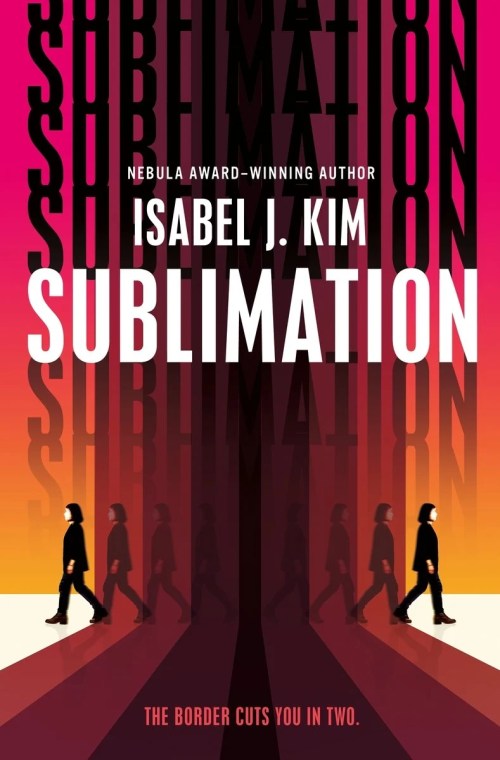
Sublimation
By Isabel Kim
Tor Books
Published on June 02, 2026


