


Every now and then, a remarkable protagonist comes around, someone so delightfully rendered into existence that you’d want to invite this person over for dinner or for iced tea and marshmallow puff cookies with that thin chocolate shell. Felicidades to debut novelist Nancy Foley for creating just such a character in her titular narrator Agatha Smithson.
Agatha is a private, self-sufficient, opinionated woman who doesn’t shy away from speaking bluntly, doing what she wants, and challenging authority. In her “more than sixtyish” years with a celebrated painting career not yet entirely behind her, Agatha seeks solitude in the wilderness of northern New Mexico, away from her students at the university in Albuquerque, away from critics and acolytes, and away from a tumultuous past. She stops for gas and meets the owner, only referred to as “Alice’s husband,” whom she tells she’s searching for land to lease. He tells her that his wife has land at Mesa Portales, an isolated, undeveloped area with an “ocean canyon” and “clean silence.” Agatha goes there immediately and feels at home. She returns to tell Alice’s husband she’s interested. “I saw by the way he eyed me closely and tucked his pencil behind his ear that he had been calculating figures, wondering how much he could get away with charging me,” Agatha muses. “Whatever figure he came up with would be small to me, just like he was.”
They head to town to sign the papers with the “chicken-lawyer” (so-named for various reasons), and at the lawyer’s office, Agatha meets Alice. She watches her with growing interest as Alice’s husband struts about with importance (“He was his own country, one it was a tragedy to visit,” quips Agatha), and soon Agatha signs a lifetime lease.
She builds a simple adobe home at Mesa Portales with the help of a local teenager named Josey. She begins to paint again. She talks with her “shark-lawyer” from New York about international exhibitions. Two years drift by along that ocean canyon at Mesa Portales, and then Alice’s husband passes away. On a visit to town, Agatha runs into Alice, who invites her to her home. She tells Agatha about her daughter Lorna, who died tragically years earlier and now lays buried in her backyard. Alice shows Agatha the grave.
“I kissed Alice for the first time later that afternoon as she wrestled with the wringer washer in the laundry nook off the kitchen,” Agatha explains. “I admired the gentle pulse at Alice’s throat and her dark hair threaded with white, and it came over me that I should kiss her.”
The women form a quiet relationship, as private yet sturdy as the adobe home in Mesa Portales. They spend more time in the backyard, too, Alice finding additional solace in the nearness of Lorna’s resting place. However, they soon face a new threat: Frank Jr. arrives and wishes to sell his mother’s house, sell the Mesa Portales property, and move his mother into an assisted living facility in Taos. Alice does not wish to go, if only because she cannot fathom being separated from her daughter’s grave. Agatha begins to devise a plan, a plan in which she could take care of both Alice and Lorna at Mesa Portales.
Masterfully subtle, though punctuated with wry humor and aching emotion, I Am Agatha is inspired by Canadian-American painter Agnes Martin, who sought isolation and healing in New Mexico after a professionally successful yet personally difficult period in New York. Martin, who kept her queer identity hidden, found solace in 1968 in Mesa Portales, a real place a little more than two hours northwest of Santa Fe. She signed a lease and lived in a simple home with no electricity or running water, and, after many months, she began to paint again. In 1977, a land dispute brought forth by the landowner’s brother forced Martin to move, and she lived in different parts of northern New Mexico until her death in Taos in 2004 at the age of 92. Described as “one of America’s foremost abstract painters,” Martin created art that has been exhibited around the world in some of the most famous museums and galleries, art that has sold for millions of dollars.

Foley, who began to write this novel at the age of fifty-two, grew up visiting her grandparents not far from Mesa Portales and became intrigued by a remark her grandmother once made about letters written between Martin and her grandmother’s best friend. Foley learned the letters had been destroyed, perhaps because of their romantic tone. She decided not to seek additional details. “I’m not an art historian or an academic,” Foley says. “I understood it was the mystery of the story that I loved, and for a long time I mostly kept it to myself.” I Am Agatha is a unique examination of love, love in a variety of forms. Foley skillfully weaves grief, resilience, and purpose with the beauty and inspiration we can find in the everyday. Agatha is at once raw and stoic, disciplined and defiant. Like Martin’s paintings—perhaps, even, like Martin herself—Agatha’s muted, measured exterior veils an astonishing, deep interior. I Am Agatha is a work of art.
FICTION
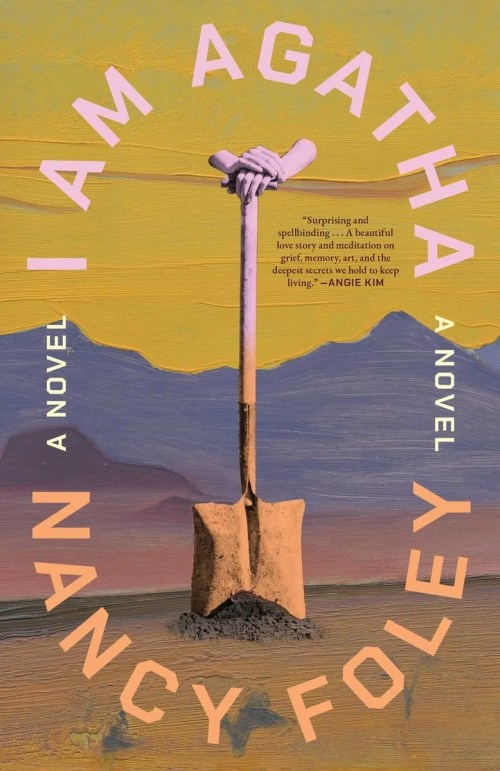
I Am Agatha
By Nancy Foley
Avid Reader Press / Simon & Schuster
Published March 17, 2026


