


One Yellow Eye is the genre-bending debut novel of Leigh Radford, a documentary and arts and entertainment producer for BBC Radio, British commercial radio, and The Times. The novel’s heroine, Dr. Kesta Shelley, guards her secrets. She avoids eye contact at her mandatory Zombie Apocalypse Recovery Group meetings. When the others try to get to know her, she politely deflects. Anything she would allow them to know about her, she has already shared. For example, that Kesta is a passionate scientist working at a hospital, and that she was widowed when her husband Tim got bitten at the tail end of London’s outbreak, three months earlier.
There is no cure for the zombie virus, and the outbreak was contained by the city rounding up and exterminating every last one of the infected. While other bereaved men and women in the group try to move on from loss, Kesta won’t even mourn. She most certainly won’t move on. Not from Tim’s (un)death—not while he’s chained to the radiator of their guest room, receiving infusions of her blood to keep him from completely turning. And not while Kesta has a raging, undying hunger to find him a cure, no matter how dangerous her illegal home research project is.
Radford’s protagonist narrates the story with a fiercely intelligent, dry wit befitting this sci-fi dark horror comedy. When Kesta’s arrogant boss is “pumping out the energy from the people he met with his animated introduction, shaking out their life force, sucking it into himself,” she muses, “Perhaps he’d started out life as a parasitic twin? He had the look of a man who’d eaten his own brother in the womb, the little embryo who could.”
Kesta uses resources she pilfers from her oncology day job to keep Tim from completing the death process. He may not exactly be alive, but he’s not yet dead enough to be beyond reanimation, should a cure for the virus be found. Rumors spread of a government program called Project Dawn where scientists work in a secret lab to find that cure. Although this is great news to Kesta, Tim’s increasing violence and deteriorating body mean they aren’t working fast enough. They need someone single mindedly obsessed with finding a cure to make a breakthrough faster. Someone like Kesta.
Radford has grounded her high concept novel with well-researched scientific content. Descriptions of the process researchers use to narrow down the possible causes of a disease, identify the correct one, and then find a cure for it are realistically portrayed. (As a former genetic research assistant, this reviewer can vouch for this.) That Radford’s novel has come out when the COVID-19 pandemic is still fresh in mind gives the story’s constant danger of a new, uncontrollable outbreak an unsettling familiarity.
Readers may notice a kinship between One Yellow Eye and the BBC’s 2013 supernatural, post zombie apocalypse television series, In the Flesh, in which a treatment for the zombies’ affliction, “Partially Deceased Syndrome,” has been found. Sufferers of this syndrome are medicated to restore their human minds but are always at risk of returning to full zombie form, should they go off their meds.
And speaking of kin—as suggested by Kesta’s last name, One Yellow Eye’s lineage from Mary Shelley’s Frankenstein shows up in the thematic backbone of the novel. Like in Frankenstein, the morality horror of the scientist’s dilemma (catastrophic risk vs. potential world-changing scientific breakthrough) and of reanimation itself begs the question of who the real monster is. Unlike Victor Frankenstein, whose own monstrosity was failing to love his creation, Kesta’s monstrosity is its reverse. Her captive zombie-husband is just one broken handcuff away from restarting the zombie apocalypse. But the risk to humanity she takes to save him can’t compete with her love.

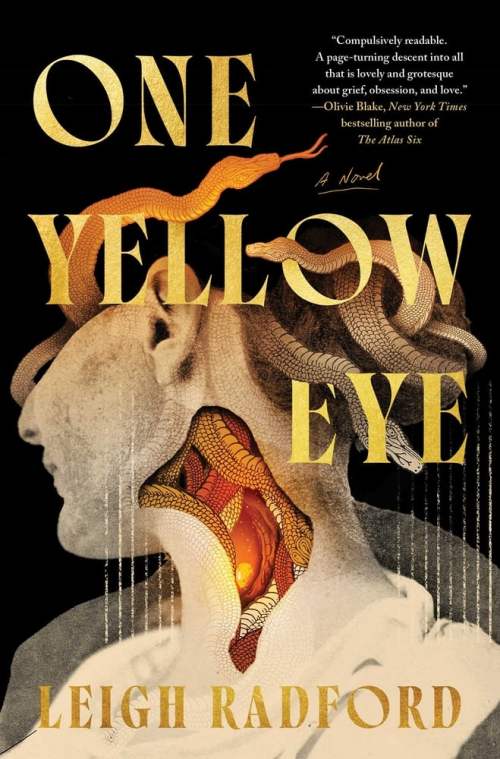
FICTION
One Yellow Eye
By Leigh Radford
Gallery Books
Published on July 15, 2025


