


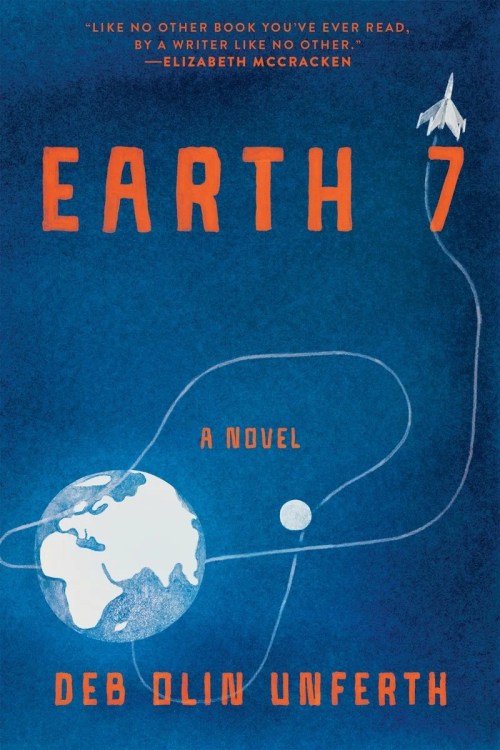
Today, Deb Olin Unferth publishes her seventh book, Earth 7, an innovative science-fiction novel that animates the isolation, loneliness, and intimacy that comes with an incinerated planet and a population in steep decline. At the onset, Unferth’s poetic, philosophical narrative orbits Rosemary Stein and her young daughter, Dylan, and their solitary existence in a remote colony of pods underwater. “No, she’d been raised in a pod in the ocean by a scientist mother who didn’t know what to do with a child,” writes Unferth. “Dylan had arrived on land with no ambitions but to be above sea level. She had not been on a search for love, she would have settled for normalcy, though it had not worked out that way.” Eventually Dylan interns as a groundskeeper at the molecular collections lab, conducting her own studies and experiments, and soon discovers unexpected intimacy in the form of a young woman named Melanie on a stretch of artificial sand. As the poignant narrative advances, Unferth entertains a multitude of questions: Is it possible to cultivate connection and consciousness in a post-apocalyptic world? And at what cost? What does it mean to be truly alone? How does one persist? With her skillful worldbuilding and sly humor, Unferth investigates these questions—and directly speaks to our current ongoing crisis of global warming and more.
Deb and I first met at Yaddo during the summer of 2009. A few years later, we reconnected at the Texas Book Festival, and then, Deb and her husband, Matt Evans, relocated to Austin and both have been teaching at the University of Texas since 2014. This interview was conducted over Zoom, and our conversation has been edited for length.

S. Kirk Walsh
What was the initial spark of Earth 7?
Deb Olin Unferth
I started noticing a bunch of articles and books about the different kinds of technological band-aids that we’re coming up with to try to solve some of the problems of climate change. Carbon capture, this strange process where we suck carbon out of the sky, and we shoot it into the ground. Or fake coral reefs, where little, tiny robots that will be creating coral reefs under the ocean because reefs capture so much carbon and do so much work for greenhouse gases. I started thinking the future is going to get very strange—and imagining what that world was going to be like. This was my slide into writing something that turned out to be a futuristic world.
S. Kirk Walsh
Was there a specific climate event that made you want to address the earth becoming inhabitable?
Deb Olin Unferth
During Covid, I was trapped in the house and reading about all these different things that were happening to the planet. It wasn’t like one. It was like hundreds, just hundreds. When we’re all inside, the animals were coming out of the forests and walking down the streets and stuff. Everything was so strange. I wanted to create some world that could hold all of this.
S. Kirk Walsh
I know you spent a month at the San Ysidro Residency in South Texas while you were writing this novel. Could you talk about how this remote landscape informed aspects of Earth 7?
Deb Olin Unferth
It was an interesting residency experience, where you live in a casita on a giant ranch. There’s really no one there except for the caretaker. The line between the wild desert and husbandry is clear, that land is being used for a purpose. In my book, I wanted to give that sense of feeling like I’m in a space of wild desert, but also that has human hands all over it.
S. Kirk Walsh
Did other travels shape the narrative?
Deb Olin Unferth
Before the pandemic, my friend Lucy Corin and I went to Morocco for a month, and we spent time in the Sahara. We stayed in a Bedouin village. We went on these evening trips deep into the dunes. We slept under the stars in the desert, surrounded by sand dunes and quiet. It was October, and the heat was unbearable. There was very little water.
Lucy and I also traveled to The Arctic. We went on a residency that took us all the way to the 82nd parallel. The idea is to get as close to the North Pole as you could. We saw the Arctic glaciers, and icebergs, and polar bears, and whales. The only humans were the ones on the boat with us. It was just the emptiness and the expanse. That’s also a desert. It’s water, but there’s very little rain—and it’s classified as a desert.
S. Kirk Walsh
What inspired you to write about sand itself?
Deb Olin Unferth
I started reading a lot of books about sand, honestly. I read like five books, including Sand: The Never-Ending Story [by Michael Weiland] and The World in a Grain: The Story of Sand and How It Transformed Civilization [by Vince Beiser]. I read about the architecture of sand dunes, and how they move, and the different categories of sand dunes. How they move like animals across the desert. They’re like living things, practically.
S. Kirk Walsh
Did you always know that Dylan’s romance with Melanie and the mother-daughter relationship would be the engines of the story?
Deb Olin Unferth
I always knew I wanted to start with a mother and a daughter in a pod underwater. I like the way, at the end of the book, we expand out so much. I loved that we could move from this very small, private, isolated spot of two people and not even enough air for insects—and then, moving to progressively bigger and bigger spaces until we’re way out where there’s the whole world, and then there’s other worlds, and the whole universe.
S. Kirk Walsh
Are there any specific books that Earth 7 is in conversation with?
Deb Olin Unferth
J.G. Ballard’s The Drowned World, which is almost the opposite of mine. The plots have no similarity, but he did have this atmosphere of isolation and water. I love Kelly Link’s story collection Get in Trouble. It’s formally inventive—and it doesn’t care if you get it or not. It takes a lot of courage and self-confidence, and it just feels so wholly hers. No one writes like that. Ted Chiang, of course. Charles Yu’s Interior Chinatown is another one that comes to mind.

S. Kirk Walsh
What do you hope the reader takes away after reading Earth 7?
Deb Olin Unferth
I want to have a conversation about the world that we’re losing.
S. Kirk Walsh
How do you feel about the future of the earth?
Deb Olin Unferth
I don’t think we’re going to be wiped out, but there might be this depop, where we can’t sustain this level of growth and population.
S. Kirk Walsh
If you were going to escape Earth, what books would you take with you?
Deb Olin Unferth
I would take all the books in the house because then I would have plenty of time to sit and read them.
A Note to Our Chicago Readers: Deb Olin Unferth will be in conversation with Sara Levine at Women & Children First, Tuesday, June 23rd, 7pm. On Thursday, June 25th, 7-9pm, she will be leading a Master Class on the First Page with StoryStudio Chicago (registration required).
FICTION
Earth 7
By Deb Olin Unferth
Graywolf Press
Published on June 09, 2026


