


Hunger and Thirst, a literary horror and suspense novel set in 1980s Britain, felt like it was made for me to read. The story follows Ursula in two time periods: her teenage years, where she is a poor child of the system, and her adulthood, where she is a successful and reclusive artist under a new name. When Ursula meets a new friend and has the opportunity to move into a home slightly better than a halfway house, she jumps at both opportunities, in the hopes of finally finding a place to belong. But everything is not as simple as finding a home in places and people. When an unexpected death occurs, Ursula soon finds that her background and her mistakes may come back to haunt her in ways she never could have imagined. Her story, at once terrifying and familiar, traipses through haunted houses, art studios, and friendships so seamlessly that I felt entirely rapt while reading.
I had the opportunity to interview the wonderful Claire Fuller this month. Here, we discussed art, horror, true crime, and the ways in which the three can be immensely interwoven.

Madeline Schultz
There are many references to some of the most iconic horror films throughout the book (The Shining, Rosemary’s Baby, etc.) Ursula’s story is certainly one steeped in horror—can you talk about what captivates you about writing in the horror genre and a little about how her unsettling, yet captivating story came to be?
Claire Fuller
My novels always have come with a kind of darkness, but this one has gone further. Is it horror? I suppose it probably is. I often call it supernatural suspense but I’m happy for it to be called horror because I like reading literary horror. Horror and ghost stories were the first fiction that I came across as a young adult: Stephen King, M. R. James, Edgar Allan Poe. I think my love for these works is why my novels have always taken a darker turn, and for this book it seemed like a natural progression to go even darker.
Madeline Schultz
Literary horror is exactly where my mind was going when I was reading it! I found this to be such an evocative piece of women’s horror because I felt at its core, the true nightmare for Ursula was that she was repeatedly ignored and/or not believed when she spoke out. When you were crafting her character, were there moments in her story for you where you felt especially sorry for her, proud of her, or other strong emotions?
Claire Fuller
I love this question. It’s not something I’d thought of before and I really had to dip into Ursula and her character to remind myself of all she goes through to answer this. There’s the emotion of being frightened, and that’s when I really feel sorry for her; there are three specific scenes in the middle of the book, and when I was writing them, I scared myself. If she was scared, I was scared. I’m proud of her when she starts to take back control, deciding she can’t go back to the house. But also, thinking about the art she makes, which was great fun to describe, I felt proud that she was able to make that kind of art. And, finally, I most liked that she found love. The book was never going to end neatly wrapped up, but I liked that there’s a bit of romance for Ursula which she keeps trying to reject and it keeps coming back for her.
Madeline Schultz
I loved reading the moments where she got lost in her art as well. Is it correct that you have a degree in sculpture? Did moments where she was working on her sculptures and working on her woodworking come a little bit easier from your artistic background?
Claire Fuller
Massively so, yes. The art process sections were easy to write because I was a wood and stone carver many years ago. Ursula works in the post room of the art school that I went to, and I gave myself a cameo in the novel, which I’ve never done before and is maybe a slightly odd thing to do but it was quite fun. Ursula meets a sculptor student who’s sitting there in her steel toecap boots, smoking a rollie and that was me. I was never terribly successful—I had a few exhibitions, I sold a bit of work but in no way enough to make a living or win the prizes Ursula wins. So yeah, it was fun to take on the role of a very successful, famous, reclusive sculptor and live that role vicariously.
It’s much easier to write a piece of sculpture than to actually make it. People often ask me whether sculpting is like writing, and while there are some similarities, in sculpting, you are given the piece of wood or stone and then you have to work it, whereas with writing you have to create the stone or wood, which is harder.
Madeline Schultz
That’s so fun to put yourself in as an Easter egg! I’m so glad I asked that question so everyone can know. Speaking of art, I’m curious about how you think of art as it intertwines with horror. We see Ursula lean into sculpting and drawing and Sue becomes immersed in filmmaking, even as these horrible things go on around them. Can you speak to how you think art and horror work hand-in-hand or, maybe, as opposing forces in the story?
Claire Fuller
I think one of the functions of art amidst the horror is to create an actual physical object that somehow expresses what Ursula has been through. So The Lithopedian, the bear sculpture, is slit open and has human eyes, human teeth, and there’s a stone figure in the middle bringing all Ursula’s pain to a tangible object whereas the words she uses to try to confess her crime are ignored and seen as made-up, unreal. You could also see her making sculpture as art therapy, maybe it’s helping her work through the horror as well as visualizing it. I never used art that way, but there’s some people who do.
I was also thinking about the other art mentioned in the novel, including Goya’s Saturn Devouring His Son, and in other novels like The Picture of Dorian Gray by Oscar Wilde or M. R. James’s “The Mezzotint.” All the books and stories I could think of draw on paintings not sculptures, which I found quite interesting. I’ve always been drawn to the gothic, so it was intriguing to add sculpture to these horror elements I admire.
Madeline Schultz

Oh, wow now that you’ve brought it to my attention, I can’t think of a story that isn’t a painting-focus either! Moving away from art slightly, a pivotal part of the framework of this story was the dynamic between Ursula, a child of the system, and Sue/Raymond’s big, bustling family. You didn’t shy away from examining how people look at children in foster systems: with distrust and poor assumptions. Were the differing backgrounds of Sue and Ursula something that was easy or difficult to write through for you?
Claire Fuller
Sue’s background, although I don’t come from a big family, is more like mine. In an earlier version of the book, Sue was very upper-class English, but I thought it would ultimately be much more interesting to make her family suburban and middle class and compare her house, with all its people and clutter, to that of the Underwood, the squat where Ursula lives. I don’t ever find it easy to write, but Sue’s background was easier to write than Ursula’s background. Ursula’s story I had no personal knowledge of, and so when I decided I wanted her to come from a background of foster care I had to do a lot of research. I managed to find various connections to children who were brought up in foster care in the 1980s. They were very generous with their time and stories, and these helped me create a background for Ursula and understand how things like placement and all the paperwork; small tiny things that helped me get her story right. I read memoirs about the British care system too, as well as watching interviews and videos to understand the prejudices and biases in the system, which allowed me to imagine Sue’s family and the lies she had to tell them in order to guarantee acceptance for Ursula.
Madeline Schultz
Definitely. As I was reading, it just seemed to be such an automatic assumption that because of her background in care, people assumed her confessions were mental health issues. It’s so great to hear about all the research that went into her story, too. To a perhaps more fun question, in the novel, Raymond, and subsequently Ursula, make the claim that people watch true crime programmes “because we want to know the absolute worst, and if it happens to someone else we can be sure it didn’t happen to us.” I have to ask…are you a true crime fan yourself? If so, do you believe this to be true and did some facets of the true crime genre inspire this story?
Claire Fuller
Once I had decided there was going to be a true crime element to the story, I decided to find a true crime documentary so I could analyze the structure and understand how they keep you watching. The one I looked at was Evil Genius on Netflix, and that’s the one I pulled apart. I also interviewed a true crime documentary producer, and she talked a lot about how much protection and care they take with their interviewees for their mental health as they pull these stories out of their heads, which is something I was thinking about in the interview sections of this book.
I do really love true crime, and it feels like it’s a shameful thing to admit to! But I really am fascinated by it. In the 80s there was a true crime series called Crimewatch, and it was about the police supposedly trying to use the public to find criminals. They’d use actors for all the real people involved in the crime, it was forty-five minutes, once a week and everybody I knew watched it. I think that’s where my love of true crime started. Then there was a long period where I wasn’t consuming any of that kind of content because for many years it just wasn’t being shown or discussed, but now it’s massive again and I’ve got back into it and I love them. All to say, I do agree with what Raymond says. It’s about the experience of watching and feeling something awful but within the safety of our own homes, and that brings us some kind of comfort.
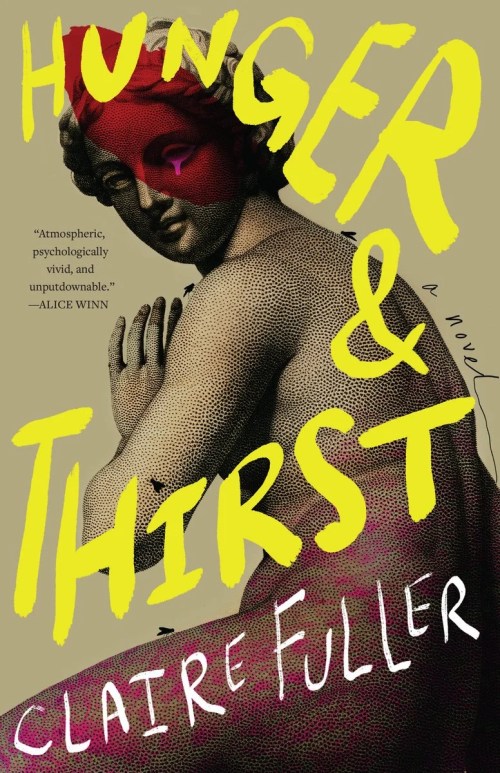
FICTION
Hunger and Thirst
By Claire Fuller
Tin House
Published June 2, 2026


