


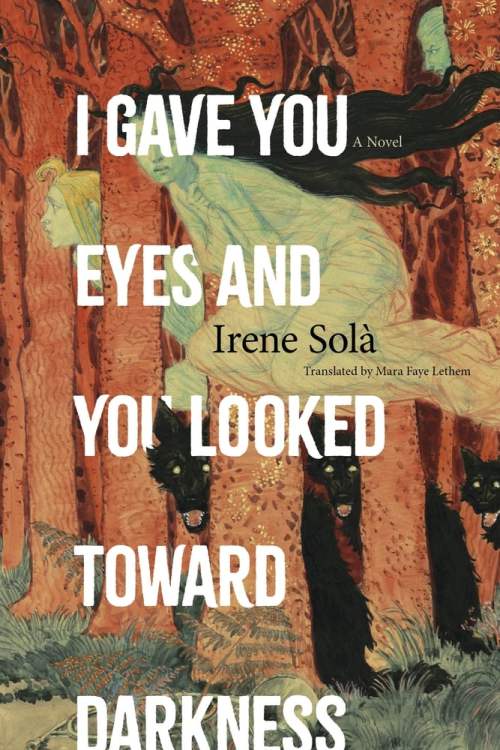
Stories of witches may be as old as tales involving the devil himself. They transcend cultures and generations. Read any account of witchcraft trials and executions and you’ll notice something missing from the long diatribes accusing women of various misdeeds though. Namely, the accounts of the accused in their own words. While the women in Irene Solà’s novel I Gave You Eyes and You Looked Toward Darkness may commune with demons and party alongside spirits long dead, their devotion to each other contrasts with the violent uncertainty of the world outside.
In the remote village of Mas Clavell, demons don’t just appear for the purpose of haunting the living, demons are summoned to serve them. But when Joana calls the devil out for not holding up his end of a bargain she’s made to bring her a full man, maybe even one with an inheritance, every child born to her is missing something. A tongue, a liver, an anus. Joana’s eldest daughter Margarida survives, but Joana listens to the girl’s heart and hears “There was something wrong with the baby girl’s heart. It was missing a piece. Which didn’t mean that Margarida had a bad heart. No. Or a delicate heart. Not that either. It meant her heart was small, tough, stringy. Hard to chew. Rancorous. The size of a hare’s.” From there, the sorceresses’ lineage continues through generations, surviving various attempts to uproot the evil that surrounds Mas Clavell.
For a story about witches that reaches back in time to the dark ages, I Gave You Eyes is also very funny. Misogynist folk sayings sprinkled throughout the story read like a catalog of punch lines to one big, albeit dangerous, joke on male anxiety, When women laugh and donkeys bray, that there’s the devil having his say. When the devil is full of doubt, he asks a woman. When the devil can’t make it, he sends a woman in his stead. Soldiers, wolf hunters, thieves, laborers, suitors, and other perfectly nice men are never far from disrupting the natural order at Mas Clavell while at the same time remaining clueless about the feminine powers they’re dealing with. When a servant proudly proclaims the murder of an old woman from a neighboring town saying, “Ye needn’t worry henceforth, ladies, for we have killed the witch.” Joana and Margarida ask, perhaps with some relief, “Which witch?” Yet, instead of fighting back with the kind of trite magic or spells one might expect from such a coven, the women of Mas Clavell persist through the relatively mundane bickering, feasting, farting, birthing, loving, and caretaking that bonds them through the ages.
Solà explores the many ways to tell a story along with the nature of storytelling itself in her novels Els Dics (The Dams), and Canto jo i la muntanya balla (When I Sing, Mountains Dance), as well as the poetry collection Bèstia (Beast). Mara Faye Lethem’s English translation of When I Sing, Mountains Dance won an impressive list of international awards including the European Union Prize for Literature, a Kirkus best book award, a New York Public Library Best Book award, and was a finalist for the National Book Critics Circle’s Gregg Barrios Book in Translation Prize. Lethem has won other awards for her English translations of authors writing in Spanish and Catalan like Max Besora, Patricio Pron, Marta Orriols, Toni Sala, and Javier Calvo. Lethem’s translations of Solà’s work orients English readers to the particularities of poetic styling and folkloric jargon the author uses to create the speculative historical worlds where Solà’s characters thrive.
Whether you believe in counternarratives or just telling the same stories from different perspectives, the narrative shifting in I Gave You Eyes is so fluid that you could be forgiven for losing your place in the story’s timeline. Chapters prefaced by quotes from authors like Virginia Woolfe, Juan Rulfo, and Ali Smith hint at the flexible nature of time and existence that the novel embraces. If it weren’t for mentions of electricity, race cars, and factories, I Gave You Eyes might sound like the stuff of much older parables from several centuries ago. An author’s note at the end lists a deep collection of sources that range from a memoir of the Spanish Civil war to cookbooks encompassing all kinds of Catalan stews. Many of the sources deal with medieval feminine knowledge and Catalan folklore, including the tale of a woman outsmarting the devil that the premise of I Gave You Eyes is based on. The research doesn’t feel like a history lesson though. Instead, Solà bridges these old legends to the present with her unforgettable family of characters, of whom at least one is based on a real historical figure from her home town of Malla.

By the end, another woman from the Mas Clavell house is welcomed to the other side while surrounded by the others joining hands over her bed. It’s a comforting image, being surrounded in death by those you fought with and loved the most in life. Yet, for all the raucous voices threaded throughout I Gave You Eyes, silence still has its place. In a moment of profound acceptance for Bernadeta, a clairvoyant mother who sees how her newborn daughter will eventually die, Bernadeta remains quiet, “Because there are things that can’t be said. Because you can talk about misfortune, and you can talk about grief; you can talk about remorse and guilt, and about death, about evil and the things men do. The good things and the bad things. But you can’t say how a girl is made.”
FICTION
I Gave You Eyes and You Looked Toward Darkness
By Irene Solà
Graywolf Press
Published June 17, 2025


