


What is it about road trips? We hope to gain some perspective, to be part of how the landscape changes from state to state. The Southwest has a particular draw for road trippers with its strange silhouettes that appear in otherwise flat, barren deserts, punctuated by kitschy Route 66 landmarks. These places allow us to confront what the now-desiccated land looked like when it was still underwater.
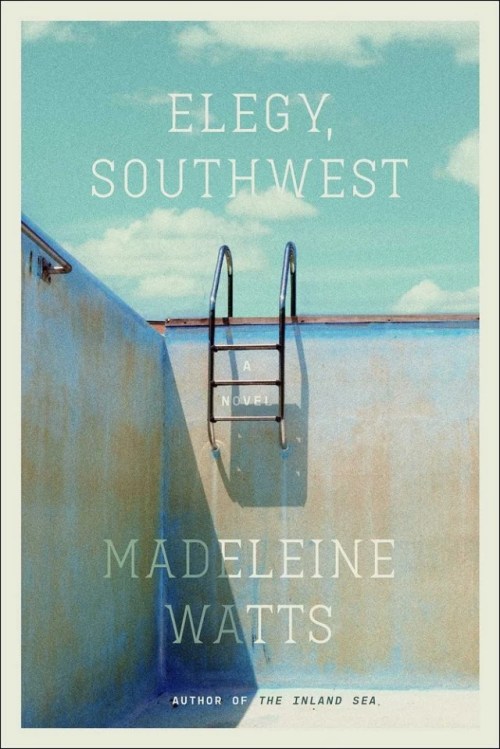
Madeleine Watts’s second novel, Elegy, Southwest, follows a married couple in their twenties, Eloise and Lewis, hitting the road for a few weeks. Eloise narrates, addressing Lewis, the ever-present “you.” They spend time in Nevada, Arizona, California, and Utah, staying with friends in Las Vegas or at Lewis’s parents’ home in Phoenix. Otherwise, it’s old motels and Airbnbs.
Their travels take place around Thanksgiving 2018, when the Camp Fires were ripping through California—still regarded today as California’s deadliest fire. Reading of people losing everything they own hits harder this year. As does Eloise and Lewis finding David Lynch’s L.A. home, just to stand in front of it. They hear someone cough and hope it’s him. As this short year has already brought so much loss, including that of the irreplaceable director, these passages feel even more consequential.
Eloise, who grew up in Australia but now lives with Lewis in New York, is working on a dissertation about the Colorado River and ongoing water shortages in the West. The trip is a chance for her to visit dams and take tours to see these places she’s researched. It also allows her to explore the fact that people have always thought there would be enough water to sustain cities like Phoenix and Las Vegas—but there was never enough, and there never will be. She says, “It’s like the Southwest is a paradise built on quicksand.”
Disasters can be fascinating, especially those we can’t control. The history and data about a lack of water isn’t hard to find (and Watts’s included research is certainly a compelling component of the work), yet government officials continue to fight over it and believe there’s enough to go around. Citizens just assume the government will figure it out. In one scene, Eloise and Lewis drive to the top of a mountain to go on a hike, but Eloise becomes frightened of bears and other dangers. They’re all alone. She admits, “I read about the wilderness, but I don’t know what to do in it.” Studying these realities is one thing; knowing how to change them is another.
Watts includes lots of other research and art and history in the book, from the dams to Georgia O’Keefe to the film Zabriskie Point. She uses these figures and accompanying themes to attempt to understand the paradox of utopian cities built on waterless, resourceless land.
As much of all this existing art and the book reflect, some of the most devastating disasters occur completely internally: a panic attack, depression, grief, terminal illness. At the beginning of the narrative, the couple seems to be deeply in love, still very fond of and attracted to one another. As things move, we learn there are many parts of Lewis that Eloise wants to know but never will. After his mother died, an experience they went through together, he turned to weed and turned inward more and more. He is somewhat unpredictable, while Eloise is obliging and giving, always trying to avoid upsetting him. She thinks, “You always liked me best when I was happy,” so around him, happy she stays. Another paradise built on quicksand?
One crux of the book is whether or not Eloise is pregnant. She’s missed her period, and as the days tick by, her denial grows. She tells no one. She has three glasses of wine or margaritas on their stops without giving it a second thought, all the while aware of the real possibility that she’s carrying their child. One tragedy leads to another near the end of the trip and years later. The narrator remains somewhat detached from what transpires, which is perplexing. It’s disappointing that there isn’t a resolution to, or much examination of, all the avoidance and self-destruction—especially in a book that is otherwise so good at exploration and digging into the details of history, however painful.

At one point, Eloise thinks, “A desert was a kind of objective correlative, an easy metaphor for a struggle of the soul.” Perhaps when the landscape is nothingness, pain can be erased as well. Even a person; even parts of a self.
Elegy, Southwest is artful and beautifully written, as are the depictions of Southwestern wastelands and the life that somehow perseveres there. There are many questions left unanswered by the end, though perhaps that’s the desert for you: a longing that’s never reciprocated, a need for nourishment that will never materialize.
FICTION
Elegy, Southwest
By Madeleine Watts
Simon & Schuster
Published February 18, 2025


