


To what lengths is one capable of understanding the people they love? And when understanding fails, what fills the gaps it leaves behind? Weike Wang’s Rental House drops the reader into the lives of couple Keru and Nate on two vacations, one to Cape Cod five years into their marriage, and another to the Catskills 10 years in.
Keru is the only child of Chinese immigrants based in Minnesota while Nate hails from a working-class Appalachian family. We meet them on the Cape when Keru is a diligent early career consultant while Nate is a not-yet-tenured biology professor.
The pair meet in one of the few places such demographically disparate people do in today’s America—an elite institution, specifically Yale. Neither of them fully belong there, as a child of frugal immigrants and a first generation college student respectively. This alienation is also the case later on when they visit one of the fancy little towns in the Catskills and stay in an expensive compound billed as a charming bungalow. The couple has strived their way into elite spaces and are left with questions about whether it was worthwhile.
Keru and Nate toggle between feeling persistently mischaracterized and troublingly unoriginal—baffling to their families, surprising to strangers, but also a “fraught yet familiar union” (a white man and an Asian woman), immediately identified as a popular version of a DINK (Dual Income, No Kids) by a European couple they encounter on vacation. “We had no idea there were so many of you until we came here. Now we see you guys everywhere,” the husband remarks.
The white male Asian female (WMAF) phenomenon is a complex piece of baggage in the Asian American identity, one that often sparks a tsunami of misogyny and rarely has much of a resolution. WMAF is a hypothetical demographic sociopolitical issue and also a romantic relationship.
Wang’s depiction is intimate and practical. Nate tries to understand Keru and her parents while knowing he can never fully grasp their experience. There is a poignant moment when it occurs to Nate that Keru’s immigrant father might only want to talk to him about his fuel cell research because “maybe fuel cells were the only area that Keru’s father felt proficient enough in to carry on a solo discussion in English that was reflective of his intellect.” Keru is frequently puzzled and sometimes even angered by her in-laws, but learns over time when to join the fray and when to back away quietly. Observing the contrast between her upbringing and his illuminates her understanding of immigration and culture.
What follows is the speculative idea of their mixed-race children. Keru dreads a hypothetical daughter who “would become one of those identity-aggrieved people who, in their confused adulthood, went on to renounce their lineage altogether, and to accuse Keru of submitting to the patriarchy, Nate of having an Asian fetish…” The couple also grapples with the ripple effects of the choice to not have children—is that why they aren’t invited anymore to events with their friends who do have children? Are people clocking them as selfish, indulgent DINKs? Is it wrong to be willing to commit to the tradeoffs of a trying career, but not the tradeoffs of having children?
An open question throughout the novel is the role of suffering in life, and what in life is worth suffering for. Keru is determined, like many immigrant children, to “build a life worth the trials it took [her] parents and [her] to get here.” She feels responsible not just for fulfilling the potential of her own life, but also compensating for her parents’ sacrifices. This manifests in her consuming, high-paying management consulting job which underwrites not just her and Nate’s life, but also their parents.
Keru’s mother genuinely believes that suffering is inherent, a prerequisite to a meaningful life. “To suffer is to strive and to set a bar so high that one never becomes complacent. To become complacent is to become lazy and to lose one’s spirit to fight, and to lose one’s spirit to fight is to die. So, to suffer is to live.” A corollary here may be that life is about choosing what kinds of suffering you’re willing to endure.
Nate accepts depressing working conditions as a biology professor in pursuit of the achievement of tenure, and then after tenure, continuing in the same job partly due to inertia and partly due to a sense of duty to his students and his work. The pair have struck out on two of the classic suffering-in-career options for Ivy League graduates: overworked business job that finances a nice life you barely have time and energy to enjoy versus overworked underpaid academia passion job that depletes your passion over time. They repeatedly eye each other’s respective career choices, perhaps a little defensive and shaky about their own.

Suffering as a requisite ingredient in life is also a point of contention when it comes to marriage itself. When are you making a reasonable compromise for the sake of love and when are you consigning yourself to misery that you don’t have to live with? Is tolerating your family’s worst qualities always mandatory? What about your in-laws?
Wang is matter of fact when it comes to some of the starkest fissures in the couple’s union. Nate’s family assumes Keru is one of those wealthy Chinese immigrants, and Keru’s parents question where that white generational wealth is and why it isn’t reflected in Nate’s bank account. Keru concludes that, “They could be locked in the same room forever and never understand one another.” Constraining the portrait of their marriage to these two trips amplifies simmering tensions. Is everyone always like this, or do the anomalous expenses and close quarters evoke extremes?
I am reminded of a phrase a therapist once said to me: “When you push things down, they come out sideways.” In Rental House, there is endless material emerging sideways from the intersecting conflicts of both Keru’s and Nate’s families. Like a real-life marriage, not everything can be easily dissected, explained, and analyzed; rather, sometimes people say things, sometimes people throw things, and Nate and Keru just get on with it. Whether that’s beautiful or deflating may depend on your personal associations with matrimony.
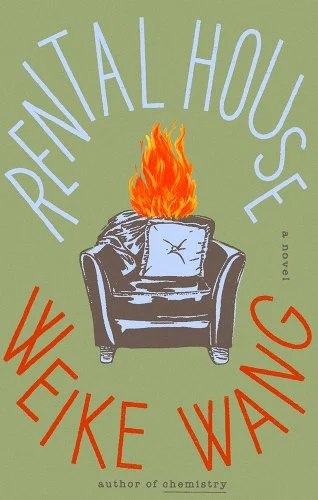
FICTION
Rental House
By Weike Wang
Riverhead Publishing
Published December 3, 2024


