


I might voluntarily assert how much I hate small talk, but if you’ve ever logged onto a Zoom call with me, one of the first things I’ll do is slide into stereotypical American prattle by bringing up the weather. But sometimes, my interviewee will beat me to it—M Lin did. She joined our call clad in overalls and a light purple shirt—in both color and texture—because, she tells me, it’s seventy degrees in New York! In March! That’s crazy! I say, It’s so cold in Chicago! Twisting around in my chair, I point to a long coat hanging on a wire rack. I’m from Florida! I tell her, And I’m still not used to this!
But then we got real. You know in China, she tells me, there is no such thing as small talk: “In Chinese elevators, people are just standing there, blank [expressions],” she says. “You don’t have to smile.” There’s even a small talk class for international students learning decorum a lá United States. And while M didn’t take it when she moved from Beijing to New York City, her fluency in Weather Conversation might come from living in the US for the past sixteen years, first moving to attend NYU as a film student, pursuing a passion borne from an adolescent education of pirating Tarantino, Bergman—the works—on DVD. Only as recently as the pandemic did she turn to fiction (“I’ve always read fiction, but I couldn’t have imagined I’d write books in my second language,” M says. “Capital-L literature is so sacred to me.”), seeking understanding as she watched the American government blame COVID on her home country while she was stuck thousands of miles away in her living room in New York.
A kaleidoscopic therapy session, The Memory Museum, M’s debut short story collection, is the result of that seeking. Her characters tumble through nostalgia, divorce, and disease, but also hot masseuse sex and Moroccan travel, feminism and robbers. M says at first she was worried her collection might only be relatable to Chinese people, but realized “it will speak to anyone who has left one place.” She’s right: The Memory Museum spoke to me immensely—in fact, one of her stories made me weep. Instead of the weather (for once), that’s where I’ll start our conversation, which has been condensed, and edited for grammar and clarity.

Ruby Rosenthal
There’s a story in this collection about an only child with a brain tumor. We meet her when she’s on her way back to China, trying to decide if she’s going to tell her parents about her condition. I don’t often cry while reading, but this one got me for a few reasons. First, I related, as I am also an only child, but second, it ends with, “As all reunited families do in their first hours, we spoke of happy things only,” and that felt very true to me. So as you were writing this collection, I was wondering whether there were any dominant emotions you felt, because there’s so much heaviness here.
M Lin
My whole generation in China, and most of my friends, are all only children. This almost has an upside—friendships become really important because nobody has a sibling—but at the same time, and as we get older, it’s very much about an only child having to take care of aging parents. As my generation gets older, there are all kinds of problems the policymakers could not have imagined when they decided to make this a law.
So back to your question of the emotion of the collection. I didn’t have any overarching things I was aiming for, but I did realize memory has been an obsession of mine. I kept a journal because I was afraid I was going to forget what has happened in my life. A lot of this was written from 2020 to 2023; 2022 was a very hard year in terms of COVID in China. So a lot of these emotions were from watching a lot of things happen in China from afar, thoughts about home, and also about being Chinese in America.
Ruby Rosenthal
Watching China from afar must have been really, really hard during that time. I’m glad you were able to write about it and—I don’t want to say it’s like catharsis, because it’s not always catharsis to be writing like that—but I do feel like it can be helpful to kind of work out the question of ‘what am I thinking about this?’
M Lin
I totally agree with that. I needed to understand what was happening in China, what I was seeing, and also what it meant to be Chinese in the US and in the world today. I realized Chinese Americans or Asian Americans in general have a different perspective on their identity because their upbringing is very different from what I had, which is a Chinese growing up in China, where I was a majority. Before coming to the US, I never engaged with the idea of race at all, because everyone was Chinese. I was reading the work of Asian Americans, and Chinese Americans in particular, and feeling it didn’t exactly represent my lived experience and people I know.
Ruby Rosenthal
So when was the first time you felt like you understood how Americans view race? Was it through something you read or was it an experience you had?
M Lin
It was not something conscious, because once you are in the US, you are seen as either Chinese or Asian in general. And I think I had to get used to being perceived as that, where I didn’t have this outside gaze or perception before, but I couldn’t articulate that to myself.
I remember two things about that; both happened in early COVID times. First, I overheard this conversation in my lobby in Manhattan, New York, where one man was saying to another, “Can you imagine this little town named Wuhan has 11 million people?” 11 million people in China is not even a big city. Shanghai has 22 million; Beijing has maybe 20 or 21. It was something that showed me that Americans—and even someone in New York who maybe could be considered a little more worldly than elsewhere—do not know what contemporary China is like, and by extension, do not understand where I come from and what kind of experiences Chinese people might have had.
I was also really struck when—I think it was—a Korean American man was attacked during the peak of anti-Asian hate. I had to come to terms with the fact that a man was attacked because Trump was attacking China, calling it “China virus.” Before that, as a Chinese person from China, I don’t necessarily identify with a Korean American, because that’s someone I feel is from a different culture, but from outside of the community, there’s no difference between me and an older Korean American man. We are all Asian. And it’s so unfortunate this man was being attacked because of something that’s happening thousands of miles away. On one hand, Asian is an insufficient term to describe anyone. If you are Chinese, like me, you would think you’re different from a Japanese person or a Korean person, but on the other hand, solidarity must be had within the Asian community, despite our differences. We have no choice just because we look alike, we have no choice but to band together when you’re on defense.
Ruby Rosenthal
Thematically, a lot of these stories deal with the idea of home, as either a place that was left behind, or a new place. And so I was curious, and you’ve answered this a bit before, but whether this was personal reflection, or if it wasn’t, whether it was difficult to write into this feeling.
M Lin
Once I started writing in English, it felt like one step further away from China. I think it was coming to terms with the fact that I have left China, my home—but still consider it my home, even though it is no longer where I live. Not being in that environment, knowing so much has happened there, created this distance enabling me to be able to write about it, but at the same time, there was this really strong longing for it. I was able to reach some of that in fiction. By that point I started to consider New York home too. I had been in New York for 10 years and I was grappling with living between countries and people and languages, and to expand the idea of home, as opposed to being metaphorically homeless.
Ruby Rosenthal
I noticed that a lot of these characters are facing some kind of instability, like work, relationships, money, and I’m wondering what interests you about instability and whether exploring it through your work helps you find answers.
M Lin
I never thought about it that way, but I think this is a really interesting question. I don’t know how commonly known this is in English, but the Chinese term for crisis has two characters––危机: the first one means dangerous or threatening, the second character means opportunity.
Ruby Rosenthal
Interesting.
M Lin
I think that speaks to the instability I probably subconsciously have latched on to these characters that I have—I see the opportunity in a crisis. But to speak more specifically to the story, “You Won’t Read This In The News,” the title as such is because the story is actually from the news. But [the news story] was very dry. Often in the West, you see ‘this happened in China,’ but we never really understand who these people are, or why these people would do something like that. This applies to a lot of China.lies to a lot of China.
For example, we often read about Chinese dissidents being arrested or detained or whatever. But from the news, we never know why a person would do something threatening their own life. Every Chinese person knows how much risk there is to speak up. Despite that, people continue to do so––there’s always a story behind that’s not in the news. The plot of “You Won’t Read This In The News” almost seems unbelievable in fiction, but it did happen in real life. I hope the story I came up with is emotionally believable for the reader.
Ruby Rosenthal
I think again, it’s such an American thing. I get so frustrated with people who, when there’s a crisis, assume they know everything about a place or a situation, and suddenly, everybody’s an expert. But of course, I’m a hypocrite, because this is me, too. I think it’s such an American thing. Or maybe I think it’s American because this is what I’ve experienced in my life here.

M Lin
I won’t name names, but I have read fiction following the logic that you have a dissident or an activist being arrested in China, which is true, which we also read in the news, but where fiction can do the work is to go into the character and show us, or imagine, why a person would do that. But there is fiction about China that does not go there. And I feel very unsatisfied when I read those stories.
Ruby Rosenthal
I think Toni Morrison said something like if you don’t see, like, what you want to see in a book, or in literature in general, you got to write that.
M Lin
She’s always right. I think an interviewer asked her, what it feels like to write from the margins or something, and she said, ‘I write from the center’—
Ruby Rosenthal
Good!
M Lin
—in turn, I don’t feel like I’m writing from them. This is paraphrasing, but that’s how I feel too.
Ruby Rosenthal
And you shouldn’t! Nobody should—well, maybe except for some white men. You’ve answered this next question a little bit in a previous answer, but I’m going to give you the chance to answer it differently if you’d like. Is there a word or phrase in Chinese that’s untranslatable into English that you wish you could have used in this collection?
M Lin
Many! I’ve made choices to preserve some of the Chinese phrases in the collection. It’s both natural and intentional. Natural in the way that they came up as I was writing, and they came up as Chinese, meaning that there’s no good way to say it in English, but intentional because I feel like [Germanic] languages often appear side by side in literature with English, preserved as they are, as if we should all understand it with no problem. And I want to give Chinese that position, and I want to prioritize people who can read Chinese, who will understand.
I’m okay with some people not getting a little bit of a sentence, and I’ve tried my best to offer help, through context and through some direct translations, but in terms of things that are untranslatable, I have accepted what’s left out of translation, what’s missing, what’s lost in translation––I have accepted that that’s okay. That is the cost of me being a Chinese writer writing in English, and the cost of being a Chinese speaker, or whoever has to speak a different language to live in a different country. That’s the nature of this experience.
The other thing is, because there are so many things that are untranslatable, I always have this doubt in the back of my mind if I am really representing the reality I’m describing authentically, because everything I’m describing is Chinese and I’m describing them in English. So there’s got to be something lost there, though maybe that is just a limit of language at this point.
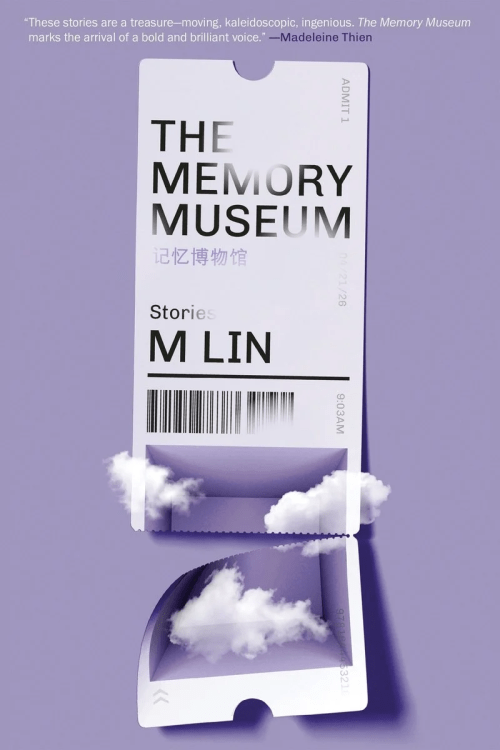
FICTION/SHORT STORIES
The Memory Museum
By M Lin
Graywolf Press
Published April 21, 2026


