On a windy day at a Belgian beach, a film crew sets up mirrors in the sand. Some lie flat, reflecting a blue sky and scattered clouds, while others sway on hooks between ocean and salt grass. In this early scene of Agnès Varda’s auto-portrait, The Beaches of Agnès (2008), the filmmaker lands in the blue-green strata of shore, sky, and the North Sea, where she spent summers as a child. “If we opened people up, we’d find landscapes,” she says.
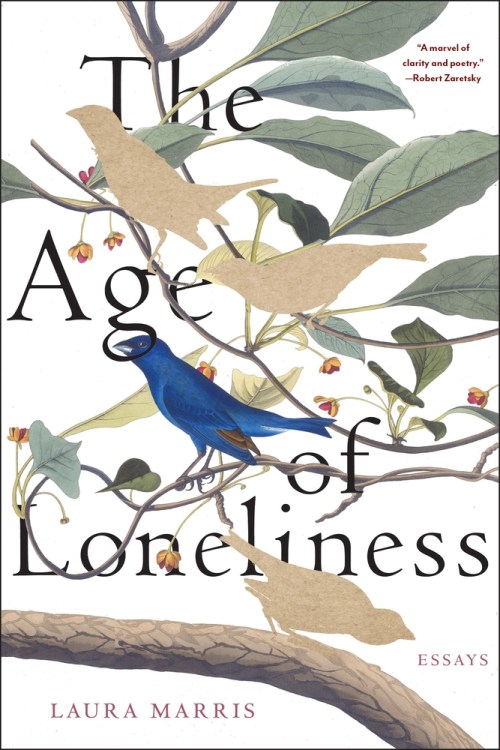
The same idea lays the groundwork for Laura Marris’s expansive debut essay collection, The Age of Loneliness. Unlike a wild place, a landscape is defined by human experience. It is “a human construction—a term for how each person’s life has touched and entwined with the places they’ve known and how they carry traces of where they’ve been. As a result,” she continues, “landscapes are both collective context and deeply personal.” Take Lost Lake, a body of saltwater along Connecticut’s West Woods that can vanish and reappear with the ebbing tide of a nearby marsh. As Marris recounts a childhood visit there with her late father—a sociologist whose teachings on the living world buoy many of her brilliant insights throughout the book—she remembers thinking that “absence itself could be a landmark.” As wildlife loss and displacement become more extreme, what do we risk by ignoring, or normalizing, the absences in a landscape? The same thing we risk by pushing away other types of loss and longing: isolation.
Enter the Eremocene, or the age of loneliness. Biologist E. O. Wilson’s alternative term to the Anthropocene suggests that the devastating ecological effects of industrial development make us increasingly lonely. “When people monopolize a place, we often deprive ourselves of sharing it with the abundance of other living beings,” Marris writes. Rather than searching for ways to eradicate that loneliness, Marris wonders if we can examine it more closely, more publicly. Digging into the feeling “makes it harder to overlook what’s missing.” And plenty is missing.
In “Cancerine,” Marris traces the decline of the prehistoric Atlantic horseshoe crab, a once-abundant species afflicted by overharvesting—mostly for their prized blue blood, used to test medicine for endotoxins—and habitat loss. The Long Island Sound’s remaining crabs, once a keystone species, are no longer abundant enough to serve fish, migratory birds, and other members of the ecosystem that rely on them. As in every essay in the book, Marris’s investigation of the species sprouts from her own experience, rooted in the ground truth of community science. She plucked the crabs from the marsh as a child and, per her father’s demand, released them back into the water.
Noting the crabs’ long history on the planet, Marris wonders if “insisting on [their] resilience makes humans feel better about the harm.” Behind the curtain of that perceived ethics is the anthropocentric belief in “the exceptional right to pass through the landscape unimpeded.” An airplane’s turbine engine ingests a snowy owl that crosses its path; a highway’s shoulder “collects the aftermath” of a pronghorn traveling an ancient route. As human passengers, to be shielded from this aftermath is to grow accustomed to the fallacy that human life—and all the expediency it demands in a capitalistic society—takes precedence over all other life. The flip side of that fallacy contains some truth: one day we might be all that’s left of an “empty, echoing Earth.” What’s lonelier than that? If we can’t save a dwindling ecosystem, maybe we can create a salve for our loneliness by naming what remains and what was once there. “I wanted to understand what it would be like to … live alongside the losses in these landscapes in a way that might be helpful, real,” she writes. Shadows work their way into nearly every essay: Marris knows that these slippery figures cast by the living can loom larger than their hosts—and that what’s gone (or lost) is always embedded in the landscape.
Marris’s background as a poet and translator makes for astonishing and controlled lyric prose. Indeed, many of the book’s ideas are informed by poets, including Susan Howe (“facts are perceptions of surfaces”) and Adam Zagajewski (“travel instead of remembrance”). To her, the landscape is a living language. At the onset of a snowstorm, a crow “caught a downdraft and perched on the guardrail like a comma, a breath of black ruffling in the swirl.”

With equal parts research and reflection, these essays transpose landscapes of personal and shared loss to show how absence can be an opportunity for connection—both to a place and to the people who define and witness it.
NONFICTION
The Age of Loneliness
By Laura Marris
Graywolf Press
Published August 6, 2024