


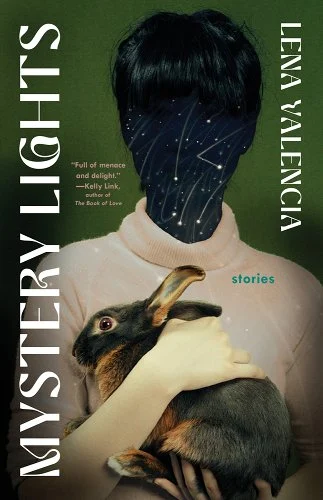
Fear often stems from truths we don’t want to face, like the truth of our inevitable death or the senseless violence that’s all around us. Our own pasts haunt us more than a horror movie’s absurdity. Lena Valencia’s debut short story collection, Mystery Lights, is particularly eerie as she expertly pulls the horror from reality. Again and again, she hits too close to home: a woman feeling scared on her own in a trailer in the desert, even while she fights that feeling. A dormitory haunting that becomes sexual assault. The rich and successful exploiting the young and poor. Online fads that turn into violence.
What’s consistent across these stories is the female protagonists’ resilience. They show vulnerability, yet learn to harness their inherent power, even if in sinister ways.
“The Reclamation” is a standout. Pat, a vintage store business owner who just got kicked out of her space, attends a cultish retreat in the middle of the desert led by influencer-podcaster Brooke Soleil, aptly named the Glow Time Retreat. Pat is looking for ways to find purpose after the store closure.
Quickly after her arrival, she tries to ignore and dissociate from her overly eager roommate, Celeste, who becomes the only voice of reason in a group of women who will seemingly do anything to try to find self-actualization and earn Brooke’s approval—agreeing to get a tattoo of Brooke’s logo and giving up food for GlowShakes, Brooke’s blue meal-substitution smoothie.
But Pat drinks the Kool-Aid, while Celeste is weirded out with the rest of us.
“So none of this is weird to you?” The woman reeked of desperation.
“Well, yes, but not in a bad way,” said Pat. “I think I needed to be shaken up a little bit.”
Then, Pat reflects, “What was the point of self-improvement if you left feeling the same?”
Can we convince ourselves of just about anything when we’re going through change? When we fear the future? Why do our standards change when faced with uncertainty?
Valencia shows her storytelling expertise in this tightly written adventure-turned-horror story that feels too true in today’s social media landscape, where people take self-improvement to an unhealthy level. “The Reclamation” takes that trend and pushes through it to a terrifying conclusion.
“Bright Lights, Big Deal” is another of the collection’s best. A 20-something tries to make it in New York and land a job before her parents’ funding dries up. A publishing industry friend advises her to start a blog and post something really juicy to get noticed. She ends up revealing a lifelong friend’s secret, seemingly unaware of the consequences, until she realizes that maybe she doesn’t have to care anymore. That she has spent too much time caring.
At one point she thinks to herself, “Maybe your problem is that you like being a loser.” She’s slowly grasping that she can try a lot harder to get what she wants.
The choice of second-person perspective here adds to the urgency of the narrator’s situation and the longing she has for continuous brain alteration through drugs, alcohol, and sex—all harkening back to Jay McInerney’s novel Bright Lights, Big City, which is where the story’s name (and the narrator’s blog) comes from. Along with the other stories in the collection, “Bright Lights, Big Deal” shows that being an emotional, intelligent woman can end up separating you from people or make you seem overly self-involved. But those traits also make you interesting.
Grace, the narrator of “Reaper Ranch,” has just been forced into a nursing home after losing her husband and suffering a fall. The story is her diary, dates punctuating the goings-on of the home, and provides some of Valencia’s most poignant lines. Packed with ghost sightings, lies, death after death, and some elder rebellion, the story explores aging and those who take advantage of frailty.

Grace is part of a book club at the home, and they’re reading The Haunting of Hill House. She reflects that it was much more unsettling when she first read it, long ago: “Perhaps now that I’ve borne witness to so much death, ghosts are less intimidating. The reader is supposed to question whether the spirits are real or just figments of the character’s imagination. Such a dull question. What’s the difference, in the end?”
Valencia’s characters all want to understand their apparitions, struggling to incorporate them into real life.
At the nursing home, Grace also keeps tabs on a comet with a telescope. “Three point two billion miles away,” she thinks. “There’s no way to fathom a distance like that. It’s a blurring of science and poetry, the way the mind stretches to conceive it.”
And in a way, Valencia is also blurring science and poetry. Her stories elevate and question the mysteries we’ll never uncover—ghosts, disappearances, underground creatures, unexplained orbs in the desert. Still, we try to make meaning out of it all and can even accept mystery itself as home.
The stories in Mystery Lights are little universes you want to stay inside, each full of intrigue. Valencia shows her range. She pulls you in from the first sentence, drops in clues at the right moments, and follows through on behalf of her characters. Despite their tragedies and ghosts, they’re real women who want to live in unison with all the mysteries around them—some visible, some unseen.
FICTION
Mystery Lights
By Lena Valencia
Tin House Books
Published August 6, 2024


