


If the pen is ubiquitous as a writer’s tool, and claims to be “mightier than the sword,” so, too, should we champion the chair; perhaps it desires to pipe up and say, “Hey, but where are you sitting when you’re using that pen?” So it makes sense that about seven years ago, Emma Copley Eisenberg—the Philly-based author of one novel, one nonfiction book, and now Fat Swim, her first short story collection—got herself an ergonomic chair for the reason we all would: she thought it’d be good for her back. But it wasn’t, Emma told me, her back continued to ache until one day, her partner walked into her office and asked, “Why are you sitting extremely far forward?”
“And I was like, I mean, I don’t know. It’s ergonomic. That’s what they said to do,” Emma said. “But that’s how I approached my body the first 35 years of my life. I think the reason I wrote Fat Swim was because I know nothing about the body, which is why I had to write a whole book about it.”
With a parade of narrators including an eight-year-old questioning her body’s worth, a YouTube star who becomes a lifeline, and a writer’s assistant—who, amongst other things, finds his boss men to sleep with—Emma’s characters grapple with gender and sexuality, their bodies’ effect on themselves and their families, and face shame, warmth, humiliation, and different shades of love. After her MFA from the University of Virginia, Emma’s agent planned to publish the collection, comprised of work from her thesis, as her first book. “But then I started to think about the stories, and it didn’t really seem like a book. It just seemed like a bunch of stuff,” she said. “Some of the stories were things that I still really cared about and some of them, I’m like, I don’t know what that was.” She pivoted entirely, first publishing The Third Rainbow Girl, a nonfiction book about a West Virginia double-murder. And although at least one story in Fat Swim is eleven years old, “All of them have been revised a lot since they were first written. I had to become a different person in order to write this version of the book,” Emma said.
Oh, and about that chair? Emma’s partner told her, “Ergonomic just means adjustable to you.” A fitting metaphor for a book that reaches to answer the unanswerable—because what’s adjustable to you may not be adjustable to me. Our conversation, which took place over Zoom, has been edited for grammar and clarity.

Ruby Rosenthal
The first thing I wanted to ask you about is palm reading, because there are two stories in here where palm reading is mentioned, so I was curious if you’ve ever had your palm read, and if so, what came from that?
Emma Copley Eisenberg
I did have a friend who read my palm once, and she said something about living a long time. So maybe that’s where that came from.
Ruby Rosenthal
Is there any part of you that’s interested in this mystical stuff?
Emma Copley Eisenberg
I think so. All of Fat Swim is interested in reaching beyond for information and insight, beyond what we can know, either through our minds or, in some ways, through our bodies. It’s become very popular to understand that the body holds a kind of knowledge, and I believe there is additional stuff in the world that is beyond human grasp, including mystical things like tarot and palm reading. But also religion, and also nature are ways to try to get at that, and so I think all of that is valid and interesting. But I was not raised with any of that. I was raised in a very logic-forward, Jewish evidence-based household. So I yearn for that in some ways.
Ruby Rosenthal
Yeah, I totally relate. I was raised by two Jewish math professors.
Emma Copley Eisenberg
Yep, sounds right.
Ruby Rosenthal
So what was your first yearning for something beyond the evidence-based? Or do you think it came as you discovered your writing process?
Emma Copley Eisenberg
My first yearning was probably crying when I read books and crying in the movies. I have always been a big crier, and I remember having a really intense reaction. I was obsessed with the movie Magnolia; I think there’s something about that movie that is also about yearning for the beyond: Frogs fall from the sky—it’s very strange. I think that was probably in high school, middle school, high school, I sort of became aware of that manifest in writing and—certainly, like, writing sucks and drives me crazy, and is also work, and is also how I make my living—but when it’s going well and I can forget those things, it can be quite spiritual. I sort of feel like I’m reaching something that it’s hard to reach any other way.
Ruby Rosenthal
In an interview with Jewish Book Council, you said that short stories are your favorite form, so I’m curious if that kind of magic and reaching happened mostly there, or elsewhere since you’ve also written a nonfiction book and a novel.
Emma Copley Eisenberg
There’s a great Grace Paley quote where she says on things that you know a little bit about, write nonfiction, on things about which you are very stupid, write a short story or a novel, depending on the breadth and depth of your stupidity.
Ruby Rosenthal
So what do you think you are very stupid at?
Emma Copley Eisenberg
I think the reason that I wrote Fat Swim was because I was stupid about the body, and then I had to keep writing stories, because I was still stupid, which I still am—there’s no illusion that I’m done here. A lot of the questions in the book are still very much live questions, I would say.
Ruby Rosenthal
Were these questions continuously happening in your mind? Are these lifelong questions for you about the body?
Emma Copley Eisenberg
Yes, 100%. One of these stories is about gender, and how queer women relate to men and power and like, especially how all these things matter in the world of art and art making, which I’m always interested in and showed up in Housemates too. So I think those questions kind of got things kicked off. But then I wrote “Fat Swim,” the title story, and that really felt like, “Oh, wow, I can say things out loud as I’m exploring this character that feels really scary and shameful to me as a person.” Me, Emma, feels scared to think and say those things, but this eight-year-old girl is going to think and say them, and I got really interested in the relationship between kids and adults, specifically around the body, which I think shows up later.
Ruby Rosenthal
Yeah, I love the “Fat Swim” story, I felt it was very true and very honest. And just the part where Emma’s—Oh, my God, no, you’re Emma—
Emma Copley Eisenberg
I am all of them. They are all me. Yes; it’s all good.
Ruby Rosenthal
Where Alice is watching the three women, that is. I remember being a kid, watching adults and thinking, “Is this how I’m gonna be?” And I know what you mean when you’re like, oh, I can say things that I didn’t think I could.
Emma Copley Eisenberg
I don’t have kids, but I think we underestimate how much kids are looking at adult bodies to understand who they are and what their body means. Like when parents mention stuff around the way they eat, or the way they think about food or appearance, thinking “It doesn’t matter. It’s about me.” But it’s like, no, because kids are looking at you and saying, “but that’s about me too.” There’s this intense porousness that I think kids have, especially at age, like, eight, or nine, or ten, where you’re really starting to question, like, what is a body? Do I have one? What is mine? Am I beautiful? Like, there’s that scene in Little Miss Sunshine too, where she’s like, “Grandpa, am I beautiful?” And it breaks my heart every time, because we all want to be beautiful, but also like, what is beauty? And also—all that is so constructed.

Ruby Rosenthal
Thinking beyond the obvious, beyond Americans’ fatphobia and such, I’m curious why you think fat representation is missing from a lot of contemporary literature.
Emma Copley Eisenberg
Yeah, I mean to be determined, but my hunches are as follows: I think literary fiction is in some ways the worst at this. Like genre fiction—including detective and romance and thrillers—tend to have more, like, non-normative, or, like, not-always-considered-beautiful bodies in them, not always as the protagonist, a lot of times they’re the villain, or they’re a sort of disposable character, which is also not great, but at least they’re there in a way.
Whereas with literary fiction, it’s like the camera can’t see certain kinds of bodies. I think, yes, in addition to the basic things—just like America as a country steeped in fatphobia that we’ve inherited from British Puritan culture that is afraid of pleasure and afraid of abundance and afraid of size—I think the literary publishing industry is a labor environment that is descended from elite, rich people, as are many industries. I think the literary landscape has a lot of class divide, a great deal of classism, and it’s very difficult to survive within the industry without inherited wealth and without access to a sort of wealthy background.
It’s a very high-brow, high class environment. And I think class and fatphobia are extremely linked, so you don’t get people in the rooms making the decisions [who are fat], nor do you get folks who are reaching the highest levels of awareness to the public, and getting the prizes. Often those folks don’t have a great deal of exposure to environments that are not solely rich people. Also, I think there’s a sheer hatred and a sheer disgust that is not getting better in a way that other kinds of discrimination have been articulated and legislated.
Ruby Rosenthal
As you were talking, I was thinking about Kiese Laymon’s memoir Heavy—have you read that?
Emma Copley Eisenberg
It’s beautiful, yeah.
Ruby Rosenthal
It’s really fantastic. And I’m thinking that even nonfiction gets it better than literary fiction.
Emma Copley Eisenberg
Yes, agree. Like, I mean, I think there’s so many interesting essay collections, memoirs, crossover, academic. But most of the books that are, I think, are really interesting about body liberty and body autonomy and of all kinds, including disability and fat liberation are nonfiction. It’s strange, yeah.
Ruby Rosenthal
Especially at the end where Alice’s father comes back, and we see him on his own, without looking at him through her. On that: You say twice in the book that “no one can have their cake and eat it too.” I was curious what that phrase means to you personally, and how—or why—it resonates.
Emma Copley Eisenberg
That phrase means so many things to me. It’s really interesting that we use all these food and sweet food metaphors as ways of talking about what we can and can’t have in the world. I did an essay once that was looking at all the words that we used to describe ice cream. And it’s like, sinful, decadent, all these things that sort of have religious connotations of too much, too dangerous, too whatever. And it’s like, it’s just ice cream. Calm down. Literally, calm down.
But I think that phrase is also about a real fear that I have. I don’t know if it’s generational, or where I grew up, but I’m questioning all these systems that are crumbling, but I’m not yet free of them. Like, what do you get in one lifetime? Like, what’s enough? What are relationships supposed to look like? What’s a normal, livable life? I think that phrase is about this idea of contradiction, and there’s things that sometimes really are opposed, and you have to choose. And there’s just that fear that we’re all told, like, “you’re going to want too much and you’ll be punished.” I think that’s true sometimes, and I think it’s also not true. There’s a lot more space to navigate the things we’re all told we can’t have, but there’s also not all the space in the world. And somewhere between those two things lies what a lot of my characters are struggling with.
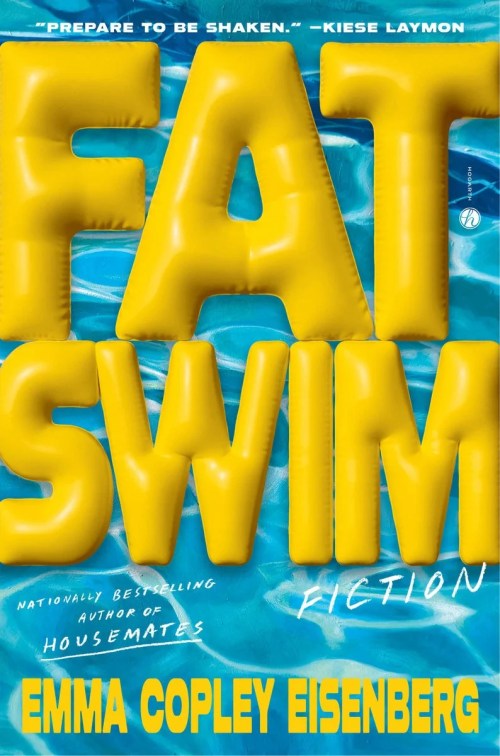
FICTION
Fat Swim
By Emma Copley Eisenberg
Hogarth
Published April 28, 2026


