In Newspaper Days, Theodore Dreiser’s 1922 memoir of his early years as a journalist prior to the publication of his earth-shaking first novel, Sister Carrie (1900), Dreiser recalls attending the 1893 Columbian Exhibition in Chicago in the company of his future first wife as a reporter for The St. Louis Republic. Wandering the fairgrounds dazzled by the White City’s “vast and harmonious collection of perfectly constructed and snowy buildings, containing in their delightful interior the artistic, mechanical, and scientific achievements of the world,” Dreiser beheld a “splendid picture of the world’s own hope for itself.” He found himself swept up in “a lightness and an airiness wholly at war with anything that this western world had as yet presented, which caused me to be swept into a dream from which I did not recover for months.”
Months later, awakened from the dream to the ugly realities of life in the “dingy city,” Dreiser fled to his fiancée’s hometown in Missouri farm country in hope of restoring the romance of their White City wonderland, or at least the pastoral charm of his own midwestern youth, only to recoil at its Great Plains provincial pieties, a worldview built on foundations as illusory as the White City itself: “This profound faith in God, in goodness, in virtue and duty that I saw here in no wise squared with… all the other life that I had seen of which apparently these people knew nothing. They were as if suspended in dreams, lotus eaters.”
Dreiser’s is hardly the joyous Midwestern homecoming from a magical distant city enjoyed by Dorothy Gale in L. Frank Baum’s The Wonderful Wizard of Oz, published two months before Sister Carrie in September 1900. After saying her goodbyes and clicking her way back to Kansas, Dorothy runs into the arms of her Aunt Em and exclaims, “I’m so glad to be at home again!”
Baum’s story—itself inspired by the author’s transformative trip to the 1893 World’s Fair—ends abruptly in that moment, with no record of how Aunt Em reacted when her niece offered her no more satisfactory explanation for where she’d spent the days since the twister swallowed the family farmhouse than to say she’d been in “the Land of Oz.”
But Baum’s is only one version of Dorothy Gale’s story, as we learn in After Oz, a new, posthumously published novel from the enormously gifted and marvelously mischievous author Gordon McAlpine, who died in November 2021. McAlpine picks up the tale at roughly the same moment where Baum left off, although his alternate history of the Kansas tornado and Dorothy’s disappearance reveals some critical details that Baum apparently missed or ignored.
McAlpine reports that four days after the tornado, Dorothy was discovered unharmed, sleeping in a pumpkin patch owned by a family named Pendleton two miles outside the Kansas town of Sunbonnet. Soon, she’s spinning tales about her adventures in “an enchanted land” populated with witches, talking beasts, and flying monkeys. “Mrs. Pendleton didn’t follow,” McAlpine writes. “She wouldn’t be the last citizen of Sunbonnet bewildered by Dorothy’s ravings.”
McAlpine unspools his own version of Dorothy’s return to Kansas from two perspectives. First is the collective voice of the townspeople of Sunbonnet, a first-person plural narrative style deployed in relatively recent novels like The Virgin Suicides and The Wives of Los Alamos. More than anything, Sunbonnet’s residents’ unified voice reads like a rural analog to the “We people on the pavement” chorus of Edwin Arlington Robinson’s 1897 poem “Richard Cory.”
The collective townspeople of Sunbonnet—much like the rural Missourians Dreiser found addled and armored with a “profound faith in God, in goodness, in virtue, and duty” that in no way reflected or welcomed the intrusion of a vast or changing outside world—respond with skepticism, suspicion, and disapproval to Dorothy’s tall tale. They scorn her “damnable lie” as a product of “an idle and dangerous mind.” That Dorothy seems to believe in witches is bad enough; but her insistence that they come in both good and bad varieties is blasphemously beyond the pale. Dorothy’s admission to killing two wicked witches, one of them by melting, soon takes on the gravity of a confession when Sunbonnet’s spiteful old spinster, Alvina Clough—often heckled as a witch by local children—is found murdered on the day of Dorothy’s return, her face melted off with lye.
After Oz’s second narrator, Dr. Evelyn Grace Wilford, encounters Dorothy in a bleak Kansas mental institution to which the girl has been confined after her “confession,” and her seeming inability to provide a legitimate alibi leads local authorities to charge her with Miss Clough’s murder. Wilford, an ambitious young psychologist (and, incidentally, a cousin of reporter Frank Baum), has traveled to Kansas from New York to conduct extensive interviews with Dorothy for research purposes.
Wilford’s narrative takes shape as a series of letters to her Harvard University mentor, the pioneering theoretical psychologist William James, whose 1890 Principles of Psychology posited the causal connection between internal emotional and mental states and external actions and behaviors. Rather than aiming to suppress, cure, or criminalize 11-year-old Dorothy’s supposedly “idle and dangerous mind,” Wilford just wants to talk and listen. She also proposes games and exercises—such as discussing the provocative pictures on a deck of Tarot cards—that will help her understand Dorothy better, yielding some of the book’s most affecting exchanges.
In a clever nod to MGM’s 1939 Wizard of Oz film, which rendered Kansas in black and white and Oz in color, Dorothy reveals to Dr. Wilford that she’s always been afflicted with color blindness in Kansas, but not in Oz, where she saw vivid Technicolor greens and blues and reds and yellows. Thus Kansas struck her as especially bleak after she and her familiar color blindness returned.
Dr. Wilford asks, “After the tornado, when you arrived back home, you told your family and neighbors that you’d returned because ‘there’s no place like home.’ But you don’t feel that way anymore?” Dorothy replies, “I never told them that… They weren’t listening. ‘There’s no place like home’ is just what they wanted to hear, so they said I said it.”
These chapters conjure a saucy, precocious, sharply perceptive Dorothy who’s arguably a more compelling (if darker) character than Baum’s original. Also far darker are McAlpine’s Aunt Em and Uncle Henry, who react to the tornado’s obliteration of their house and farm and the disappearance of their niece much as one would expect them to, with a voice-snatching stroke (Em) and a lot of sullen, antisocial drinking (Henry).

Dr. Wilford’s conversations with Dorothy prove far more productive than her encounters with the grim and tight-lipped Uncle Henry and Sunbonnet’s condescending and apparently all-powerful Reverend Richter and Doctor Ward.
After Oz reads less like a sequel to The Wonderful Wizard of Oz (Baum already made a career of those) than a book that simply turns the original story inside out. Rather than trying to twist The Wonderful Wizard of Oz into a far-fetched political allegory on 1890s populism or national coinage policy—a competitive sport amongst a string of one-upping 20th-century academics—McAlpine brings it crashing back to earth. The novelist astutely situates Baum’s light-hearted (if often strikingly violent) YA fantasy in the harsh reality of poor, post-Panic rural Kansas and the “two Americas” clashing of disparate worlds, one embracing progress and the other desperately fighting it off.
Is After Oz, after all, a somber meditation on the grim world of subsistence farming, housing insecurity, and religious and social intolerance in turn-of-the-century Kansas? Not any more than McAlpine’s dizzying Hammett Unwritten was just a gloomy disquisition on the great Dashiell Hammett’s protracted battle with writer’s block, and not any more than his mesmerizing, mind-bending Woman With a Blue Pencil was an angry screed against the horrors of Japanese internment during World War II.
Improbably, irresistibly, inimitably—which is to say, par for the course in a Gordon McAlpine novel—After Oz spirals into a strange, multilayered murder mystery with a spectacular show-stopper of a reveal. If you know McAlpine, you know it’s coming—and at the same time you know you’ll never see it coming.
Gordon McAlpine’s 2021 death is an irreplaceable loss. Like all of his novels, After Oz is a miraculous find—and we can only be grateful that it has dropped out of the sky in 2024.
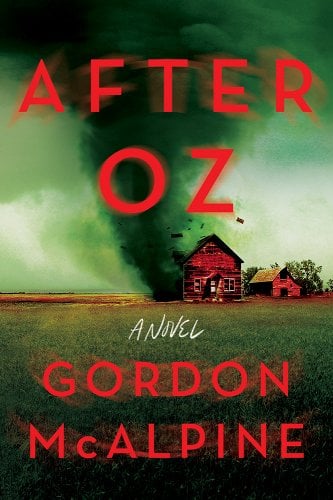
FICTION
After Oz
By Gordon McAlpine
Crooked Lane Books
Published August 6, 2024