


No degree of narrative and structural complication or self-awareness will cover you if you cannot write a good sentence, let alone if you write howlingly bad ones. A few pages into Unspeakable Home, a new novel from Ismet Prcic, one is reminded of Jonathan Lethem’s work. It’s the same intermittent solipsism, nervous metatextual trickery, lingering on popular culture, and worse, the embarrassingly voulu weirdness, confused collegiate diction, haphazard, promiscuous way with metaphors, and basic ugliness of the prose. Prcic is a Bosnian refugee who has lived in the States since 1996. Like his debut, Shards, Unspeakable Home is an autobiographical work about a man named Ismet (Izzy), who after a childhood in wartime Tuzla, Bosnia and Herzegovina, came to the US as a teenager. Izzy is now a divorced alcoholic with a son, and a huge stock of stuff to say about his experiences.
The narration varies between first and third person, between past and present tense, featuring other characters who may really be versions of Izzy, and each section is introduced by a letter addressed to the comedian Bill Burr, with explanations as to the narrative mode and sequencing. The settings include Tuzla in childhood, San Diego during Ismet’s college years, and Salem, Oregon, at the time of writing. There are a lot of prefatory layers to get through, starting with Samuel Beckett’s very short story “neither” from which the title is taken, before “SIDE A(MERICA)” begins, which is to be followed by “SIDE B(OSNIA).” Following a letter to a Croatian academic who has written about Prcic’s work, there is a final section named “LINER NOTES.” As Ismet explains to Mr. Burr, the A parts don’t involve his ex-wife (called by the narrator “Beloved”), but the B parts do, and they include the elements of the “weird and unhinged” that lead to the end of the relationship. Underneath this rough chronological scheme, the novel moves fairly freely across time and space, away from and back to Ismet’s life.
A sort of preface titled “Obligatory Warning,” cutely cited as an excerpt from the novel which contains it, explains that Ismet’s efforts to write will “ultimately fail my feelings, my experiences, and my language,” because of a war in the writer’s mind, which is also to be understood as a version or legacy of the actual war he has survived. If something seems off, he knows it, and he’s working on it. It ought to be acknowledged, as it of course is by this most apologetic narrator, that he is not speaking (so to speak) in his mother tongue, but the language problems, leaving aside a few odd prepositions, are not really problems of fluency. Nor did Prcic’s fellow Slav Joseph Conrad speak any English until he was 21.
To begin with, Prcic has his tics, which will irritate some readers more than others. Should they have been suppressed, even medicated? Firstly, clichés of a demotic sort, such as “thanked their lucky stars,” “burning any bridges,” “down for the count,” “like you wouldn’t believe,” etc. And secondly, more willfully, there are quirky, hyphenated adjective phrases, some of which employ other stock expressions: “fucked-with-during childhood, can’t-face-the-real-world fetid sot”; “squeeze-the-last-drop-out-of-this-vacation float in the sea”; “count-your-lucky-stars reality.” Moving into a less subjective area, one notes a lot of nonsensical and even contra- diction. In Prcic’s world, “yellowed radiators” are “redolent of fear”; SUVs in the afternoon sun have an effect of “uncanny but dulcet shimmering”; the narrator, holding a tire iron, is “magnetized by the thingness of the contrivance in my hand”; and a drug dealer gives a look of “livid apathy.” Staying with diction, I suspect that Prcic used a thesaurus to decorate plain thoughts, or rather, utilized a thesaurus to bedizen spartan cogitations (with both colloquial and literary substitutions). For example, most egregiously, “I’m still abased by the dreams about it,” or “The forceful heat and the physical effort make my heart bombinate,” or “In time I quit my sedulous fussing, realizing the fettle I was in.” The awful jarring noise of “sedulous” and “fettle” is like an alarm bell. A talented writer with a good ear knows to avoid these particularly unsuited pairings of the Latinate and Germanic, and of the high and low.
In “SIDE B(OSNIA),” there seems to be less self-editing going on, certainly less of what you might call “sedulous fussing” over vocabulary. There is still the baffling diction, to be sure, but Prcic’s narrator is ruminating, even ranting, so we are treated (some of us squirming) to speculative confessions in looser rhythm: “Maybe I refused to write it and only spoke it, my truth, out loud to myself, and for myself only, only to forget it again, push it away again.” Emotions and instincts may be considered in separation from the intellect, but for a writer like Prcic, the pseudo-intellectual probing has the same quivering, desperate sound, the same neediness heard in the confessions. He continues: “Or maybe I let it tell itself inside my head, in that fuzzy, unmanifested, wave-without-particle, word-without-utterance way.” The second halves of so many sentences lapse into lists, wherein metaphors are mixed, technical sounding references are clunkily imported, and something very simple is made to sound more complicated. There is no need for thesaurus substitutions when you can just keep going like this: “Unuttered, our shame latches on to us where we’re the warmest and the wettest, on the inside of us, leaching out life and guzzling our time, defiling every other contiguous experience of life.”

It takes discipline to determine which of your pet words and ideas can safely play together, but mixing elements is the whole game for a writer like Prcic, who would like to make confusion an aesthetic principle, disorder a new kind of novelistic order. Unspeakable Home, with its sordid detailing of alcoholism in the American suburbs and violence in the Bosnian streets, and its narrator’s mad oscillation between the two, has and will be commended for its honesty and its bravery in being honest, and for its apparently related formal experimentation. Leaving aside the sad story and the bag of gimmicks which are pretty much just grabbed at and thrown at the page, what about quality, or rightness of expression, let alone music? What about those most basic criteria for any craft, knowing what you’re doing, and doing it well?
FICTION
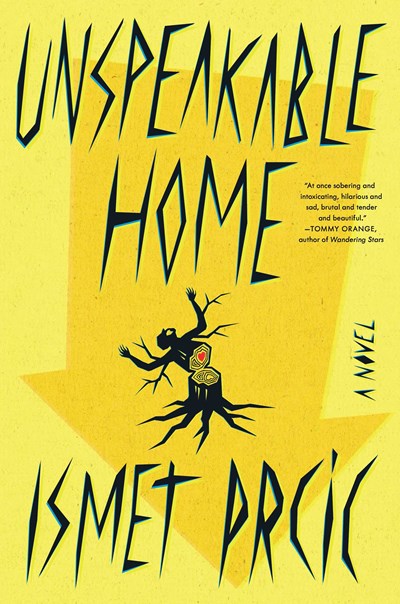
Unspeakable Home
By Ismet Prcic
Avid Reader Press
Published August 6, 2024


