At the time of this writing, much of Illinois is in a college basketball frenzy, as the University of Illinois, the flagship state university, has advanced to the Sweet 16 of the men’s tournament for the first time in almost twenty years. The Illini have a legitimate shot at the national championship, and even people with no affiliation to the school other than loose regional identity are cheering for the Fighting Illini (update: the championship did not happen).
But of course, when we are cheering for the Illini, we are cheering for a name spelled with theft. The name Illinois is derived from the prominent regional tribe at the time of conquest. Illini itself means warrior, making Fighting Illini largely redundant, a hollow honorific all but stripped of actual meaning. For most of us, Illinois is a vague identity, our teams another signifier. But there are many who don’t have the option of comfortable ignorance.
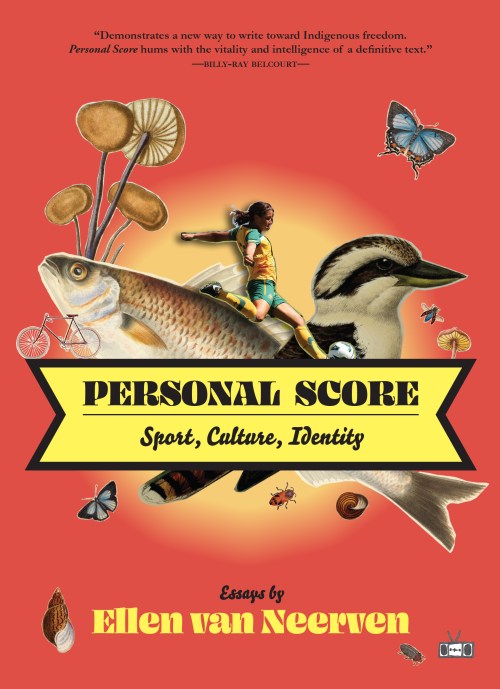
These are themes explored by the Indigenous Australian poet and writer Ellen van Neerven in their new book, Personal Score: Sport, Culture, Identity. I say Australian because that is where they are from, on my personal map. But van Neerven is of Mununjali and Dutch heritage, and the term Australian is one of coercion, conquest, and cruelty. This idea of identity, the one that is imposed and the one we create, is at the heart of their memoir.
Blak. Queer. Indigenous. Different. All these are part of their identity, which they explore through the lens of sport. They grew up playing football (soccer in America), though they had to start after their younger brother because the leagues for girls weren’t as developed yet. But football was their passion, and they became a skilled striker, playing throughout university and then on club teams after finishing university.
It was in football that van Neerven’s differences were constant. They recount being teased about being Blak, and remember the other girls talking in demeaning whispers about how there were some teams where everyone was a lesbian, and how you wouldn’t want to play for those kinds of teams.
These were van Neerven’s teammates. They had to play with these girls, learn how to get into the flow of the game, using both the assimilation of teamwork and the singular flow of personal genius to succeed. That’s sports. That’s also life. Which is more important?
In Australia, for much of their life, the answer was the former. Be on the team, don’t make waves, and don’t make too much of your indigeneity. Because while we don’t want to have a kind of Racist Olympics, the level of public racism in Australia is enough to shock even the most aware American.
One harrowing example (please be aware—the following contains a vulgar racial slur): in the ’90s, there was a rugby pitch where one end was called the “E.S. ‘Nigger’ Brown Stand.” It was painted on the wall. The announcer said it. The area was named after Edwin Brown, a popular white player of the 1910s and ’20s who had the nickname for reasons lost to time. But there the word was, used with no compunction. van Neerven had not gone to the stadium before the name was finally changed in the 2000s (though even that was accompanied by horrific backlash), but they know the feeling of being somewhere where everything is wrong:
It’s a nails-on-the-chalkboard feeling. Something inside you is dying. And you wonder why you are the only one feeling like something is wrong.
This jarring isolation is personal and political. The names of the land betray a history of violence and murder, of theft of land and identity, of coercion, of poison. Poison seeps through the land, making the ground unsteady for those whose lives are shaped by this cruelty. van Neerven’s book, which speaks of terrible floods and ruined buildings fenced over stolen land, often feels like a reckoning of sorts. It gives you the feeling that the land is inflicting a punishment for the ongoing extirpation.
But the book is also filled with desire, with sex, with awakening. There is a delightful passage where van Neerven’s normally rigid-to-the-point-of-superstition pregame routine is happily disrupted with a bout of explorative sex with their partner, and van Neerven ends up scoring all three goals in a shutout victory. A new routine is born. This joy, this personal joy that ends up with a team victory, is important. It is important to show that while these social constructs tie them down, van Neerven can find joy and desire and can raise their own personal score.
There are also great passages where van Neerven steps into the third person, narrating their life from the outside, and the writing avoids some of the political didacticism that, while probably necessary, can be overwhelming. I think my favorite section is a chapter titled “What I Want When I Want You,” describing how they became “hooked on queer longing in writing, fueled by Jeanette Winterson and Dorothy Porter.” It is a series of short bursts, culminating with the following:
11.
Desire is not a design flaw.
12. “I want you” are dangerous words for a Blak queer to say, but I say them anyway. I say them with every inkling of the consequences these words can bring. I say them again and again and again.
It is wrong and diminishing and too cute by half to suggest that sex and desire can overcome cruelty and theft, but one’s identity can rise through the muck. Identity is a social construct, but it doesn’t have to be a one-way street. One can make their claim through overlapping impositions. It’s just not easy.

van Neerven is a great advocate of their own identity, in a way that their society (and ours) tries to diminish. An example of this, one that I found uncomfortable, is when they talk about the great Australian tennis player Ash Barty. Ash was the best player in the world, and retired at a shockingly young age, with the admirable goal of spending less time being the tennis player and more time being herself.
Above, I said Ash was a great Australian tennis player. That’s how I always saw her. I had no idea that she was, as van Neerven describes her, a “proud Ngarigo woman.” They talk about Barty having “Big Aunty Energy” in once bringing her baby niece onto the podium after a loss, saying it “was like a big F U to white expectations of female athletes.”
Now, this is where I goggled. Ash Barty? I had followed her career with love, she was one of my favorite players to watch, and I admired the way she carried herself on and off the court, with what I probably thought of as particularly Aussie irreverence. If you had asked me if I thought she was white, I wouldn’t have understood the question.
It is my imposition. My understanding, or lack of understanding, of the dynamics of history, of race, of Australia, of identity. It was easy to see Barty as what the map says she is—a white Australian—ignoring who made the maps. Ignoring who makes the rules. Ignoring who polices desire, who arrogates unto themselves the status of baseline and declares everything else a deviation.
van Neerven makes the case, both obvious and urgent, that there is no baseline. That who you are might be a product of a million different personal and political and cultural overlaps, but there isn’t one way to be. That these lines that are drawn—What is Australia? Who are Illinoisians?—are just that: lines on a map. These impositions matter, they can’t be ignored or wishcast away. That’s not how this works. There’s no sudden freedom from the past. That’s the score.
But there is a personal score as well, the goals you score, and even the ones you miss. Those matter too. They count.
NONFICTION
Personal Score: Sport, Culture, Identity
By Ellen van Neerven
Two Dollar Radio
Published April 9, 2024