


I’ve been hungering for climate change fiction that feels real, honest, and personal, so when I came across The Alternatives by Caoilinn Hughes, I knew I’d found something special. In this book, four orphan sisters, now in their thirties, all respond to the climate crisis in disparate ways. One sister, in despair, runs away from everyone and everything she loves. Another retreats, in a different way, into ancient classical philosophy. The third sister nearly pulls her hair out trying to change the political system. And lastly, a chef tries to embody the solution through sustainable food and education. Yet all this is put aside as they look for their missing sister and confront one another.
In this book, Hughes takes you on a journey through the human psyche as the sisters search for and find each other. Because at the end of the day, in a crisis, what more do we have? With this in mind, I spoke with Caoilinn over Zoom about her attachment to her main characters, the difficulty of loving a climate scientist, and how her vision for the story deepened.

Denise S. Robbins
What was the initial inspiration for this story, and how did it evolve? Did you know you wanted to write about climate change?
Caoilinn Hughes
I followed some impulse to write about women at work: women who are trying to do meaningful or fulfilling work that gives them energy and anchorage and purpose. The characters occurred to me as sisters. I loved the idea that a book about sisters could also be a book about a geologist, a philosopher, a political scientist, and a chef… who most definitely walk into a bar! Family doesn’t only exist in the domestic realm. It’s a story about how these women are living individually, each contending with their own moment of flux. It’s a story depicting a society in crisis, reflected through the lives of these women.
Denise S. Robbins
Did your initial vision for it change or deepen?
Caoilinn Hughes
By necessity! I write into the dark, so I never know where a book is going to go. If I have any vision, it only extends to arm’s length. It was as I wrote each of their separate chapters that I came to understand who these characters were as individuals and what their stories might be, as distinct from their collective one. The disappearance of the oldest sister, Olwen, prompts the other sisters to reconnect. Though their parents are dead, the story isn’t about that past trauma at all—it’s not about adult siblings revising their childhoods. The characters are each more invested in the present than the past. And the story is about now. I tried to set it as close as possible to when it would be published!
Denise S. Robbins
Was climate change always going to be a big part of it?
Caoilinn Hughes
If I had any sense of that early on, it was because Olwen was the first character I wrote—she’s the one I wrote the novel for. An earth scientist. A geologist. I think it’s deeply interesting and existential work, studying how the land got that way, what its processes are, what life it’s sustained, what it’s capable of. Geologists are often interested in what lasts, what’s settled and storied, as opposed to, say, glaciologists, who might be interested in the ephemeral. Ice is ever-changing. I wrote the bulk of this novel in Connemara, Galway, which is one of the most beautiful places I’ve ever been. It’s wild and dynamic, while being somehow immovable… a bit like Olwen. And there’s limestone breaching through the fields everywhere, and bare, low-lying hills. It was a good context for writing Olwen’s chapters, because it’s somewhere she’d be obsessed by. Maybe that’s why she teaches in Galway. Once upon a time, I would have thought it was a romantic life, being a geologist, or any job that has you out in nature, studying it. But these days, it’s hard to be a romantic earth scientist. You’re reckoning with natural hazards and dwindling resources, degraded topography, and catastrophic climate change. My partner is a climate scientist, and it’s not a field you’d urge a loved one into. I suppose I wanted to write about what it is to love someone who does that work because it does affect everything that you see and absorb and emit and appreciate.
Denise S. Robbins
Has climate change become a prominent theme for you in your writing?
Caoilinn Hughes
I just don’t think that you can avoid it anymore in any fiction unless you’re writing something historical. There’s a cliche that all writing starts with descriptions of weather, and often closes with weather. And something to do with light in the sky [laughs]. Yesterday in New York it was 18 degrees Celsius (64 Fahrenheit), blue sky and glaring sun at the start of March. Climate change is contemporary realism. It will become stranger and stranger to avoid it in your fiction.
Being ultra-aware of it isn’t really a choice. And there’s something to be said for ultra-awareness. Denial is more horrible and depressing. There’s some sort of consolation in acknowledging and facing up to the moment that we’re living in. This is when we’re alive, and it’s no less worthy a time to be alive than any other time. And it’s no less worthy a time to make art about.
Denise S. Robbins
It must have been helpful to date a climate scientist during the writing of this book. But how much additional research did you have to do?
Caoilinn Hughes
I am a terrible procrastinator, so I avoid doing too much research. I write into areas I’m already interested in. Actually, the chef character was the biggest stretch for me because I’m a vegetarian and I’m also a very impatient cook. So understanding what it’s like to enjoy spending hours preparing food, and also preparing meat, was genuinely tricky. I asked a writer friend who was a chef for 30 years to look over my recipes to make sure that Maeve wasn’t going to poison her clients.
For Olwen the geologist, I always loved geography as a subject. My geography teacher in school made more of an impression on me than my English teacher. There were some books I’d read as an adult that made quite an impression on me too, like Basin and Range by John McPhee, which is a very unusual geology book. And then more recently, a book called Notes from Deep Time: A Journey Through Our Past and Future Worlds by Helen Gordon. I’ve bought that book for people. It’s wonderful.
Once I’d finished writing The Alternatives, I asked a geologist called Christopher Jackson, who’s also a wonderful science communicator, to read Olwen’s sections. And I was really shocked when he said that it was plausible. Especially the rejection letter she gets from Nature Geoscience! I won’t mind if some Reddit corner of the internet begs to differ.
Denise S. Robbins
What was the hardest part of writing this book?
Caoilinn Hughes

When you include teaching in a book, you have to be mindful it doesn’t become didactic. That was one challenge. Then I was mindful of how readers would encounter Olwen’s crisis. Reading is a generous act, as it makes the reader vulnerable. So it’s a challenge to uphold the responsibility to be truthful to the world and the characters, however existentially challenging the material, while knowing there’s a reader on the other end, who has ideally opened themselves up to the book.
Denise S. Robbins
Interesting that you don’t want the novel to be seen as didactic. I don’t think didactic necessarily has negative connotations. It’s about teaching.
Caoilinn Hughes
That’s right. Three of the characters in the novel are teachers, though we only see two of them in a teaching context. There’s something universal in that because we all have experiences of being taught or even of teaching ourselves, enough to know that it involves so much more than learning new information. It involves the handling and guardianship of students, their curiosity, their risk taking, their participation, and their mental health, especially when it comes to issues like the welfare of the earth and our prospects of the species. All the while, it’s rarely adequately compensated, and it’s increasingly hard to teach well with, for example, in Nell’s scenario, no sick pay, no office, no security with contract work, no commuter’s allowance, no autonomy over when and where she’s teaching, and having to hold office hours at a flexi desk. There is a connection between teaching and the role of care in the novel. I’m interested in that because I do think that reading involves care. Paying attention is a form of care. And the vulnerability and care are hopefully reciprocal. A novel is vulnerable to its reader just as a teacher is vulnerable to her student.
Denise S. Robbins
One interesting way you approach this topic didactically but not preachily is refraining from one clear point of view. You have your four different characters with four different approaches to the issue of climate change, among other things. So do you feel like you identify with any character the most, or do you see yourself in all of them?
Caoilinn Hughes
I felt very close to each of them as I wrote them. I think novelists are partially in all of their characters, but in none of them wholly. The more you publish books, the truer it is, because you have less of the problem of being pinned to a single character. I can’t write a character that is me because I have no clarity on myself. Also I can be boring and confounding and annoying! I’d rather spend time with someone else! But I definitely couldn’t write a character who I don’t feel deeply connected to, who I haven’t given some of my pathologies to. And so, yes, at times I felt most similar to Nell—who has the closest sensibility to an artist’s—and at times I felt most like Olwen. She’s a lot funnier, though. I imagine a lot of readers might feel affiliated with Maeve, because she’s the messier one and a little inconsistent in a way that I feel is very true to how people are. She’s the light. She’s the one who sneakily orders another round.
Denise S. Robbins
What are you working on now?
Caoilinn Hughes
I’m finishing a collection of stories. I’m also at the very early stages of thinking about a new novel. The early stage for me usually involves running away until I accept that there’s something that wants to be written. It was the same with The Alternatives. I rang a Dutch writer friend of mine, Bette Adriaanse, and told her, “I want to write a simple, linear, 200 page novel, damn it.” I was driving myself absolutely crazy, running away from this book. She said, “Caoilinn, you have something in your garden. It might be ugly and poisonous, and you might not want to go there and tend to it. But if you don’t see it through to fruition, nothing else can grow in your garden.” That was the sting I needed to begin.
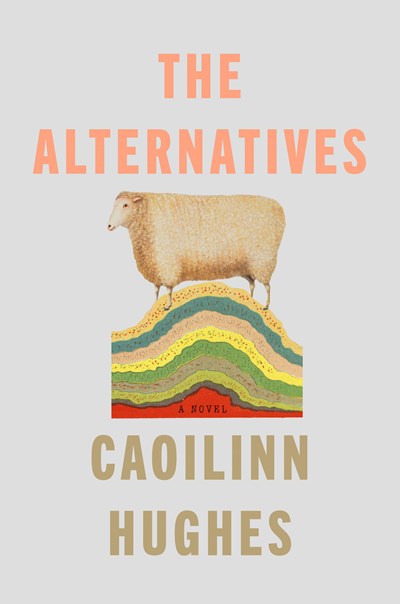
FICTION
The Alternatives
By Caoilinn Hughes
Riverhead Books
Published on April 16, 2024


