


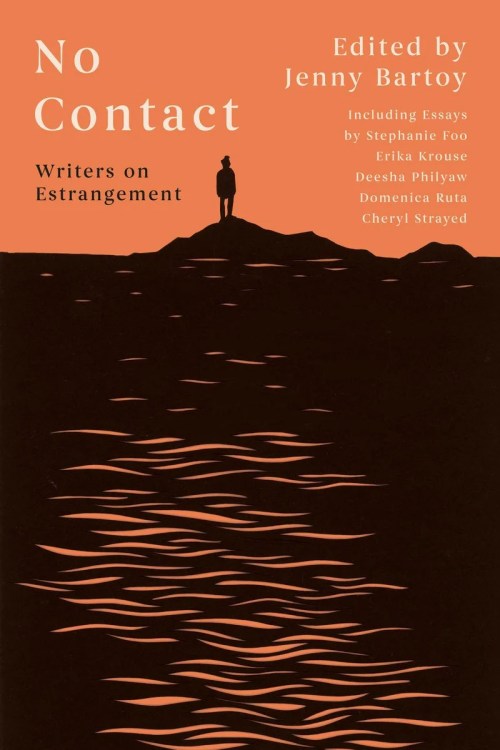
When writer and editor Jenny Bartoy became estranged from her father, she searched for stories that could help make sense of the experience. She found that stigma around estrangement had mostly kept it out of public discourse, and she longed to connect with others who could understand. No Contact: Writers on Estrangement is the song to fill that silence, a collection of memorable voices deftly joined in a powerful chorus. Beloved literary stars like Cheryl Strayed, Erika Krouse, Deesha Philyaw, and Stephanie Foo belt their truths alongside a bounty of emerging writers performing triumphant solos. Immigration, language, power, truth, shame, choice, and love form rich harmonies that deepen the overall effect.
In No Contact we hear from writers for whom estrangement is the wound and writers so wounded by those they loved that estrangement is the balm. In both cases the writers cry out in pain. Pain is a constant refrain. Mothers refuse to touch their children, girls’ bodies are offered to adult men, children are beaten, lives are threatened, money is stolen. There is drug addiction and mental illness. The narrators are told again and again, ‘you don’t matter,’ ‘you aren’t wanted,’ ‘you and your reality are not valid.’ As a whole, the collection is a testament to art’s ability to transform that pain and trauma into connection, growth, and beauty.
That connection, growth and beauty are amplified across the collection to counteract the weight of the pain. Many of the essays conclude with the narrator describing the richness they’ve discovered in their estrangement. Emi Neitfield, Lindsey Danis, and Alyson Shelton found a stronger sense of self, while others, such as Domenica Ruta and Stephanie Foo, expressed gratitude for the found families estrangement gave them the opportunity to cultivate. Bartoy has also lightened the collection by interspersing a carefully curated selection of related poems.
My favorite pieces in No Contact seemed primarily concerned with laying the pain of rupture bare. In these essays, the beauty was found in that bareness, in the authors’ unflinching, full-hearted view of the pain. I was moved by Erika Krouse’s heartbreaking “Nobody Owns You.” I admired the vulnerability and commitment to truth in “Dichotomy of the Rejected” by Geneva Phillps and “Episodic Tremor and Slip” by Lorne Daniels, both essays in which parents struggle to love their children. I was destroyed by the sorrow and longing of the adult daughters contemplating their mothers in “Wash Belly” by Soni Brown and “Prodigal Daughter” by Michelle Dowd.
I was lucky enough to speak with Bartoy about estrangement, No Contact, and her editing process over Zoom.
This interview has been edited for length and clarity.

Brianna Avenia-Tapper
Many of the narrators in No Contact wish that estrangement wasn’t necessary, worry about how their choices will be perceived, and note the stigma that still surrounds estrangement. Publishing this book weakens that stigma. It makes me think of the line from Gabriela Denise Frank’s essay, “ESTR NGEMENT”: “I beg you uncouple wrong from different.” I think that plea could be applied to this anthology.
Jenny Bartoy
There’s such shame and guilt associated with estrangement. It’s a very alienating and isolating experience. So you do feel different. I think all of us who are estranged feel that disconnect. But the decision to go no contact is rarely wrong. It’s often a relief from long-standing issues, even if it’s complicated. You can see those nuances throughout the anthology. I love Gabriela’s essay, and that line stands out for me too. She really gets it in a nutshell.
Brianna Avenia-Tapper
Do you think we could expand the sentiment to, ‘I beg you uncouple wrong from painful‘?
Jenny Bartoy
Yes, definitely. Painful and wrong are two different things. Sometimes the painful thing is the right thing—or the inevitable or necessary thing. That is evidenced by every single one of these essays. Estrangement’s a bit like divorce. Divorce was stigmatized as well for a long time. It can be a very isolating and alienating and painful experience too, but sometimes the painful thing is the right thing.
Brianna Avenia-Tapper
Useful life advice generally! When you began working on this collection, what kind of estrangement narratives did you expect to get? Which did you want to get?
Jenny Bartoy
In popular stories about estrangement, reconciliation is often assumed to be the desired endpoint. But that’s not the reality for a lot of people. So I wanted to challenge that narrative. But there are many different experiences of estrangement, and I had a long list of angles I wanted to cover in this anthology. I created a whole spreadsheet with the essays and poems listed along the y-axis and important descriptors listed along the x-axis. My editor and I just pored over it, making sure we’d included all the important angles.
Brianna Avenia-Tapper
What were some of the dimensions you were focusing on? What were the columns in the spreadsheet?
Jenny Bartoy
Estrangement from a mother, from a father, from other family members, or from the whole family. There were different kinds of abuse, sexual, emotional, verbal, physical, financial. There was—this was a big one—if the narrator made the decision or the decision was made for them. That was in bold. Then there were the themes that recur: religion, addiction, mental illness, immigration. Degrees of estrangement, low contact versus no contact. Duration—intermittent, temporary, or permanent. I kept in mind the concept of reconciliation not being the end point, but some of the stories, like Susan Ito’s, Deesha Philyaw’s, and Tiffany Aldrich MacBain’s pieces, have a reconnection at one point or repeatedly. There are a lot of echoes, which is normal. I expected the stories to be in conversation with each other. But I also found that my expectations about estrangement narratives were too categorical.
Brianna Avenia-Tapper
What does ‘too categorical’ mean?
Jenny Bartoy
The more I read, the more estrangement felt… very nebulous. It defied categorization. Towards the end we put out a call for submission to cover three angles that we hadn’t yet fully explored. We got so many amazing submissions, but none of them fit exclusively and neatly into the boxes we were trying to check. A perfect example is Kate Lewis’s flash piece [which explores estrangement due to political beliefs]. With everything that’s been happening with the current administration, I really wanted to include estrangement due to politics. So we put out a call, and I expected a hard hitting piece about cutting ties with MAGA parents. That wasn’t Kate’s piece at all! But it was so good!
Brianna Avenia-Tapper
What did the editing process look like? Take Gabriela Denise Frank’s essay, for example. How did you work together on it?
Jenny Bartoy
I don’t know if Gabriela is a good example, because I gave her, like, three edits. I’m exaggerating, but I think the first round was just, ‘shorten it a bit,’ because it’s an intense piece to read intellectually. We set a word count. I think she had 2,000 words, and I asked her to make it below 1,500. Then there were maybe two rounds of minor edits, with a handful of word choices or clarification points, really straightforward. She had a very clear vision of what she wanted to write, and she was excellent at accomplishing it. The editing process was more collaborative with certain writers, and their pieces were shaped in iterations. Estrangement is a tough topic to write about!
Brianna Avenia-Tapper
Why was it important to include Gabriela’s more experimental piece, “ESTR NGEMENT,” and how did it function in relation to the rest of the anthology?
Jenny Bartoy
From the start I wanted pieces rooted in personal experience, but I wanted to be cognizant of the weight on the reader. I aimed to diversify the tone, content, and length of the pieces. If you read the collection in order, you’ll see it goes: short, medium, long, medium, short, medium, long. Some bigger waves, some smaller waves, but it’s consistent to give the reader some breaks. My trusty spreadsheet, again, was color coded by length. Gabriela’s piece, with its formal experimentation, provides a little bit more distance than the raw content pieces. Other writers experimented with form too, for example there’s Erika Krouse’s sonnet and Monique Laban’s piece in five acts, inspired by an opera.
Brianna Avenia-Tapper
The majority of the essays were written by adult children estranged from parents or siblings. This made the essays in the voices of parents estranged from children stand out. I’m thinking of “Episodic Tremor and Slip” by Lorne Daniel, Onita Morgan-Edwards’s “Grips and Pulls”, and “Dichotomy of the Rejected” by Geneva Phillps. How did it differ (if at all) for you as an editor, working with writers estranged from their children rather than writers estranged from their parents?

Jenny Bartoy
If you look online, stories of estrangement in mainstream media are heavily weighted towards the wronged, jilted parent, towards “Family is more important than anything.” I really wanted the anthology to push back against these tropes, which is why it features a majority of adult children estranged from their parents. It also seemed important and fair to include parent voices, but I wanted a sense of accountability, pushing back against that entitled narrative so common in the media. The parent voices in No Contact are reflective. They’re grieving the loss of their child, but they are holding themselves accountable. That was of utmost importance for me. From an editing standpoint, my working approach was the same for all writers, and rooted in compassion and honesty.
Brianna Avenia-Tapper
I was struck by the line in Anna Qu’s essay, “Is it my fault I’m estranged from my family? Or is it cultural? Is it just the ordinary cruelty of power dynamics in a communist country?” Up to that point I had been thinking about the relationship between capitalism and estrangement, or modernity and estrangement. I was thinking about how we have become more and more reliant on our market labor and less on our family, for our sense of self-worth and identity. But then I read MacBain’s essay. She writes that estrangement “has been around for centuries.” What broader social forces do you see behind the intimate, personal stories of estrangement gathered in this collection?
Jenny Bartoy
I think that—in a very conceptual way—estrangement is a rebuttal of traditional power structures. Family is our most fundamental power structure, and it is undeniably shaped by its sociocultural and political context. Estrangement comes from a refusal to tolerate a harmful status quo. Sometimes that means you distance yourself from family because they’re harmful; sometimes that means family pushes you away because you’re rocking the boat.
There’s been a lot of talk about estrangement online and in the media recently. Oprah had a podcast where estrangement was referred to as a rising trend. It’s been called a crisis and an epidemic too. But I don’t see it as a trend—that’s an offensive label for something so painful. I think the trend is simply that we are talking about estrangement more now. It’s the conversation that’s growing, and with it a sense of permission. Estrangement is definitely not new. People used to cross oceans or hitch their wagon and move to the other side of the country! I would bet that in many cases it was to get away from oppressive or abusive family. Now, the decision has to be much more deliberate, because we are uber connected constantly. Family can track you down on social media, on email. You always have your phone in your pocket, so there’s no escape aside from cutting contact.
Brianna Avenia-Tapper
I love the line from Nayyirah Waheed, “My mother was my first country.” I thought of it often as I read No Contact. National and cultural estrangement, losing and reclaiming home language and homeland, are themes that repeat across the collection. I’m thinking of Raksha Vasudevan relearning Tamil, or Soni Brown intertwining the loss of her mother to Alzheimer’s with loss of Jamaican culture. You, Jenny, grew up in France, and you are working on a memoir about estrangement. Are there connections between your relationship to France (or French) and your estrangement?
Jenny Bartoy
French is my mother tongue, but my first language was technically English. My formative years were in France, and leaving the country was my first experience of rupture from home. But I’m still connected to extended family there, so I don’t feel estranged per se from either language or culture, aside from the fact that I don’t live there. I feel like my main estrangement, geographically or culturally, is from Texas, which is where we moved when I was fifteen and where my unraveling with my family of origin happened. Austin was my home for eight years, but I feel like I can’t go back, like I’m not welcome there anymore. It’s a peculiar sort of grief.
Brianna Avenia-Tapper
How has working on No Contact influenced the way you tell your own story of estrangement?
Jenny Bartoy
Honestly, working on the anthology humbled me. There are so many amazing writers in the collection. They’re able to make such beauty out of such difficult material, to show such vulnerability. I can only hope that I am able to replicate that in my own writing.
NONFICTION
No Contact: Writers on Estrangement
Edited by Jenny Bartoy
Catapult
Published on April 28, 2026


