


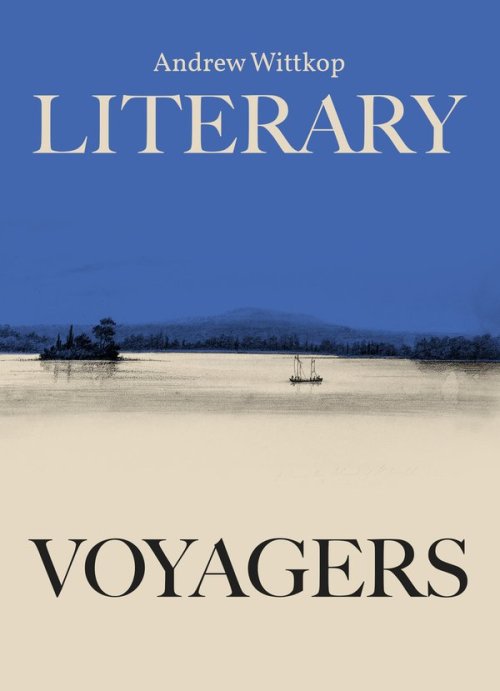
In Andrew Wittkop’s nonfiction debut, Literary Voyagers, an established British literary figure journeys into Michigan’s upper peninsula to write about the “plight of the Indian Woman.” She takes advantage of selfless hospitality as she is entranced by the beauty of Michilimackinac—and tortured by swarms of mosquitos. The book she ultimately publishes is praised by her English contemporaries but contested by her generous hosts.
It makes for a funny summary because it is, at least in its broadest strokes, a familiar one. How many stories have been told by writers from metropolitan hubs parachuting across the country or the world, trafficking in stereotypes and, in the end, seeing only what they want to see? Indeed, how much of the story of the Midwest has been told this way?
Of course there’s nothing funny about the harshness of life on the Great Lakes in the 1830s, or about the horrific mistreatment of Indigenous tribes. But in Literary Voyagers, Wittkop is clearly interested in the funny nature of time; how the constrictions of one’s era can define one’s intellectual contributions; and how we, readers from the far-away future, receive them.
In 1836, the British author Anna Brownell Jameson was summoned to Canada by her husband, an ascendant figure in provincial government. Their marriage was a passionless one—unconsummated, Wittkop implies—and Anna soon secured a separation agreement and resolved to travel alone, before her return to Britain, to explore Indian settlements in Canada and along Lake Huron.
On Mackinac Island, she met the Ojibwe-American poet and translator Jane Johnston Schoolcraft and her husband, the geologist and U.S. Indian Agent Henry Schoolcraft. Anna was immediately fond of Jane, who was pleased to receive such a distinguished guest. The women had long conversations in the Schoolcraft home, and on carriage rides around the island. Jane opened up to Anna about her life and the challenges she faced such as her status in Henry’s “Christian house,” her chronic illnesses, and the prejudice she confronted because of her “mixed blood.”
When Anna lamented the lot of Jane and women like her, Jane tried to communicate to her new friend that Indian women are held in high regard, often considered equals with men in war and leadership. She pointed out other examples of women taking men’s roles and owning property. Europeans had difficulty, Wittkop helpfully explains, understanding the division of labor in American Indian tribes—with men hunting and women farming—often equating the latter task with slavery. Ultimately, Wittkop writes, Anna seemed to side with “observers who deemed Indian women little more than drudges and slaves.”
Again and again, Anna’s preconceptions of “the noble savage” were challenged. And while she was not incapable of sympathy—to her credit, she was genuinely disgusted by the American government’s treatment of local tribes—as Wittkop writes, “Anna, for all her expressed interest…seemed to harbor views that scarcely differed from those of the countless white men who came before her.”
Anna was clearly fond of Michilimackinac, writing that “she wished she could filch the island from the Americans and carry it home in her dressing box.” (Indeed, on her journey home, her guides stopped her from filching a skull from an ancient Huron sepulcher.) Unsurprisingly, to the modern reader: While Winter Studies and Summer Rambles in Canada was published to significant acclaim in England in 1838, there’s little in it to distinguish from what Wittkop calls the “orthodox narrative of savagery and civilization.”
Jane and Anna’s relationship quickly crumbled, and Wittkop skillfully traces the ripple effects of their brief but memorable meetings. While Jane died at forty-two and her stories were published under her husband’s name, Anna went on to pen an acclaimed six-volume series called Sacred and Legendary Art. Writing more freely on social issues later in life, she eventually became a pioneer in the women’s rights movement in England. Here Wittkop entertains the question of how much Jameson’s social and financial situation influenced what she could write:
“[Anna] remained accountable to her morals, her husband, her family, her society, forces that allowed certain conventionality to wash over her. With no wealth to fall back on, radicalism was never an option: Had she railed against the patriarchy, had she indulged in torrid affairs, she and her family would have died ostracized and penniless.”
It’s compelling context for the story of Anna and Jane. How else, readers wonder, could Anna have heard all Jane had to say about the Ojibwe storytelling tradition? For that matter, how could Anna have reproduced some of Jane’s own stories in her own writing, and still claim that “the Indians had nothing to say because they had nothing to talk about”?
The magic of narrative nonfiction comes in translation: from stuffy primary documents into modernized, novelistic prose. Wittkop is thorough and fastidious, often sticking closely to the text; as a result, Literary Voyagers, though well-crafted and well-sourced, can sometimes lack some of that stylistic magic. Still, the book is beautifully produced, complete with full-color visuals that enhance the text. Ultimately, Wittkop has discovered a worthy slice of history and done it great justice.
The world of Anna and Jane is both foreign and familiar, fraught in ways both recognizable and quaint. “The past is never dead,” goes the old Faulkner gem: “It’s not even past.” The ripple effects of history are of great interest to this book and its author—and to us readers, too.

NONFICTION
by Andrew Wittkop
Belt Press
Published October 13, 2026


