


I’ve been a fan of Daniel Peña’s work since he won a Pushcart Prize in 2016, and was later published in our literary magazine, Arcturus. I interviewed him when his debut novel, Bang, came out in 2018. We finally met in person in 2022 at AWP in Seattle where we grabbed lunch together, and I learned that he’s not only a smart and talented writer, but also an exuberant person full of energy and kindness. So his searing new essay collection, How to Look Away: On American Cruelty and the Refusal to Disappear, ranked at the top of my personal list of most anticipated books of 2026.
“What does the white gaze need with brown trauma? And where does the penchant for inflicting it and consuming it come from?” Those are the central questions of Peña’s How to Look Away. As incredibly important as the content of the book is, it’s equally beautifully crafted, with stylistic prose that is striking on both the sentence level and each essay’s individual arc. The point of view Peña uses shifts throughout the book, so while these essays use personal narrative, they also braid in reportage and cultural criticism offering readers an expansive and resonant connection. It’s a book, if you’ll pardon my cheekiness, that makes it hard to turn away.
We’re living in an era when information about the injustices around us are in real-time and in the palm of our hands: atrocious headlines and videos of people being tortured and killed by people in power—children being kidnapped by ICE as their families seek medical attention or as they are returning home from school—there is ample evidence circulating of violent and inhumane actions by our government. People consume these articles, stories, and images—and then what? Agree that such actions are cruel, maybe sign a petition, and then back to posting selfies of themselves sipping pumpkin spice lattes… In other words, looking away. Peña’s book forces us to look sharply at the dynamic of white people inflicting cruel harm to Brown and Black bodies. It also questions our complacency because we can’t change systems until we examine them; recognizing and reckoning is the first critical step. How to Look Away isn’t always an easy read; it chronicles longstanding injustice and trauma, but it is essential reading.

Rachel León
As someone who first read your fiction, I want to start by talking about genre. Because I’ve followed your work for about a decade now, I remember when you started publishing essays. I’m curious if your gravitation to writing more nonfiction was a response to the increasingly troubling state of this country? Not saying it’s necessarily gotten worse, but it’s more apparent now with the rise in injustices being documented on social media and such… Has that impacted what you’re drawn to write about?
Daniel Peña
I love this question! Has it really been a decade? Wow—that puts everything in perspective. You’re totally right. My nonfiction was in large part a reaction to the unraveling of the world: the stripping back of American civil rights; the disappearance of neighbors via detention or deportation; COVID[-19] and the fallout of that stuff. I’ve just had so much to say about this era. James Baldwin was (is) a major influence on me. I’ve always loved that he could do novels and essays in very different registers while also interfacing with the big questions of his time.
I’ve read and taught a lot of fiction in the last decade (and even wrote a novel I’m revising). Some of that craft stuff I use a lot in my nonfiction—I’m thinking specifically of narrative stakes and momentum. Why is something important to me? What makes it timely? I think about those questions a lot as I’m drafting nonfiction. There is just an urgency right now for me to write nonfiction. Some of these essays in How To Look Away were fully formed as they came out (I’d been thinking about them for years). Others resisted a bit, but the adventure for me was in untangling them which changed the way I thought about the world. I think that’s what I love most about nonfiction. The truth has a tendency to surprise you with everything underneath it. If you can step away from the task of being what I call “the big narrator” in the essay, the truth will have a way of messing up everything you thought you knew about the world.
Rachel León
I want to talk about the writing itself because How to Look Away is stunningly literary. I’ve read powerful nonfiction books that deal with important social justice issues that don’t necessarily stand out on a craft level, but your book really does. The shifting point of view, the structure of some of the essays, the work on a sentence level… It makes me think of a comment I heard about literature being a vehicle to fight oppression, and how craft is the tool to make it work. So while I thought I’d keep this interview focused on the content, I also need to ask about craft because of how gorgeously written this book is. Do you see it like that? Like words alone aren’t always enough, that to fight oppression we need to watch how we’re crafting them for maximum impact?
Daniel Peña
Oh wow—I really love that quote! I worked really hard to get these essays tight on a line-level. It’s a true pleasure when [someone] appreciates that work. I was conscious in the final draft that some of these essays were like time capsules of sorts. Like, artifacts of the era in which they were written. And the writing from all of my heroes like Baldwin, [Ta-Nehisi] Coates, and [Gloria] Anzaldúa (among others) really drilled into me that there’s real beauty within the raw truth. And it’s important not to obfuscate the truth. It is scary to lay it bare, but it’s necessary. It is at once a question of craft (how does one do this in an artful way) but just as often I wonder if it’s a question of courage: do I believe in this thing so much that I’m willing to lay it bare? That I’m willing not to obscure it with less than perfect language? I found myself in the final draft going back and asking myself a lot, Is this exactly what you meant? If it wasn’t, I fixed it. Once I fixed it, I was always trying to go back and make it simpler in a way where the writer disappeared and the truth was the thing on the page that took up space. I think generally I’m less courageous as a person in the world than I am as a writer on the page. The beautiful thing about writing is we get multiple opportunities, through many drafts, to show up and be courageous. On a craft level, I was conscious that I just had to be courageous for one day.
Rachel León
Another thing I admired about the book is how it blends personal narrative, journalism, and cultural criticism. It feels like you must have done some sizable research for this book, and the research deals with pretty heavy topics, like hate crimes, lynching, internment camps, and the terrorism inflicted by ICE. But I also noted that it seemed like you considered the reader—cared for them, even—as you include some lighter moments, such as the essay entitled “The Joys of Biking at Night.” Am I correct in assuming that’s something you thought about when putting this book together? And also, I wonder if you can speak to the role of care and looking for moments of levity in regards to fighting oppression?
Daniel Peña
Frank McCourt is one of my favorite writers of all time. I think reading his work early—and the work of a lot of Irish writers—made a huge impact on me as a burgeoning writer. McCourt always wrote with this idea in mind that right next to the heaviness of life there is always something humorous right in the backdrop and that bit of humor was our humanity peeking through. As an aside, Dickens knew this too (he called narrative tendency “streaky bacon”). But the bathos of humor right next to heaviness always felt incredibly alive and dynamic for me on the page. You can see this at work in Angela’s Ashes. The film captured some of that. But McCourt’s book, heavy as it was, is really, really funny. And there’s so much that’s simpatico between Irish letters and Mexican letters (and MexAm Letters) generally—strong Catholic streak in our respective histories; we were a colonized people; etc. Anyway, that narrative tendency has always resonated with me and it felt like the right aperture through which I might unpack, say, some of the moments of levity within Diego’s story in the book as he was faring in life and fatherhood post-deportation. His story in particular could have been written in a single, heavy register. But that’s also not fair to him (or to the reader) to render a complex human being in that way. Especially a human as complicated as Diego who in real life is actually a very funny person. He was conscious, for example, of the way white journalists saw him and Mexico writ large. He was able to use that essentialized gaze to his advantage with his t-shirt company (F*ck La Migra) and this Satanic tour he created [in order] to give journalists from major outlets the Mexico of their imaginations (which is to say a false Mexico; the Mexico they had in their mind before they got there).
You’re totally correct in tuning into the fact that I thought about levity a lot as I was drafting the book. Overall, the arc of the book is from the heaviness of disappearance to the frivolity of being, which is essentially being embodied. I think that’s one of the core arguments of the book. Part of refusal to disappear is the refusal to flatten ourselves into a single story of trauma.
Rachel León
This book asks a lot of questions, ones that don’t have easy answers. Or, at least not comfortable ones. It makes me think of how a lot of essays talk about how the word ‘essay’ means ‘to try,’ that an essay isn’t necessarily about finding the answers, but trying to look for them. And yet, I’m wondering if writing these essays did help you find answers, at least for yourself?
Daniel Peña
This is such a great question. I think writing this book did help me find some nuanced answers to questions I’d been considering for a long time now. A core argument of the book is that we’ve ensconced in the American fabric tiers of citizenship and belonging through violence. Historically, we’ve known this to be true if we study Reconstruction and the Jim Crow era in America. But exactly how this happens and the process through which we look away from the mundane cruelties of everyday life in America was really eye-opening for me. There is a chapter in the book, for example, called “The Disappeared Body” in which I confront a gunman who I didn’t know to be a gunman at the time, but who ended up conducting a mass shooting at a movie theater in Lafayette, Louisiana some days later. If you’ve ever been on the other end of a gun it’s remarkably similar to being cancelled for something inane online. You’re flattened from a three-dimensional person into an object. Like, a puck of a person without nuance or backstory or say in what happens to them. And in writing these essays it was the first time I linked those two things in my head. It gave me and my editor [the book’s] subtitle. I think to disappear someone and to ask that they disappear comes from the same place in the heart. And once I saw the world with that lens—and thinking about this in the valence of citizenship—I couldn’t help but think of all the ways I’ve been disappeared (or willed to disappear) in my life. And the way that was a major facet of the lives of the subjects I was writing about as well.
For me, that was how I landed the narrative arc of the book. I just refuse to disappear. And even if they do disappear me, I’m in the metadata of the land. Historically, this is true in a place like Texas.

Rachel León
Let’s talk about looking away from oppression. You talk about how we’re as quick to look away as we are to stare at it and consuming cruelty inoculates us from the shock of it. And how ultimately, the ability to look away is fundamentally a white supremacist impulse. And yet the book is called How to Look Away—something you more or less argue people have an easy time doing. Can you talk about the title and the idea of looking away from dehumanization and oppression?
Daniel Peña
The title is a double entendre: it’s at once a question (How to look away?) which speaks to the morbid fascination bit of the book but it’s also a meditation on the process through which we look away from the suffering of others. In this way, it’s like a manual of sorts—this is how we do it. And the essays are just facets of a question that has intrigued me for years from Susan Sontag. In her final book she asks: What do we need with the pain of others? I think she kept asking that question throughout her career. Especially on her books on photography. But in this American moment I was fixated on the morbid fascination bit of it—the compulsion of people to slow down and gaze at a car wreck, say.
Far-right elements of society seemed to be getting off on the casual cruelty meted out to those they considered “the enemy from within” to quote Trump. And that cruelty seemed at once strategic but also predicated a narrative of impotence which felt ironic to me. They were the ones meting out the cruelty in places like Minneapolis or Los Angeles or Chicago (against citizens and non-citizens alike). Trump often invokes this idea that the world was laughing at “Us.” So, in this book I was curious about that impotence narrative as a prerequisite for violence.
I write in How to Look Away that white impotence begets white innocence which is the prerequisite for white violence. We think of this level of cruelty in America as new but you can draw a line from the contemporary era back to the rhetoric of Manifest Destiny and the justification for the the genocide against native peoples and it’s pretty much the same rhetoric. Ironically, it’s the rhetoric of the Enlightenment which now seeks to destroy the major pillars of society that (in the far-right view) no longer serve white supremacism sociologically. Academia, the Press, etc. In their mind, it must all be dismantled.
Rachel León
What do you hope readers take away from this book? And maybe that’s different for different groups of readers—white readers, non-white ones, activists, those no longer civically engaged…?
Daniel Peña
How to Look Away seems heavy but I swear it’s actually an uplifting book! Believe it or not, having finished the book I have quite a bit of hope. I think of that line from Baldwin every time I’ve been asked about hope on the book tour thus far. Baldwin said, “I can’t afford despair…you can’t tell the children there’s no hope.” To this end, I’m reminded of an idea from the Jazz great, Wynton Marsalis, who said once that our human tolerance for fascism is not very high. It is outside of the fascist imagination to create anything beautiful. And humans, by nature, just want to create. It’s for this reason that you can go to any sundry number of places that fascism took grip throughout history—Berlin, Tokyo, Rome—and people have moved beyond it. People are still flirting in the streets. They’re still enjoying coffee with a friend. The children are playing in the parks. This is ultimately the distillation of How to Look Away. The last chapter, “Letter from Houston” tries to articulate this. Who better to save America from itself than the people who still believe in it?
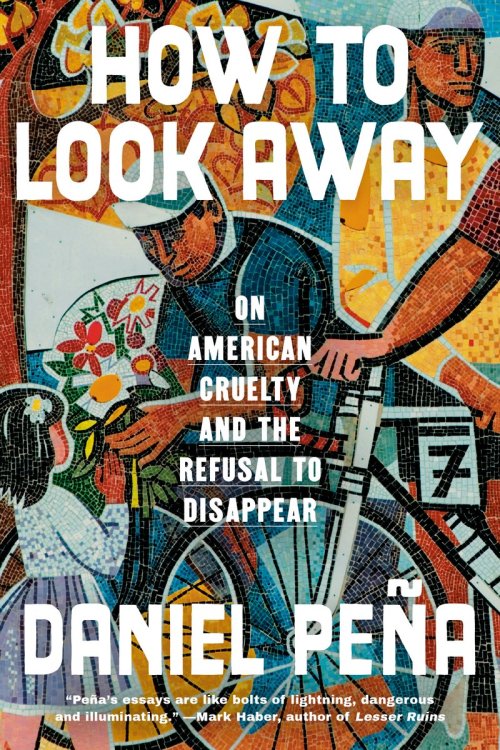
How to Look Away: On American Cruelty and the Refusal to Disappear
by Daniel Peña
One World
Published October 6, 2026


