


Critics in Conversation is a “podcast on the page” feature in which contributors discuss a book or issue currently making headlines in the literary world. Read our piece on Angel Down here, Yesteryear here, and Dungeon Crawler Carl here.

“You don’t finish The Disappearers. It finishes you,” wrote New York Times critic Dwight Garner in his review of Marlon James’s new novel. Believe it or not, he meant that as full-throated endorsement. Indeed, the headline for Garner’s piece, which itself drew headlines in the book world for just-on-the-right-side-of-over-the-top-effusiveness, is “This Masterpiece Is the Novel of the Decade, if Not the Century.” Usually it takes several years for any critic to declare a novel worthy of such pantheonic praise. So when you consider the piece is about a violent 650-page novel with no shortage of graphic sex scenes, well, this review was truly a unicorn.
And so is this novel. It’s a singular reading experience. You don’t read The Disappearers. You endure it. You emerge a changed person. Again, that doesn’t sound like praise, but it is.
The Disappearers is James’s first non-fantasy novel since 2014’s A Brief History of Seven Killings, another universally lauded novel. The Disappearers takes us back to James’s native Jamaica to tell the story of the gay experience in the late 1980s and 1990s. It’s a story about homophobia and violence and revenge, and it’s imbued with a roiling rage that makes reading The Disappearers a teeth-grinding, fist-clinching, heart-hurt inducing experience.
For this edition of Critics In Conversation, I again recruited Chicago Review of Books Editor-in-Chief Michael Welch, a massive Marlon James fan, to discuss. Here’s the conversation:
Greg Zimmerman: Let’s just start with something simple… that’s actually not at all simple: Did The Disappearers live up to the hype for you, both in terms of the expectations set by reviews like Dwight Garner’s, but also your own personal build-up?
Michael Welch: To be honest, I sometimes become a bit hesitant to actually start reading a book that I’m so eagerly anticipating. This was definitely the case for The Disappearers, not only because of the massive hype around it, but also because A Brief History of Seven Killings is one of my favorite books ever. That book carried me through a very difficult time in my life, and I have so many great memories of reading the hardcover in packed Blue Line trains on the way to and from my first job out of college (I also have a tattoo of the cover.) But I’m happy to say that his latest absolutely lived up to the hype, and James’s utterly distinct and powerhouse writing style took me immediately back. While A Brief History of Seven Killings will always be my personal favorite, it’s not hard to argue that The Disappearers may be his magnum opus.
So let me ask a baiting question: Do you agree with Dwight Garner that this is “the novel of the decade, if not the century?”
Greg Zimmerman: This… feels like a trap. 😂
For real, though, I think I speak for most of the book-loving community when I say that it’s way too soon to know. Any novel should breathe for a minute in the real world before anyone declares it the best book of the year, much less of the century. Is The Disappearers very, very, very good? Of course it is.
My own reading experience with it was… complicated. The more books you read, the harder it is for a novel to surprise you in terms of what a writer can do with form and story. This was a novel that surprised me. And I should’ve been ready, because like you, I absolutely love A Brief History of Seven Killings.
But I don’t know that I loved this book. Did it blow me away with how it accomplished what it set out to do and as a completely original text? Most definitely. Did it make me feel a spectrum of emotions (including extreme discomfort) I’m not sure any book I’ve read recently has made me feel? Yes, yes it did. Did I enjoy reading it? I’m not sure. I feel like I survived it.
What was your actual reading experience like? I remember getting more than a few texts from you while you were reading, including one at like 11:30 pm when you finished that said you thought it actually might be the book of the century. Still think that?
Michael Welch: Full disclosure (and since we’re friends you know this already): I’m prone to dramatics! I’d say reading any Marlon James book is a unique and rewarding experience, because a James book requires you as a reader to fully invest and give over all of yourself. You can’t half pay attention. His books can feel daunting at first, because his writing style is so conversational, digressive, and steeped in the Jamaican dialectic and cultural reference points of the time that there are times where you may feel unsure if you’re falling off the tracks as you read. But for me, there’s always a soaring moment when it clicks into place, and it begins to feel as if you’re reading poetry. There’s this incredible lyricism to his writing, even when he’s making jokes or describing one of the most brutal and upsetting things you’ve ever read (and there’s certainly moments like that in The Disappearers). I think that style and that demand he places on the reader fits well with this book though; it’s as if he’s telling the reader You will sit in these characters’ experiences in all their beauty and violence, across all the years and the silence that remains.
I’m very interested in the complications you felt and what might have held you back a bit. And maybe beyond that, what do you think it means for a book this unsparing and—to put it frankly—punishing has become this massive commercial and critical sensation?
Greg Zimmerman: He is, indeed, a demanding writer – both in terms of what he asks of his readers from a style and structure standpoint and also his subject (violence against gay men, homophobia, AIDS, suicide). I think we both saw the quip he made in an interview about the violence in his novels, and how he counts himself lucky not to be a character in a Marlon James novel.
The themes of rage and shame—in this novel, two sides of the same coin—are so prevalent, and manifest in such violent and haunting ways. But I think at the end of the day, this is a novel about revenge. The character Jordan Brown (if there is a protagonist in this polyphonic novel, it’s him) is one of the victims of the attack that sets the novel’s action in motion. Later, he mentions his inspiration for revenge is a subplot in Toni Morrison’s Song of Solomon—how a group of Black men would take justice into their own hands, as they saw it, as revenge for violence perpetrated on their community. James also alludes to the idea of revenge in this wonderful CHIRB interview with Stephen Patrick Bell, “The thing about revenge, they’re right about it being a dish best served cold. My characters, even after they’ve gotten revenge, still have to deal with the emptiness of the life that made them seek revenge in the first place. That revenge restores nothing. It repairs nothing.” To me, that is so profound. And brilliant. But it’s also impossibly sad.
Why has this been so successful given every reason it shouldn’t be? I think the simple answer is that a Marlon James novel is an event. He is a magnetic personality and readers, critics, and tastemakers love him. But as the resident Marlon James expert, what do you think is the reason for the book’s success, despite the fact that this novel is far off the beaten bestseller path?

Michael Welch: Well, for starters, I think it proves book marketing still works, especially at a time when everyone seems to be ringing alarm bells that reading is flagging in America and books don’t carry the relevance they used to (which I disagree with in general, but that’s another story entirely). It’s a great example that with enough resources, supporters, and—of course—great writing, a book can still catapult into the stratosphere of our attention. What’s sad, however, is that fewer and fewer books are able to get that treatment these days.
I think what often makes a novel a “literary event” is an element of grandness, both in topic and scope as well as length and time span. And The Disappearers certainly hits that mark. It tackles the long history of violence, shame, and silence specifically in Jamaica, but it also speaks to the gay experience overall. It spans decades and continents. And perhaps most importantly, the novel feels like it’s capturing something inherently true and deeply ingrained in its themes.
But as you said, it’s quite a difficult book to reach these heights. It kind of reminds me of when Hanya Yanagihara’s This Little Life became a social media sensation and then a lot of readers started being like “this is great and also the most upsetting thing I’ve ever read.” And you know what, I’m here for that! Let’s not be afraid to read things that stir difficult feelings.
Greg Zimmerman: Haha yes, that’s like the booklovers meme: “Readers be like: This book emotionally destroyed me and ruined my life. Can’t recommend more highly, 5 stars!” But I’m glad you brought up A Little Life, because it’s a very good comp for The Disappearers. Not only was A Little Life a social media and critical sensation, the reading experience was also very similar in how upsetting the book is.
While reading and since I finished The Disappearers, I’ve been racking my brain for other comps. A few thoughts: Sophie’s Choice, by William Styron, which I think may be the saddest book ever written. Blood Meridian, by Cormac McCarthy, which is one of the more gratuitously violent books ever written. And lastly, The Trees, by Percival Everett, which is also traumatic, but very, very funny.
What books would you compare this to? And what are your parting thoughts on this novel, ie. what impression do you want to leave readers who are trying to decide whether or not to read The Disappearers?
Michael Welch: I’m not sure actually how apt these comparisons are, but I’ll give it a try. The sensational critical response to The Disappearers reminds me a bit of Colson Whitehead’s The Underground Railroad, which also is a deeply compelling read that has some of the most heartwrenching, unsparingly painful moments in fiction. While reading, I thought about Richard Wright’s Native Son, which similarly is a testament to the inequities that exist in our society and can be similarly punishing in the ways the story spirals. And then this might sound absurd, but Jordan’s narrative in The Disappearers kind of reminded me of reading Dostoevsky’s Notes From the Underground in the way you are trapped within the narrator’s head and his language—especially toward the end of Jordan’s story as you see the toll his desire for revenge has taken on him.
I recognize undecided readers may look at these comps and roll their eyes, but I think they are actually helpful in beginning to scratch the surface of the book’s legacy. The Disappearers in many ways is a landmark book that is trying to take a giant swipe at the history of a nation and a community of voices that have been silenced. It’s a crime thriller, a coming-of-age story, and a dialectic novel about desire, sex, regret, and hate of all forms. And if there’s one thing I really love about Marlon James and his writing, it’s that he is one of the boldest voices in fiction. Sometimes he’s writing a novel about the attempted assassination of Bob Marley that’s in part told by ghosts and where the crime in question doesn’t occur until maybe three-fourths of the way through, or a high fantasy series inspired by African mythology in which each book is a parallel retelling of the same story, or this deeply earnest and heartwrenching saga of a group of men who are forever bound to one another even as they are scattered to the winds. Few writers would dare attempt the stories and flourishes Marlon James attempts. And I’m convinced only he can pull them off.
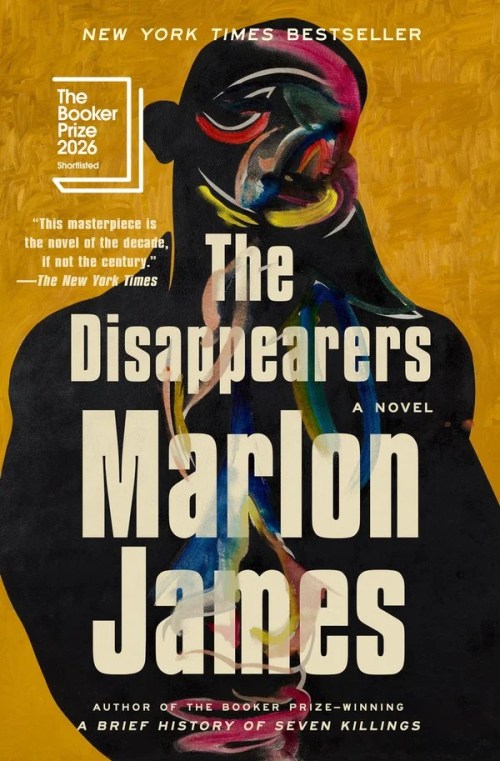
FICTION
The Disappearers
By Marlon James
Riverhead Books
Published September 1, 2026


