


Critics in Conversation is a “podcast on the page” feature in which contributors discuss a book or issue currently making headlines in the literary world. Read our piece on Angel Down here and Yesteryear here.

Here at the Chicago Review of Books, we take great pride in the intellectual rigor, insightfulness, and erudition we put into our literary criticism.
But we also like to have a good time.
And if there’s one, universal, prevailing opinion regarding the runaway hit Dungeon Crawler Carl, it’s this: “It’s just really fun.”
The eponymous first book in the series was first published in 2020, but the books really took off like a Goblin Copper Chopper when Ace Books began republishing the series with flashy new cover art in August 2024. The latest novel in the so-far eight-book series came out this past May, and rumor has it, at least two more are planned.
For the uninitiated, here’s a one sentence summary: When the world is destroyed by an advanced alien race, a dude named Carl and his ex-girlfriend’s cat Princess Donut are thrust into a Running Man-like “reality show” in which they’re forced to beat increasingly difficult bosses and monsters in an underground dungeon to advance to the next level, all while doing so with style and charisma to appeal to the show’s trillions of fans.
At local indie bookstore, RoscoeBooks, we also are always up for a good time, so my colleague Adi Alsaid, who had just finished the first book on audio, agreed to write this feature with me about the Dungeon Crawler Carl bandwagon. In addition to being a skilled bookseller, Adi is a novelist whose books include YA hits such as Let’s Get Lost, Before Takeoff, and Brief Chronicle of Another Stupid Heartbreak.
In the conversation below, Adi and I discuss our experience reading/listening to a book both of us would probably admit is outside our comfort zone, why these books have become runaway hits, whether you (yes, YOU, CHIRB reader) should give them a try as well, and what Carl’s success means for the very future of books.
Greg Zimmerman: Adi, this was my first foray into the genre known as LitRPG. I even had to look up what LitRPG actually meant (Literary Role-Playing Game, for anyone who was in the same boat as me) before starting this book. But this was fun, wasn’t it? My biggest difficulty with the book was just saying “Dungeon Crawler Carl” without sounding like I had a mouthful of marbles. Why is it so tough to say?! Anyway, so you said you read the first and have started the second. What was your reading experience like?
Adi Alsaid: Totally agree with the mouthful of marbles comment. When I first heard the title spoken out loud without having seen it written, my brain could not piece the sounds together into words. Strong Rural Juror vibes.
My sister was pushing for me to listen to the audiobook, though I wasn’t convinced until one of the book clubs I’m in and rarely attend chose it for September. The audiobook seems to have accrued plenty of word-of-mouth buzz on its own, but shortly into the novel it’s easy to see what draws people in. The narrative voice is fun, the action kicks off right away, and the world is imaginatively constructed (and Dinniman skillfully never ceases his construction, Winchester-mansion-style). Plus, despite the main character being a white cismale former Coast Guard capital-D Dude, his sensitivities align closely with those of many a modern fantasy reader (I assume). Carl comes off as a fun, conscientious guy who’s well-read and though he’s cantankerous, he’s not a full-on asshole, so it’s easy to spend time with him and root for his survival.
Greg Zimmerman: So true. Some of my favorite moments of comedy are when Carl’s exasperated with Princess Donut (catchphrase “God damnit, Donut”), which endears us to both of them. But truly my favorite parts of this first book were the stupid jokes the dungeon makes when it’s explaining a new monster, or experience, or reward box, etc. The humor is perfect for someone who watched a lot of Beavis and Butthead while drinking cans of Icehouse in their freshman year dorm room…and whose sense of humor hasn’t evolved much since. I’m not saying that’s me, but it’s definitely not NOT me.
But that’s also one of the reasons I’m so interested in why these books have taken off. They’re apologetically geeky, and don’t, on the surface, seem to have wide appeal. But they do! They have!
So Adi, why do you think Dungeon Crawler Carl has become such a phenomenon?
Adi Alsaid: My guess has something to do with my former roommate Joshua. Joshua is a wonderful, sweet human who spent what I considered to be an inordinate amount of time watching YouTube clips of other people playing video games. Which led me to discover that millions of people do exactly that. My niece and nephew did this for a time as well, and though I silently judged these great people in my life for indulging in that confounding behavior rather than playing the video games themselves, I’m also someone who follows one sport or another 95% of the year, so who am I to complain? I know all too well that it’s satisfying to watch someone who is extremely good at what they do.
Fictional though he may be, Carl is very good at the high-stakes video game he’s involved in. Granted, if we think too long about the fact that there are eight books and counting, the stakes are softened quite a bit, implying his and Donut’s survival. But I don’t think we’re meant to think too long about anything in the Dungeon Crawler Carl world. Or feel too much either. He’s vanquishing baddies in inventive and funny ways, surrounded by an ever-revolving cast of characters, and we’re meant to be on the couch along for the ride, taking in his commentary.
The YouTubers Joshua watched playing video games also, allegedly, have fun personalities that make following along interesting (I never saw evidence of charm above a level 1), and we as viewers don’t have to know details about their personal lives or care about whether they are growing as people to enjoy ride.
At least with Dungeon Crawler Carl, there are some emotional threads and moments dotted here or there to make us feel like we’re reading about people, not just video game characters, so I think it veers away from “guilty pleasure” territory (please no guilty pleasure discourse in my inbox) and lands, for most people, squarely in the pleasure area.
So, Greg, do you think you’re along for the entire eight (ten, twenty)-book ride? Or do you see yourself hopping off sooner?
Greg Zimmerman: Great points! Yes, our bookstore colleague Olivia, who is a huge fan and has read through book eight already, made a good argument when I was talking about this with them the other day: One of the reasons the books are popular is because we like to see someone beat such a carefully constructed challenge, like there’s something universal about cheering for Carl and Donut’s innovation in engineering solutions to overcome whatever is thrown at them. (Easy examples from this book: The way they beat the pig boss, and the strategy they deployed to destroy the elemental.)
And not to be a Donnie Downer about the state of the world these days, but also I think people just need a good diversion. And this is exactly that: A book and series that can hold the horrors at bay for a few hours.

But to answer your question, yes I do plan to continue. I’ll be honest, for about the first 200 pages, I wasn’t sure. The world-building seemed a little repetitive at first. But it was in the back half of the book that we get some real threads of plot that seem as if they’ll carry through to the next book and beyond. So I’m all in! They’re a perfect plane or train read, I think, and so I’ll mix them into my regular “boring” lit-fic rotation when I have a chance.
I want to get back to something you mentioned at the start—how the audiobooks have become their own runaway hit. I just read that Jeff Hays, who narrates the audiobooks, is voicing Princess Donut in the upcoming TV series based on the books. What specifically do you think makes these audiobooks special?
Adi Alsaid: That’s fun! I’m just now learning it’ll be a TV series, though I’m not surprised by that. Congrats to Jeff! His performance really brings the book to life. There are a few steps taken in the production to up the experience as well (voice effects during the achievements and rewards Carl receives). He does accents and voices and they’re all perfectly in line with the book’s geekiness and humor. There’s also something about the action being performed for you by a professional actor that elevates the action and works particularly well for the story, especially when contrasted with the terrible accents that our inner reading voices can actually conjure up in the act of reading. Unless I’m naively speaking for myself here! Greg, do you do different voices in your head when you’re reading quietly?
Greg Zimmerman: I do! And this one was especially fun. Carl was basically my own voice, but Princess Donut was oddly the same voice I use for my dog Winnie (don’t @ me about voices for dogs, everyone does it!) which is sort of high-strung but breathy. Like Taylor Swift on speed.
Okay, last topic: I’m always interested in positioning a novel in a larger context of the literary moment. We’ve already seen several more LitRPG books and series coming out from publishers, but as a bookseller, I haven’t noticed—and maybe your experience is different—quite as many readers coming into the store to ask for the “next Dungeon Crawler Carl.” There could be a number of reasons for that, but Adi, do you think Dungeon Crawler Carl represents the start of a trend or is it a more singular success?
Adi Alsaid: Oh, I’m certain there’ll at least be a trend of DCC imitations. For the next five years agents and publishers are going to get pitched “It’s Dungeon Crawler Carl meets X”, and a lot of them are going to jump at the opportunity to get involved. The problem is (let me whip out and comfortably arrange my soapbox), publishers are so often focused on the idea that a success can be replicated. That we as booksellers face an onslaught of readers with that exact demand: “I want the next Dungeon Crawler Carl!” In my experience, readers don’t actually think that way. They might want a book that made them feel like DCC did, but that doesn’t mean it’s going to be a LitRPG book, or have any perfect parallels to this series. Like you said, DCC is taking off in part because of the wider societal context, and how we all just need to have some fun rooting for someone who’s not a fascist. Maybe in a year we’ll be clamoring for books with more emotional depth because we’re drowning in “fun” AI slop. Maybe we’ll be tilling some trillionaire’s fields eighteen hours a day and will only want to read stand alone novels that max out at 200 pages. Maybe! I don’t actually know. No one does, is the point.
Yes, there are obvious trends that readers clamor for, and it’s not the worst business decision in the world to give your consumers what they most recently wanted. I’m sure millions have been made correctly predicting that people want 10 (or 20 or 30) books of the same concept, but I also bet millions have been lost chasing a formula for success that doesn’t actually exist. And as any parent of a toddler who demanded eggs for breakfast and then looks with disgust at the eggs you served him will tell you: people themselves don’t actually know what they want.
I also know that I’m not telling people who work in publishing (publicists, marketers, sales reps) anything new. But Publishing itself, that Level 93 beast, refuses to be sated by the shrugging emoji that comes with predicting what readers want. Publishing has to throw money at something, and I suppose replicating the last known success is a reasonable enough approach. (I personally hate it, but I’ll tuck away the soap box for now).
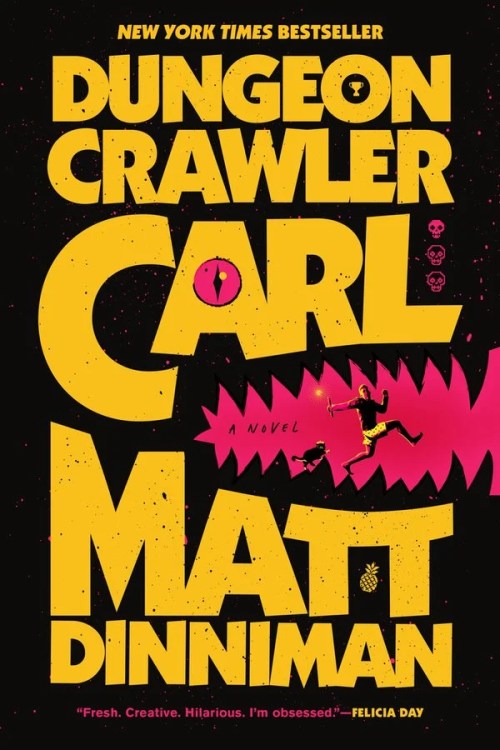
FICTION
Dungeon Crawler Carl
By Matt Dinniman
Ace
Paperback published December 30, 2025


