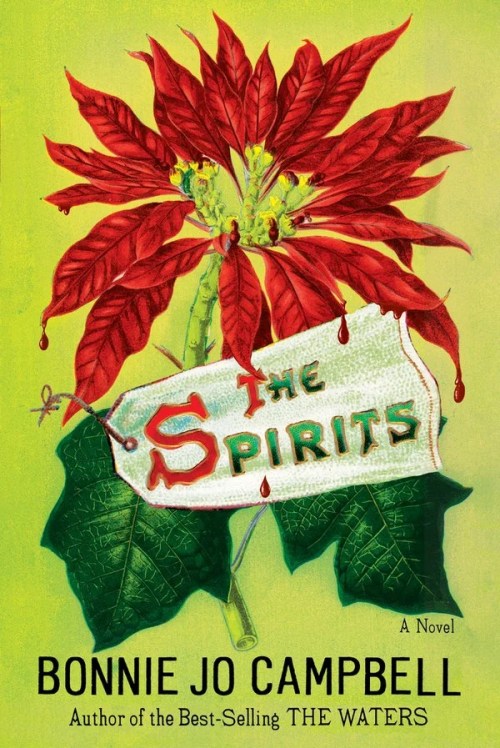
National Book Award finalist Bonnie Jo Campbell’s fourth novel, The Spirits, invites readers to one of the most tense, haunted, and impactful Christmas dinners imaginable. Surrounding a table filled with ham, pies, and green bean casserole, the Whitbys attempt to navigate the return of eldest sibling, Sister, and the emotional wounds left open from her actions the previous Christmas. As the evening passes, the family unearths the long history of violence and guilt that even the youngest siblings have carried for most of their lives. Lingering, sometimes at the periphery of the dinner and sometimes appearing smack in the middle, is the ghost of Daddy Whitby, whose violent death was only matched by how violently he lived. His haunting sometimes threatens to become a possession, not just of Sister, but of the entire family.
Over the course of a single night, the Whitbys face how broken the old ways of living with guilt and fear have made them. Daddy Whitby’s bullying has left scars on everyone, forcing even his youngest children to hide their involvement in his death. These realizations, though painful, offer for each a glimmer of redemption. The question is, are they able to turn that glimmer into a pathway forward?
RS Deeren
The Spirits is inspired in part by Charles Dickens’s A Christmas Carol—characters are haunted by past Christmases, the Whitby family tries to celebrate what they have in the face of loss, Daddy Whitby is referred to as Scrooge, and there is even a character with crutches. You’re familiar with literary reinterpretations; “The Trespasser,” the first story from American Salvage, is a methamphetamine reimagination of “Goldilocks and the Three Bears.” What work goes into these reimaginations? Do you find that having a source material helps jumpstart your own take?
Bonnie Jo Campbell
Thank you, RS, for taking time to read The Spirits and talk to me about it. Well, in the case of my short story “The Trespasser,” I had no intention of retelling the Goldilocks story, and in fact, it was a friend who pointed out to me that I had just done that. With The Spirits, I was telling a story I felt compelled to tell, and when I looked up, I had created a contemporary rural Michigan version of A Christmas Carol. On my own terms, of course, with my own kind of characters. Once I see what I have done, the revising can commence anew, taking the old stories into account. For example, in “The Trespasser,” the girl had been a brunette, but I made her a blond. When I realized what The Spirits was, I gave Mary crutches. Those appear to be superficial choices, but in revision those simple changes inspire deeper reflections, and I went on to recreate Mary with some of Tiny Tim’s earnestness and innocence. When I realized I’d made her too earnest and innocent, I had to tone it down and I gave some of those characteristics to another character in the story. After all, Mary has to be a fully rounded character in a way that Tiny Tim does not have to be for Dickens. Tensions like that required me to develop characters (including a ghost) who could both function as mirrors of Dickens’s characters and also contemporary characters full of their own desires, strong enough to cause the kind of dinner-table conflict such a story demands.
I enjoy thinking about this sort of thing, contrasting my own way of working with the soulful and thorough interpretation that Jane Smiley did of King Lear in A Thousand Acres and the structural marvel that is Barbara Kingsolver’s Demon Copperhead.
RS Deeren
You’ve said before that you can be a methodical writer—and diligent reviser—with a handful of years coming between your novels: Q Road (2002), Once Upon a River (2011), and The Waters (2024). When we first spoke about The Spirits, you said this novel shot out of you. What contributed to this quick follow-up from your most recent novel?
Bonnie Jo Campbell
Okay, I’m going to confess. As much as I enjoy the mystique of having created a new novel so quickly, I’d rather be honest with you. This novel is based on a not-so-short story I wrote a decade ago and never published. So, while my revision into a novel took only about a year and a half, the groundwork was laid earlier, and the story has been kicking around in my head all the while. It was originally hovering around a hundred pages, but I wasn’t happy with the way so much was unexplained and undeveloped. Also, in the shorter version, it felt too brutal. That said, my year and a half revision process of turning it into a novel did feel like a whirlwind, or even a fever dream. Every morning I returned to my desk full of an urgency to get it right, eager to puzzle out what the hell happened to this family. By contrast, my revision of The Waters took about seven years, and it swelled to 650 pages, and much of my time was spent cutting it down. The Spirits also had a cutting phase, but I only reduced it by about twenty-five pages. After such a long haul, over a decade, for The Waters, I did feel empowered by getting The Spirits presentable in a shorter time period.
I never regret spending lots of time on my stories. Having stories in my head for a long time allows them to marinate in a mix of other stories, including folktales and folksongs, dreams and fantasies. Allowing time and space puts me in a receptive position to hear from the old gods and goddesses and muses (sometimes in the form of illnesses and sorrows and joys), all of whom are the advisors for work that has any hope of standing the test of time.
RS Deeren
Every scene in this novel is electrified with tension and stakes. One flashback retells of a violent hunting accident; a smokey presence looms near the Whitby’s fireplace; eldest siblings Sister and Doug routinely spar in subtext. For a novel that primarily unfolds within the walls of a single home, how do you maintain tension?
Bonnie Jo Campbell
If I managed to succeed in that, then I am overjoyed. That was the main work of it, creating energy in a scene while people are just sitting around talking. It took a while to figure out what was at stake in the story, and it turns out that it is the family’s integrity that is at stake. You could even say this is a very sentimental story, in that it believes in the family as a moral organization, as a supportive structure for those in it. In real life I see how families fall apart—whether from personal disagreements or political differences or just plain disinterest—and I’m tempted to shrug and say, oh well, that’s how it goes; in the life of the novel, however, it is not fine. The family has the potential to be great in this novel, great in their support for one another and complete in the sense that each family member plays an important role and together they create a whole.
This sounds rather grand, and I don’t mean to say this is how families must behave all year long—that would be exhausting—but it seems triumphant if a family comes together as this one does to solve a problem, while allowing each member to absolutely be him or herself. I’ve long written about how communities contain the solutions to community problems, and now I’m making the case that families, as the most tightly knit communities, can also provide their own solutions.
RS Deeren
I’m always drawn to fiction that showcases a large cast of characters without scenes feeling crowded. Many times, scenes in fiction can get boiled down to just two or three characters. Though mostly confined to the dinner table, Sister, Ma, Trevor, Beth, Doug, Mary, and even the ghost of Daddy, all have desires—even if for Trevor, the goal sometimes might just be to eat dessert. When you come at these scenes, either initially or through revision, how do you balance the spotlight across half a dozen or more focal points?
Bonnie Jo Campbell
Great observation! Yes, this situation (one night, two rooms) created problems for me as a writer, with everybody on top of one another the whole time. To get anybody away from the table for a moment was a challenge—I was glad when I figured out how to send Mom away for a couple of hours so people could say things they wouldn’t say in front of her. In truth, though, the dinner-table setting of the book was my initial inspiration; in The Waters, I had a 45-page dinner scene, and initially it had been a 110-page dinner scene, but I told myself that such a long dinner scene just wasn’t permitted. Well, the minute I forbid myself anything, I begin to fight against the rule, and so this novel was a way of proving that I could keep a big family dinner intense enough, despite the limitations. Also, that I could get characters to change in real time, right there in the scene. I agree with you that the intimacy of two or three person scenes is easier to construct, but having the extra people there worked well for comic relief in The Spirits. Young Trevor’s role in some of the scenes is to crack jokes that occur to him when the adult conversations are annoying him (and possibly the reader); he brings things back to simple concerns, such as what he wants for Christmas. The role of Beth, the teenager, is to sometimes attempt to make things seem sweeter or nicer than they are. Doug’s desire is simply to survive the meal with his relationship intact. And everyone at the table wants Mary’s attention.
A family dinner with children present does limit what we can say, and so that was a good challenge for me. As it happens, this is my only novel that does not deal with sexually explicit material in any way. It is interesting that in an essay by M.R. James, the famous ghost-story writer, he wrote that sexually explicit or erotic content is not at home in a ghost story, and now you’ve got me wondering. Maybe that will be the next rule I break.
RS Deeren
To Sister, there is a clear social hierarchy to the family since Daddy’s death: she is the caretaker who works, fixes things around the house, and makes sure the bills get paid. But she’s been mostly absent for a year and is unsure of her place in the family anymore. The presence of Doug’s new girlfriend, Mary, adds to this as she genuinely—sometimes naïvely—asks about Whitby history. Late in the novel, Sister thinks that maybe they needed an outsider to help them understand the past. How does Mary play this part?
Bonnie Jo Campbell
Yes, Sister has somewhat mindlessly stepped into the role of the father, and it isn’t working very well for her. I mentioned the old gods earlier, and I do rely on those to make sense of my characters. I usually want to get all my characters in touch with at least one archetype, such as the Patriarch or the Caretaker. This helps me figure out how characters can interact with each other on a basic level and what it means for the story; I would rather chop off my hands than make this overt or visible on the page, but there is an archetype of the Guest which is a person from the world outside of the family who arrives to help transform a static situation. This Guest arrives and asks questions that the family has not been able to ask themselves. The family is on their best behavior because of her presence, and she allows each character to express a different side of themselves than is usually expressed within the family. This Guest, any guest from another kind of place, provides an outsider’s view to moral issues in the community and challenges the status quo.
Mary’s presence at the table is critical to the work the family does this evening, the work of forgiveness, redemption, finding comfort and joy in one another after a period of estrangement. Most of all, her presence helps the family see more objectively what has been clouded by their own memories and fears, even by their love.
RS Deeren
Storytelling, and the impact memory has on it, is at the core of this novel. Sister has her own take on the events from Christmas Eve nine years ago, so does Ma, Doug, even youngest siblings Trevor and Beth. The Whitbys have survived a terror in Daddy but their memories of him are, many times, how they connect with each other. They’re beginning to live life on their own terms, but Daddy is a heavy anchor. Where do you see the family break away from him?
Bonnie Jo Campbell

Thank you for this question! That is the goal of the novel, to figure out how to move on from living in the shadow of Daddy (the way the family does now) to creating something new that is more nourishing for everyone in it. The opposite of patriarchy is not a system where women are in charge—the opposite of patriarchy is something like community and democracy. However, the danger of abandoning the old system is that there may be nothing to take its place and this family might dissolve. Something new has to take its place, and I try to create events over the course of the evening that have the potential to show how there are other bonds—changed bonds—that could become just as strong as those that existed in the patriarchy but without the pain and suffering and inequality. We see a variety of relationships change and develop this evening, starting with the arrival of Mary and continuing through the various realizations people have about one another and their building of plans for the future. There is a big epiphany in the book—I’m allowed that in a Christmas story!—but more importantly, there are dozens of cracks and pinpricks [of] light and air that allow everyone to see and breathe more easily as they move forward together.
RS Deeren
As expected, complicated, driven, and troubled women carry this novel forward. Still, Daddy haunts them, even speaking to and through Sister. He’s very much got a hold on them despite being nine years dead. Will they ever be fully free of his impact?
Bonnie Jo Campbell
Well, no. After all, Sister has done things that will always haunt her, and she must carry that into the future. Furthermore, she still loves her father, respects his knowledge, and is continuing to learn from him, sometimes viewing his life as a cautionary tale. Clearly, he was a bully, but we don’t get rid of bullies in one fell swoop—we are all related to them and even depend upon them. (Bullies are people too!) And Daddy’s DNA is carried in his kids, who embody to different degrees his quick temper and his violent tendencies. But I am trying to create a larger community that can contain those relationships, soften them and provide a place for everyone to continue learning. There is a Jungian notion that we don’t solve the thorny problems in our lives, but we grow out of them or grow larger than those problems, and that is what I hope for with the Whitbys.
RS Deeren
Unfair question: What does the next Christmas look like for the Whitbys?
Bonnie Jo Campbell
Ha! Oh, you are good! I imagine that next year Doug and Mary get there by noon, early enough that Doug drives out to procure the family a Christmas tree. Then they create a lovely Christmas dinner, and everyone will take part in creating the meal. They cook Brussels sprouts instead of the green bean casserole, and maybe Mary can convince them to broil the sprouts instead of boiling them within an inch of their lives. The family argues as families do. The ghost is still there by the fireplace, but he is quieter.
RS Deeren
Any closing remarks on this excellent novel?
Bonnie Jo Campbell
Though I don’t set out to write political novels—heaven forbid I write a clunker that a political novel inevitably is! But because we writers live in our novels for years at a time, we do use them to respond to current events and life’s developments. The Waters contains my responses to the brutal actions of January 6 and the parody of masculinity we are seeing around us, and also it contains my responses to having breast cancer and watching my mother die of it. The Spirits is (in some part) a response to living in the Trump era and trying to see a way through. The danger of writing a novel responding to a political situation is that it could be irrelevant when things change, when we move on from a politics of bullying, but it seems fair to say we will always have to deal with bullies. Finding timeless concerns in contemporary situations is part of the work for all fiction writers, as we struggle to make our work both topical and timeless. I guess we’ll know in fifty or a hundred years whether I pulled it off this time.
FICTION
The Spirits
By Bonnie Jo Campbell
W. W. Norton & Company
Published October 13, 2026