


If you took Classics 101 in undergrad, or if you’ve visited a Western art museum recently, The Rape of the Sabine Women might ring a bell. But you might be a little fuzzy on the details. After all, many of the placards accompanying the paintings are quick to reassure us that “rape” is a mistranslation—these women were merely kidnapped (albeit with sexual intent) and maybe they didn’t even mind that much.
In her debut novel, The Stolen Women, novelist Alysandra Dutton aims to set the record straight—not just about the fate of the Sabine women, but about how this defanged version of the myth came to dominate the narrative. Her protagonist, Safinia, is a female brawler whose main concern is keeping her sisters alive and fed. But when the young, upper-class women and girls of her town, Sabinum, start vanishing quietly into the night, she is compelled to track them down. With the help of Livy—the real-life historian, who happens to be a time traveler in the novel—she starts to get answers. Unfortunately, they will lead her and her people directly to war with Rome.
The book is a brilliant critique of political myth-making and the way history gets told, wrapped in the fast-paced packaging of a mystery and thriller. I talked to Alys about digging into archaeological archives, balancing historical detail with plot, queerness and homophobia in antiquity, and how mythmaking is used to justify appalling acts of evil.
This interview has been edited for length and clarity.

Emily Mirengoff
At one point in the novel, your character Livy says, “I’m a historian. I get to write my own rules.” He’s talking about his ability to travel back in time, but of course, that’s also exactly how writing history works. How did you come up with the idea for this character, and why did you start the novel with him, instead of your protagonist, Safinia?
Alys Dutton
Livy was around from the earliest conception of this story. There’s a lot of rhetoric these days about how glorious Rome was—people go on and on about the greatness of the civilization and the technology, and if critics dare to mention the war crimes, or chattel slaves, they’ll claim that it was all worth it. I wanted someone who was shameless enough to make that argument to someone directly affected—my protagonist, Safinia. Livy basically says, “Everything you’re enduring, the suffering of your loved ones, will be worth it because it gives us the greatness of Rome.” Of course, she doesn’t agree.
Introducing Livy in the prologue was a late-game decision. In the scene, he’s talking to Augustus—the first Roman Emperor—and they come to an agreement on what the city’s foundational myth should be. A writer friend of mine read the scene, and said, “It’s funny, because the way your book is structured, this is both the beginning and the end. It kicks off all the events of your book, but chronologically, it happens after the book’s events.” I wanted to create a circular experience, so that when you reach the end of the book, you could flip back to the beginning and recontextualize it. That’s the real time travel that historians do: contextualizing and recontextualizing.
Emily Mirengoff
Let’s talk about history. This book is chock-full of historical details—things like what they use as toothpaste (ground oysters and bone grit!) Where did you get that kind of information?
Alys Dutton
As a reader, I love those kinds of details. They can help establish the author’s authority and prove that you’ve done your homework. Especially in a novel like this one—where I knew I was challenging a version of history that people feel strongly about—it’s important to show that you’ve delved deep into your subject matter. That particular detail I found in Roman archeology. There’s almost no archeological records about Ancient Sabinum—where my novel takes place—but I figured those kinds of way of life practices would logically cross-pollinate across cultures.
Emily Mirengoff
Where did you get access to Roman archeological records?
Alys Dutton
I did my Masters at the University of Arkansas, where I had access to an international fellowship program. I applied and ended up in the awards cohort of the British School at Rome, and it was an unbelievable experience. For three months, I had my own carrel in their world-class library. I was pulling material that I wouldn’t have even known to Google on my own. We had regular lectures from visiting scholars and archaeologists. Also, one of the program directors pointed me toward the Forma Italiae series—these huge tomes describing the excavations of these historic sites, and what was uncovered there. They were invaluable. I was holding Google Translate open on my phone, above these massive pages in Italian, translating in real time.
Emily Mirengoff
With all that detail on hand, how did you resist the temptation to overdo it? You’ve written a page-turner, but it sounds like it could have easily been bogged down in historical trivia.
Alys Dutton
It took a lot of editing! An earlier version of this book—the first one I sent my agent—was 145,000 words. This version is 110,000 words. I wrote the behemoth version while I was in Rome—I let myself shove every detail in. But I had a come-to-Jesus moment where I reminded myself what mattered most: the story I’m telling, and the point I’m making. That’s when a lot of things went by the wayside. I’d spent a whole day studying hut construction, when ultimately all I needed was that the hut was made of mud.
Emily Mirengoff
One area where your research really shines is religion. Safinia is devoted to a woods god named Feronia; other characters pray to different gods, and others are agnostic. How did you come up with a historically plausible belief system for each character?
Alys Dutton
I was a comparative religions major in undergrad—until my small, struggling college cut the major! Then I switched to creative writing. But Roman religion is really tricky, because around the third century BCE, Hellenism sweeps through Europe. Suddenly, all these Roman gods become attached to their Greek counterparts, like Diana to Artemis. But in fact, Roman religion is its own thing—the gods don’t neatly map onto their Grecian counterparts and until Hellenism, they weren’t personified in the same way. The idea that Roman gods would walk onto a battlefield and argue about the winners of a war—that wasn’t really how they thought about gods.
I found some great scholarship from over a century ago that led me to animism, which really helped me think about how Feronia worship could look. But I chose Feronia specifically because other Sabine goddesses, like Diana and Minerva, get muddled in the popular imagination with their Greek counterpoints. Feronia doesn’t have a Greek counterpoint, and I wanted to draw that distinction.
Emily Mirengoff
You have some absolute gems of insight. Of a gay male character who experiences a lot of homophobia, you write, “That was always it, wasn’t it? A man couldn’t be fucked because women got fucked—and while it wasn’t a crime to be born a woman, to choose to lower yourself to the status of one was unacceptable.” Like much of your book, this idea felt devastatingly timely. How do we escape this hideous cultural mindset?
Alys Dutton
I think it starts by pointing it out. If we don’t name a cultural norm, we can’t challenge it. I’m neurodivergent, so I was always a very “why, why, why?” kind of kid. I constructed Safinia to be the same way. I anticipate criticism about this, because some people really feel some type of way about seeing queer characters in ancient contexts—they think it predates the written record of queerness, which is only true depending on how you interpret the ancient texts.
It is true that there’s no historical record of anyone saying, “Men can’t sleep with men because that’s lowering themselves to women and we don’t like women.” But I was giving myself the opportunity to ask—through Safinia—why does this attitude exist? To me, it’s the only logical explanation for this very specific kind of homophobia that existed in these ancient Mediterranean cultures. Of course, I’m writing from a very feminist lens about characters who are subjugated because of their gender.
Emily Mirengoff

One thing that might surprise readers is how contemporary the characters sound. Your dialogue is very naturalistic. How did you make that editorial decision?
Alys Dutton
Some historical fiction authors use Homeric effect really well—for example, Madeline Miller uses a mythologizing distance that’s beautiful and satisfying to read. But my point is that this story is incredibly relevant to the present day, so I didn’t want to create that distance. This conversation—about how people want to legislate women’s bodies and reproductive systems—is happening right now, and I wanted Safinia to feel like someone the reader could talk to.
We also don’t actually know what Paleosabellic would have sounded like, so I hated the idea of writing dialogue in the Queen’s Latin, so to speak. It would be putting a layer of artifice onto the story, when I’m actually trying to show how devastating it can be to glorify history in unrealistic ways. In real life, no matter what culture or time people live in, they speak to each other casually. That said, I did try to give Livy’s dialogue some of that affected loftiness, because he’s the one constructing this grand historical narrative.
Emily Mirengoff
Speaking of a grand historical narrative, how did you decide to take on this major myth that’s been depicted in so many works of art?
Alys Dutton
The story itself angers me so much—I’ve spent the last ten or fifteen years being kind of obsessed with it. I still cannot believe that the major modern retelling of it is Seven Brides for Seven Brothers, which is a frothy romantic comedy from the fifties.
As you mentioned, it’s been depicted in countless works of art—including Luca Giordano’s The Abduction of the Sabine Women at the Art Institute of Chicago, which was a major inspiration.
Emily Mirengoff
The name of the myth is, essentially, a spoiler for your novel—but the book is brimming with suspense. How did you pull that off?
Alys Dutton
I really tried to embrace posthumous irony, which is a term I learned from Peter Ho Davies at the Bread Loaf Writers Conference. The idea is that even though you know what’s going to happen, you’re desperate to know how it happens, and who will survive. I actually think the “spoiler” works in my favor, because you already know that an extremely dire situation is coming. My job is simply to get you to love the characters. If you do, you’ll spend 400 pages wondering whether they’ll make it through.
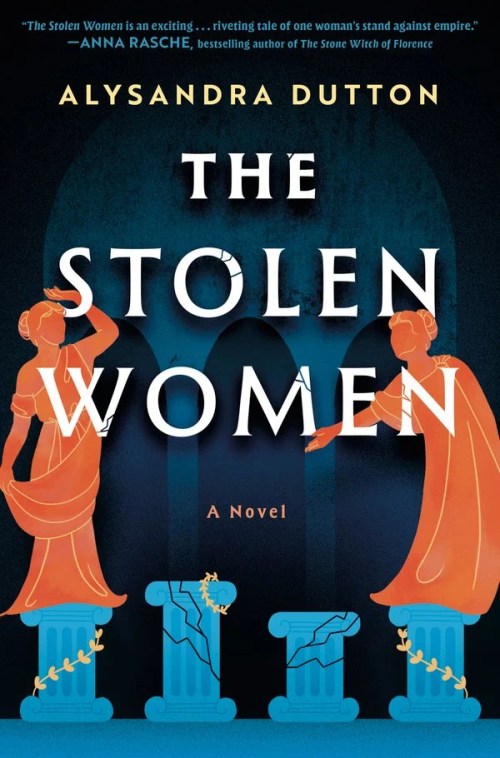
FICTION
The Stolen Women
By Alysandra Dutton
Park Row
Published October 27, 2026


