


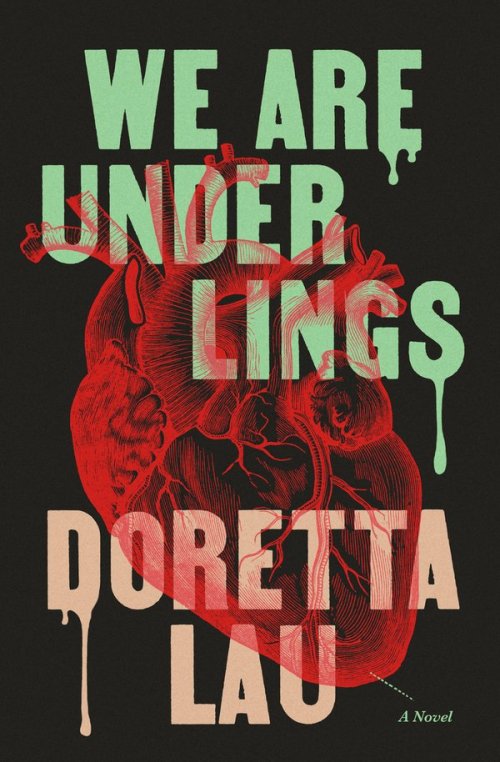
Doretta Lau’s We Are Underlings follows marketing associate Zita Chang as she navigates the tumultuous opening of Hong Kong’s first theme park devoted to death. When her boss dies just a week before opening day, Zita must unravel the mystery of his death while keeping it a secret from everyone around her. As more coworkers turn up dead, she finds herself confronting an increasingly difficult question: What’s worse, the possibility of dying or the sheer amount of work she still has to do?
It really is a one-of-a-kind novel. If I had to describe it, I’d say: picture the workplace banality of The Office transplanted to a Hong Kong theme park devoted to death. It’s set in the past but feels like the future, and also contains a legitimate dose of Weekend at Bernie’s in its DNA. The result is a truly unforgettable and remarkably assured debut.
I spoke with Lau over Zoom about balancing the mundane with the surreal, managing a large cast of characters, pop-culture, Hong Kong, and, of course, Weekend at Bernie’s.
This interview has been edited for clarity and length.

Michael Costaris
The novel opens with a character chart. It feels like a blend between a cast list and corporate document. When did you decide to begin the book that way?
Doretta Lau
It started as a practical tool for me while I was writing. There were so many characters moving through the book that I needed a way to keep track of who everyone was and, specifically, what their positions were. If I was going to build this world, I needed that hierarchy to be accurate. But later on, when early readers and editors started, I realized how many characters there were. One friend just kept writing in the margin: “this is a little psychotic.” There were too many names. It occurred to me that the chart could be useful for the reader too.
Michael Costaris
How did you manage that many characters, from a craft perspective?
Doretta Lau
I made the decision to filter them all through Zita. It’s as skewed as any first-person narrative is, but once I had her voice, it was easier to manage. And then it’s just a matter of going through during revisions and making sure that every character sounds like a unique person.
Michael Costaris
I wanted to talk about Hong Kong as a setting. What made it the right place for this story?
Doretta Lau
I actually worked in Hong Kong. The book is very much speculative fiction, and I always think that for speculative fiction to work those real-world details really have to jibe. I lived in Hong Kong for ten years, and it just seemed like I should write it there. For a lot of people, if they haven’t been to Hong Kong, it’s hard to tell what’s real and what isn’t. But I really tried to balance that so that, at the center of it, the work itself—before all of the fantastical elements come into play—is as real as possible. It could take place in other places. That’s the thing about offices and bureaucracies. They’re sort of universal.
Michael Costaris
You touched on an aspect of the book that fascinated me. It’s quite speculative but is grounded in our real world, too, through pop culture references. How did you view balancing those references, which set this in quite a specific time and place, with the fantastical elements that are not a part of our world?
Doretta Lau
It’s funny, within Canadian literature, there’s this idea of the natural landscape being so important. But I grew up in the suburbs. My flora and fauna are very much pop culture. That’s what’s in the landscape. This book was started in 2016 and I liked that time period, which ended up being 2018 in the final draft, and those elements I just found important to the world I was creating. Pop culture is what, for me, makes a world feel alive and real. I just really tried not to get too much into the science of things. There were moments when people were reading and asking, “would a body do this at this point of death?” And there, I had to pull back and think, “I should probably look this up.” But I tried hard not to get too deep into the mechanics of how the surrealist elements worked. First person helps that cause. My character is not a scientist. She’s not the person doing the work of reanimation.
Michael Costaris
You began the book in 2016, and some elements that might have seemed surreal then now feel almost commonplace, like her dead father’s voice being used as Siri. Did you ever have to go back and edit those elements to make sure they still hit as intended?
Doretta Lau
I didn’t. I really was keeping it within that 2018 knowledge and not trying to speak to another time. It was like, okay, if this were happening in 2018, how would they react? I wanted to stay within that and not let too much of what we know now take over, even if that changes the way the story is read. Otherwise, I think it becomes too much. It’s like reading historical fiction versus fiction written at the time—they feel like two different things. I wanted the book to feel contemporary, even though time has elapsed and we’re looking into the past. I wanted it to feel like the experience of being alive in 2018 and moving through the world, so that some of these moments that once felt everyday might bring us back to that feeling of, oh yeah, that’s how we felt then. We didn’t feel differently. That was just what life was like.
Michael Costaris
When you began the novel, a theme park devoted to death and true crime might have seemed almost ludicrous. Since then, true crime has exploded. Do you think you were tapping into something in the culture before it fully arrived?
Doretta Lau
I think it was a happy coincidence. I was trying to create this hierarchy of workers at the theme park, and I landed on the idea of this group called hauntologists. It would be their life’s work to create these exhibits. And once I had the word hauntologist, I thought, well, obviously this is going to be about dying, death, and the afterlife. Let’s see what we can do with that.
At the same time, I was consuming all of this stuff. I remember listening to the first season of Serial week by week as it dropped. I remember getting on Gchat with people after an episode, or going out for drinks and breaking it down. So I don’t know if I consciously saw where true crime was heading. I think I just consume so much media that certain things are in the air. Sometimes you catch something at the beginning, document it, and then watch it grow.
Michael Costaris
There is one specific cultural artifact I wanted to ask about, which is Weekend at Bernie’s. It feels like an influence and is even referenced in the novel.

Doretta Lau
The idea began for me at work. We were trying to bring in an outside developer to test something on our website, and to get this person a one-day security pass, we needed six signatures. Six. The CEO, the executive director, possibly the head of HR, his supervisor, and a couple of others. All so one person could get through the locked doors for a day. Each of these signatures were incredibly difficult to get, each involved their own web of bureaucracy.
Around that same time, someone had come into our office to meet everyone before starting a new job. Then on Monday we found out they had died. He hadn’t even started yet. He’d come out for drinks with us, and suddenly he was dead.
That stayed with me. I started thinking about this organizational chart and those six required signatures. What happens if one of the people you absolutely need dies at the worst possible moment? And what if the workplace is under so much pressure to open on time that, instead of reporting the death, they decide to keep pretending that person is still alive?
Then I thought, oh, that is kind of Weekend at Bernie’s.
Michael Costaris
And did you feel the need to tag Weekend at Bernie’s in the book so that the reader doesn’t tag it before you?
Doretta Lau
Definitely. It’s in the culture and let’s not pretend that I came up with anything new. I’m just going to have a character say it, and then we can all rest easy. It’s just like, yes, she knows. I know. It’s Weekend at Bernie’s. It’s fine.
FICTION
by Doretta Lau
Spiderline
Published on October 20, 2026


