


This month I had the pleasure of catching up with my long-time friend and colleague, Jihoon Park, to discuss his debut novel, Stickman. Jihoon and I went to grad school together, where we read each other’s work, crashed social functions, and even hit the gym between classes.
Stickman depicts the internal and external byproducts of alienation from self and others. Subtle wounds that—if left untended—lead to dangerous outcomes. Here we see two examples: an Uber driver who lashes inwards, and the deceased school shooter he briefly knew in grade school.
benjamin inks
Sup bro, great to connect with you so long after our MFA days. I spent three years in the military and made lifelong connections. We spent three years at George Mason and the experience was equally life-changing. Friendship aside, I’ve always admired your work—long before your recent success.
This first question is more of a comment: reading Stickman, I couldn’t help but think of other seminal works featuring maladjusted young men—Notes from Underground, Taxi Driver, Joker, and Martyr!
Jihoon Park
It’s great to connect again! Thanks for those comparisons to such great narratives. My editor at 7.13 Books, Leland Cheuk, actually brought up Taxi Driver as the chief comparison when we were writing our Publisher’s Marketplace blurb. I hadn’t thought to consider that film. It’s definitively a character study, and the vision I had for my novel at the time was more a hybrid fiction-nonfiction narrative exploring the psychology of shooters in a more conceptual way. It wasn’t until I revised the novel as a dual character study of Juni, the protagonist, and Jung Hwan, the school shooter, that it started coming together.
benjamin inks
I wanted to be Batman growing up, but I was greatly affected by Joker. I felt sorry for Joaquin Phoenix’s character. Less so for Travis Bickle. Your protagonist intrigued me because I couldn’t pinpoint the source of his malaise to any one thing. It felt generalized to our unique burden of existence in 2026. In a way I felt a lot closer to him than Joker or Bickle.
Jihoon Park
I think that’s a double-edged sword with Juni. On one hand, there’s an aimlessness to his malaise, and the novel doesn’t have that tight narrative drive as in Joker or Taxi Driver where there’s a more clear point of suffering. On the other hand, like you mention, it’s more reflective of the malaise of the average person in the contemporary world. Most people don’t have clear points of suffering, but instead a relational web of insecurities, anxieties, and repressions. Parsing through this requires a lot of emotional labor, and it’s tempting to instead project it onto some singular thing. Juni’s obsession with Jung Hwan might be seen as an emotional scapegoat of sorts from this perspective.
benjamin inks
Your book seemingly claims that “People read books about serial killers and genocide, but there’s something different about mass shooters.” Why do you think that is?
Jihoon Park
This is the main question that drives Juni’s initial curiosity about Jung Hwan towards obsession and intense anxiety. Dictators, genocide, these sometimes feel distant and abstract for many people living in America and other First-World nations because they’re often reduced to matters of politics in the media. Serial killers are often turned into “edu-tainment,” and dramatizations paint them as enigmatic killers to capitalize on people’s morbid curiosity. Mass shooters don’t fit into either category. Maybe they resist categorization altogether, which is also discomforting. They’re committed by our neighbors and classmates and can’t be distanced by politics or ideology. When I was researching shooters’ manifestos and writings, I found that even with shootings that were deemed politically or ideologically driven, those grand motives are often just cloaks for underlying emotional and mental challenges. Anguish, hatred, contempt, these are all universal emotions, and the more one thinks about this side of mass shooters, the more one might feel a disorienting, uncomfortable kind of empathy. Juni is very much plagued with this kind of empathy, and for him it funnels into self-loathing.
benjamin inks
Like any book destined for literary canon, Stickman tackles the daunting question of identity and selfhood. Drawing from themes in your book, to what extent does the way a person views themself shape who they ultimately become?
Jihoon Park
Juni is shaped by not only how he views himself, but also how he thinks he should view himself as an Asian American man. He’s isolated, depressed, and faces anxieties and insecurities about his relationships and career, or lack thereof. He’s educated and aware of contemporary identity politics, but doesn’t have the enthusiasm to engage with it genuinely or productively. He’s only aware of himself enough to exist in a hyper-neurotic state, but not enough to fix any of his behavioral and cognitive patterns. Throughout the novel, when he does or says something that makes him feel like an ethnic stereotype, or is haunted by violent sexual tendencies, he has trouble untangling his own view of himself from the narratives he’s been exposed to. I think this is where a lot of young men in today’s society stand. Somewhere in the middle, where they’re aware of problematic thoughts, but unaware of the actual nature of it. For example, Juni notices problematic views of masculinity and internalized racism in his peers and has empathy towards how they ended up with those views in the first place, and he mistakenly comes to certain conclusions about himself that might not be true. Similarly, he internalizes his obsession with Jung Hwan and grand violence into something more distorted and grotesque as the novel progresses.
benjamin inks
There’s a lot of toxic narratives floating around the interweb these days, which raises the larger social question about freedom of speech vs. censorship. On a more psychological level, I’m not able to withstand or mindfully compartmentalize certain rhetorics or current events and find avoidance the best strategy. I call it a dopamine detox but really I don’t want to be exposed to news or reels that might upset me.
Jihoon Park
I also try to limit my exposure to certain content. But Juni is someone who is chronically online and internalizes a lot of the anxieties of the content he consumes, including toxic narratives. When I was first writing him, I spent hours searching for depraved, echo-chambery content and comments online to get into that psychology. Thinking of it solely as research helped with keeping that content at bay, although I admit it can be hard not to take things in emotionally sometimes, especially since they’re designed to exploit prevalent anxieties of today’s world.
benjamin inks
We should probably talk about the masculine urge to sacrifice yourself in service to a larger cause or ideal . . .
Jihoon Park
Definitely. For many shooters, within the frame of their own warped visions, maybe this is what they were aiming towards. It’s such a primal, fundamental reaction to the existential struggle for a meaningful life. Traditionally, this urge has been tied to the mythos of the classical hero, the ultimate ideal of a great man. Of course, as with everything in the contemporary world, this narrative has been deconstructed and reconstructed, and I don’t think it even has to be a masculine or even heroic urge. When Juni reflects on this urge in the novel, imagining dying while saving a woman or a child from a shooter, I think he’s doing so in an unsavory mix of the life and death drives. He wants to be a good man, but he genuinely doesn’t see the possibility of that happening and can’t even create a fantasy of it, so he envisions a good deed that can still exist within the frame of his self-disgust.
benjamin inks

Ha! It’s hard work to be a “good man.” It’s a lot easier to earn that label in one final heroic moment. But this raises the question about how we are remembered, which I believe is of some importance to mass shooters.
Jihoon Park
Important to mass shooters, and maybe for average people as well. I’ve definitely had fantasies about dying heroically in some redeemable way so that people who I’ve had arguments with or girls that have rejected me would see me differently, haha. It’s such a trivial, silly thing, but those fantasies are tempting sometimes. For a shooter, who may have faced ostracization and harassment, abuse and trauma, undiagnosed mental disorders, who may already consider their lives to be over in a way, how they’re remembered becomes much more pressing. Maybe it becomes the only thing that matters.
benjamin inks
“Her grief immediately overwhelms me.” It’s such a simple line in your book but struck a chord with me. Every artist/sensitive person knows what this feels like. Your narrator aside, is there a correlation between empathy and internal struggles?
Jihoon Park
I think so. That line is from a scene when Juni meets Jung Hwan’s older sister, who, along with her parents, retreated from society after the shooting. I think a part of good fiction is finding empathy in places where people usually may not, or even should not. Jung Hwan is heavily based on Cho Seung Hui, the perpetrator of the 2007 Virginia Tech shooting, and parts of the drafting process were deeply uncomfortable for me because it relied on exploring that strange contradiction of contempt and curiosity. Cho killed innocent people with no remorse and caused tremendous suffering and grief. Simultaneously, he suffered from selective mutism and other behavioral disorders and was the victim of intense bullying all throughout his life. He was also an immigrant who came to the US from Korea at the same age as me, and parts of his upbringing feel similar to mine. I won’t lie that all this instills, to some degree, feelings of empathy, and at times I felt (and still feel) a revulsion towards myself because of it, because morally, I feel I shouldn’t at all. This uncomfortable inner exploration is directly reflected in Juni.
benjamin inks
I’m starting to see the nonfiction version now, though I’m glad you went with the novel. Well, I wasn’t artsy growing up. It was only after a catastrophic injury in the military that I started reading and writing. The story I tell is that my amygdala grew in response to active threats and a near-death experience and with that came a greater emotional range and self-awareness. Although I don’t believe he ever labels it as such, would the shooting be a type of trauma for Juni (even if nowhere near it when it occurred)? What would he be doing if the shooting never occurred?
Jihoon Park
I see it as a possible form of indirect trauma. I remember when the Virginia Tech shooting happened, it was one of the first times I was racially profiled as a Korean American. I’d always grown up in areas with large Asian populations, so I never really had that experience of having to assimilate with people who didn’t look like me. I was in middle school when the shooting happened, and some kids were going around asking what kind of Asian we all were, and put the Korean students on a “watchlist.” I remember my parents and parents of friends having hushed conversations. I think there’s a cultural trauma when a mass shooting intersects with racial disparity. Another fantasy Juni has in the novel is picturing what Jung Hwan’s life might have been like if he never became a shooter, and removing this narrative of a Korean American shooter becomes a way for himself to save a certain part of himself too. But of course, there’s the possibility that even if Jung Hwan didn’t become a shooter, Juni would still have the same darkness within him, and perhaps the darkness would be a heavier burden without his connection to Jung Hwan.
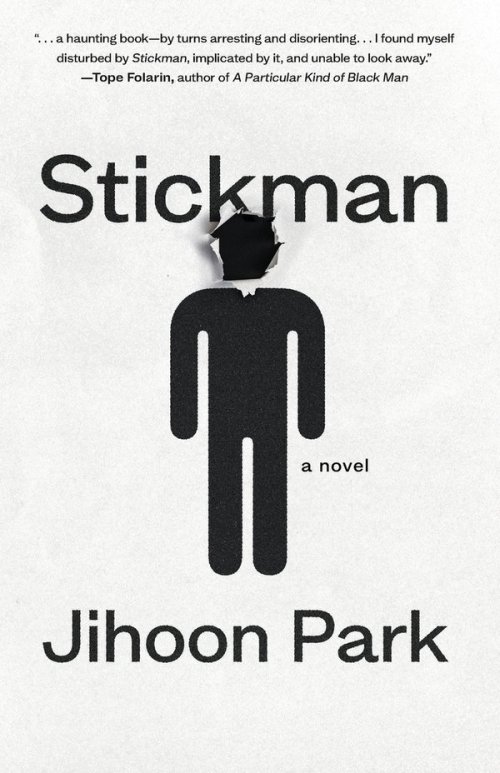
FICTION
Stickman
By Jihoon Park
7.13 Books
Published October 20, 2026


