


Set in the late eighteenth century, Music Against the Night starts Yiyun Li’s Nocturne Trilogy, the story of John Field, a precocious virtuoso and sensitive child who invented the nocturne, a style of composition later popularized by Chopin. Field was fated to marry Adelaide Percheron, called Percherette, an orphan of mixed descent born in French Pondicherry and a precocious virtuoso in her own right. The novel begins with a prelude or a coda: the deaths of John and Pecherette and an end-of-life review of their complicated union. This is Li’s first novel since the publication of Things in Nature Merely Grow, the Pulitzer Prize-winning memoir in which she manages, in austere and sparkling prose, to give language to the grief of losing her sons, Vincent and James, to suicide. Death is an unavoidable inevitability, but it is something Li and her characters seem to coexist with gracefully.
Aided by a cheeky narrator (one with an affinity for parenthetical statements that seamlessly weave the past and the future into the present action) Li takes the smallest moments in the lives of two prodigious children and infuses them with the epic gravity of life, death, and the striving that happens in between. Arranged musically, not unlike an intricately composed nocturne, the novel unfurls as the story spans the globe. Sharp sentences leap out and strike new chords, etudes signaling shifts in the characters’ lives building to become recurring motifs. Percherette’s childhood lessons with her fearsomely shrewd grandmother echo as she makes her way from Pondicherry to Moscow. Young John Field’s obligation to the family that sacrificed to nurture his genius fuels his drive to be the next Mozart. Music Against the Night is a novel breathtaking in its tiny intimacies and the grandness of its emotional scope.
I caught up with Li over zoom near the end of summer and, since most of our correspondence is via text, we were both excited to finally give language a rest and talk with our hands again.
This interview has been edited for clarity and length.

Stephen Patrick Bell
Right off the bat, from a structural and general craft perspective, I felt the narrator’s voice was such a strong backbone for the novel. It is a familiar voice that creates these parenthetical moments right next to the main action, bringing us through time, the past and future, without bogging us down. Is this going to continue through the series?
Yiyun Li
Yeah, it’s this omniscient third-person narrator, which I suppose sounds like me.
Stephen Patrick Bell
I didn’t want to put that in your mouth, but it really does. There’s a sense that the narrator is a mischievous co-conspirator in the story, and we’re kind of stepping outside of the narrative to have little chats about things for context.
Yiyun Li
It’s funny you mention that because, early on, I remember showing my editor a draft and she said the most important character is the narrator. I thought, well, you’re right. The narrator is as important as the two main characters. The narrator’s voice will be present throughout the books, because that will be what sort of carries them. Contemporary writers don’t use that omniscient narrator as often as the older writer. I read a lot of older novels and the omniscient narrator seems very natural to me.
If you read Dickens, other than the first-person narrator Dickens, there is third-person narrator Dickens—I’m thinking Bleak House, for instance. That’s all Dickens talking! Tolstoy also has this very omniscient narrator—not as naughty as my voice is, right? I like that.
Stephen Patrick Bell
It hit me at the end, in the acknowledgements, when you mentioned Edmund White. He was terribly sweet, and I wish that he were around to read this. You mentioned that you were reading together and discovered the subject of this novel in Tolstoy.
Yiyun Li
We were reading Tolstoy’s autobiography. It’s a three-volume autobiography and very early on Tolstoy described listening to his mother as a child. His mother died before he turned two, and he described the memory of listening to his mother playing John Field on the piano. He said, “Field was my mother’s master.” When I read that, I thought, oh no, I’ve never heard of John Field. I did a little research, and I told Edmund I’m going to write a book about John Field. Even he said, “Oh, John Field, wasn’t he the Englishman?” And no, he was Irish. But he was known as The Englishman throughout his adult life in Moscow.
Stephen Patrick Bell
What kind of research went into discovering more about John Field?
Yiyun Li
I should take it back. I didn’t right away decide to write about John Field. I did read about him. There was a very thin biography of him and half the biography was music scores because it’s more like a study of John Fields’ music composition. But there was a sort of very thin biographical sketch. You know, I really liked when you messaged me online, “I’m so glad to have met Percherette.” When I read the biography, so few paragraphs were spent on Percherette, maybe less than a page or two, which made me interested. The biographer said, “how this young woman came from Pondicherry and came to live in Moscow, nobody knew.” You know, anytime ‘nobody knew,’ it’s a novelist job. I thought about how Percherette would make that journey all the way to Moscow and how John made it all the way from Dublin to Moscow. It was a fascinating story. That’s when I decided to take both of them up as the subjects of a novel.
Stephen Patrick Bell
Were there any stories that you came across that felt essential to the story that you’re telling in the novel?
Yiyun Li
The two funniest things I did take into my novel. The first thing from the John Field biography is that Percherette was a flirty woman. There was a contemporary comment that if you put a hat on a walking stick, she would start to flirt with it. What an odd thing to say about a young woman. The other thing is, John went back to London in 1832. He was a middle-aged man, and he said to all these English ladies, “I married my wife because she could not pay the fee for my lesson, and I took her up because I had to get something out of my lessons.” So those are the two interesting things in the biography. We sort of know their geographical movement, John from Dublin to Bath to London, all the way to Moscow. With Percherette, we have to assume she moved from Pondicherry to Moscow in the usual way: Pondicherry to France to Moscow. That’s the frame of their geographical movement and their growing up to become two virtuosos. He was more successful than she was, but even he became a sort of footnote for Chopin. Everything else I had to make up in a novel.
Stephen Patrick Bell
Chopin looms large in the story of John Field—he basically became famous for popularizing a structure Field invented—but we don’t see much of him on the page in this first book. Even though this is the story of John and Percherette’s marriage, we don’t see many scenes with them together in this book. With the structure of the trilogy in mind, how did you think of the shape of these three novels as parts of a whole?
Yiyun Li
The Tolstoy autobiography, for instance, it’s childhood youth and something, something. Then Gorky: childhood, youth, then adulthood. Three parts are sort of a conventional way to say, you have to write the childhood, you have to write the growing into adulthood, and then adulthood.
But you can’t just tell two children’s stories without who they are. The beauty of novel writing is we actually know who John Field is and where he ends up. We know who Percherette is. We know that, in a way, their marriage failed. All that knowledge is good for a reader to hold on to. We know they end up—especially John—they end up broken and hopeless. But, before hopelessness, there’s hope. We need to know the hopelessness, but we also need to know him in his hopeful years. I made it so that the story started with the end. Both of them died. But going back, before their deaths, there are stories. I spent a lot of time writing them growing up because I think it’s important for them to grow up and for us to grow up with them to know them as children, in part because both of them are musical prodigies. Percherette, more than John, is interesting. She’s not only a musical prodigy; she’s a prodigy in living. She really is a living prodigy. I think we need to spend the time in their prodigyhood with them.
Book two will be their marriage. They’re growing into their mature artistry, their artistic pursuit, and struggle in their marriage. In book three, John will return to London. As you know, he returned to do a tour of the continent, but that tour failed, because now, as you said, Chopin is in the picture. Now everything is about Chopin. To be an artist around this time—there were all these musicians, and now we only know Beethoven, right? Mozart, Beethoven, Chopin, Liszt, and there were all these contemporaries who had been hardworking, touring, producing, and manufacturing. Clementi, for instance, became a manufacturer. All these people that make music a business, a viable business, I find them all fascinating.
Stephen Patrick Bell
What kind of analogs do you see between writing books and music in John Field’s eighteenth-century scene, all these people collaborating and contributing, and the literary scene we’re navigating today?
Yiyun Li
That’s a very good point. I don’t particularly think of this as just a historical novel, not just pastiche and historical facts. I like to think about how music became a business. Before John Field, before Clementi, so twenty years before them, music belonged to the church. Music belonged to the aristocratic court. Ducal courts and empires had their musicians, but they were all slaves to either religion or to power. But around this time, suddenly music became a business, and the public became interested in music. There were public concerts. There were music manufacturers, and music publishers. It’s a new ecosystem for musicians, and they were part of the most exciting moment in music history. Music is becoming accessible to everybody. Look at Jane Austen’s characters. They live in the countryside. They could buy a pianoforte and play little songs. But if you think about those little girls in Jane Austen playing little songs on the pianoforte—there are people who write those songs, people who publish them, and people who make the pianoforte. That is very interesting to me, the whole system.
It’s the same system as we are today in publishing. The music industry has changed a little, but publishing still is a little like that. You always have artists. There’s always struggle. All artists struggle. All musicians struggle. Then you have businesspeople, the agents. I like thinking about that. I think you’re right. It’s not only just the past in music development. To me, it’s eternal.
Now Clementi said something so interesting in the book (I gave the words to him). We knew he came from a prodigyhood, but then he became a businessman. I remember he said something about how he realized he would never reach the top of the pyramid. There you have Mozart, you have Haydn, you have Beethoven. Clementi realized he’s not there, but he’s equally important. All the big rock stones that made the pyramid are equally important, and he figured that out. He’s not the top of the pyramid, but he is one who makes that pyramid possible.
Stephen Patrick Bell
Enamored as I am with Percherette and her own prodigyhood, John has an interesting arc because seems to have a lot more to learn. He strives for perfection in his composition that takes up a lot of his younger years. This novel also follows a very strong musical structure. Continuing with the parallels between music and novel writing, I was wondering what you think writing a perfect novel might look like.
Yiyun Li
Okay, I didn’t really strive for a perfect novel.
Stephen Patrick Bell
Oh, God, that would be stupid.
Yiyun Li
That’s right! I love Percherette. She brings life with her. She is a force wherever she goes, and she brings the whole world with her. Her life and John’s life are two contrapuntal themes or threads. When I was working on my first draft I thought, I so love Percherette. She is a little easier to write. She wanted a lot of things. Music was not the only thing she wanted. Unfortunately, for John—and I feel John represents more artists than Percherette does—he is set by other people. His fate was set by his elders. They said he is going to be the musician. He doesn’t have another way to live. He can’t read. He can’t do math. He can’t do anything but music. His talent clearly is both a blessing and a curse and he’s not only one. There are crops of prodigies coming up, George Pinto, for instance. I really like Pinto, he’s such a sweet character. Everybody hated that he was gay, and everybody talked so badly because he was gay, everybody said, “If only he were not gay, then he would become a great musician.” I just thought, these people don’t understand. He was gay. He was deep in his feelings. That was what made him the musician he was. John, George, and all these extraordinary children were facing a very difficult situation. They have to be themselves, but they cannot be themselves in art. That’s quite a striving, and it’s not an easy life, right? Mozart died very young. Chopin did not live long. I’m curious about there being something a little bit fatalistic with these music prodigies. They were set early upon this road. Percherette was so interesting as she didn’t have to do this. She really had no reason to do music, but she wanted to do it, and she tried all sorts of ways to become a musician. That, to me, was interesting.
Stephen Patrick Bell
You know I’ve always appreciated the way that you write children. You wrote “their scales are sensitive and as precise as a jeweler’s.” One of your tricks hinges on making minds feel separate but legible. How do you find yourself entering a child’s perspective?
Yiyun Li
When I was working on this, I remember having a conversation with a novelist. I said, I’m writing about the two musicians and, it’s funny, they are taking their time growing up. The other novelist was very dismissive of my approach. She said you don’t have to write about their childhood. Just give them a few pivotal moments and launch them as adults. [laughter] I found that so insulting to my character. Also, to all children, right? You can’t just say to children, “Your life doesn’t count. Just have a few pivotal moments of experience and launch into adulthood. That’s when real life starts.” I think children are living in their lives as seriously and as befuddledly or as troublesomely as we are. We cannot write off children as larvae of adults. I often think children are in a disadvantaged situation because they feel, they observe, they think, but they don’t have our language. They don’t yet have the adult language to articulate all the things they feel or all the things they think about. Writing about children really is to give them the words so they can articulate themselves. But not in a way that feels so artificial.
When you were a very small child, nothing made sense, right? All the things were imposed on you. Early in the novel, Percherette, because she was a child, did not understand that it was her who was not making sense. She thought the world wasn’t able to make itself make sense to her. As she saw it, by and by, the world learned the language and made itself understood to Percherette. That’s exactly how you write about children, because they are looking at the world in a way that is unlike the way grown-ups do. It’s always fun for me to get into the children’s minds. And of course, these two are extraordinary children, right?
I’m very fond of Grace Anne, John’s little sister. Now that’s a precocious little girl who knows everything, who’s sort of sassy. But then when they moved away from Dublin, she cried and said, “Why are people so afraid to die? Growing up is more terrible than dying.” I feel that’s sort of the quintessential line for a child to say, because no adult would be able to say that. They forgot how that feels. Children have the ability to say these things and to observe these things. We cannot look down upon them. We have to give them the space. I feel the novel gives children the space to feel and to live.
Stephen Patrick Bell
A lot of Things in Nature is in this novel, especially the idea of being present and how the past, present, and future don’t necessarily follow the structure that we often assign it in our culture. Some of the personal thoughts you express in your memoir return through the novel’s narrator and there’s a wisdom in that book that characters in the novel possess. How did writing that memoir shape this novel?
Yiyun Li

Clearly, things happen. I started the novel at the beginning of 2023. A year into writing the novel, James died. I actually went on to finish a draft before I started Writing Things In Nature Merely Grow. I finished. I went back to the novel to revise. Certain things I learned from writing the memoir came back to the novel. I would say the books are quite intertwined, but they’re different in that the novel is clearly novelistic. I think things through the characters rather than through my own life.
Stephen Patrick Bell
When do you feel most present? For John, it was those five hours where he was rehearsing.
Yiyun Li
Well, isn’t that just me? Five hours of writing is a little bit. You’re sitting there, you can do the work. It may not be good work, but it is something. It’s better than nothing. Anything is better than nothing. When you write a book, you live with these characters for years and years, and I will live with them for two other books. I do feel quite close to them. They have been with me the whole time and I recognize them. You did ask about the intertwining of the book with the memoir. I think Percherette is a sustaining factor for myself. Her aspiration really supported me during the most difficult moments of my life. I was writing about her and a lot of people died on her. After her companion died, she said she was going to aspire to live forever. Not to live forever, but her aspiration was to live, because her friend died. I think that kind of aspiration has been helpful for me too.
Stephen Patrick Bell
There is this sense that rather than an adversarial force, death is more a constant companion. The story begins with the ends of the main characters and almost all the births in the book are bookended with deaths.
Yiyun Li
If you look at the biography, John Field’s parents had other children who died. Sometimes people lost a baby, and they reused the name. John, Robert, Grace—they’re all reused. Parents die. Everybody dies. It’s inevitable. People die. This really comes back to Percherette’s aspiration. She really does live a long life and acknowledges that everybody died, but she did say her music is an argument with finality. Finality—that’s death. Until she dies, she’s going to keep up this argument with that dark thing, the music against the night.
I was talking to my piano teacher about this: these days when we think of nocturnes, we think about Chopin’s nocturne. They’re very beautiful and sort of calm. But night is not that beautiful image, because night is disturbing. If you listen to John’s nocturne, it is pretty, but also there’s some disturbing moments. It’s going back to the music against night. It is still against all those deaths.
Stephen Patrick Bell
Going back the ways you share with other writers, I did notice you thank Bridgid Hughes for a placeholder, and I was just curious what that placeholder might have been.
Yiyun Li
Oh, that is a very good question. She’s a close friend, and she has been with me throughout difficult moments of my life. Sometimes I feel like she’s just a placeholder of my thoughts. I would say something to her, a half-baked thought, or not a very brilliant thought, not even sensible thought. She holds those things. Maybe later, I would say, I’m going to explore that thought so to make sense of it. The other thing is, because she has edited me quite a bit, sometimes she would say ‘this line is not good. It’s a placeholder line,’ which means the thoughts are there, but your language is not good enough to express the thoughts. But writing is a placeholder. You asked about perfection. You can’t strive for perfection. You just have to have better placeholders than yesterday. You just replace one placeholder with a better placeholder.
Stephen Patrick Bell
When one of John’s teachers told him that the music that you compose and play will never be as good as the music you hear in your head, that really resonated with me as a writer.
Yiyun Li
We all feel that way. But you still have to reach for that, right? You want to reach for that height.
Stephen Patrick Bell
It often feels like the point of it is in the reaching. Which, I guess, is very Percherette.
Yiyun Li
I love that you love Percherette, because I also love Percherette. She has our spirit, you know.
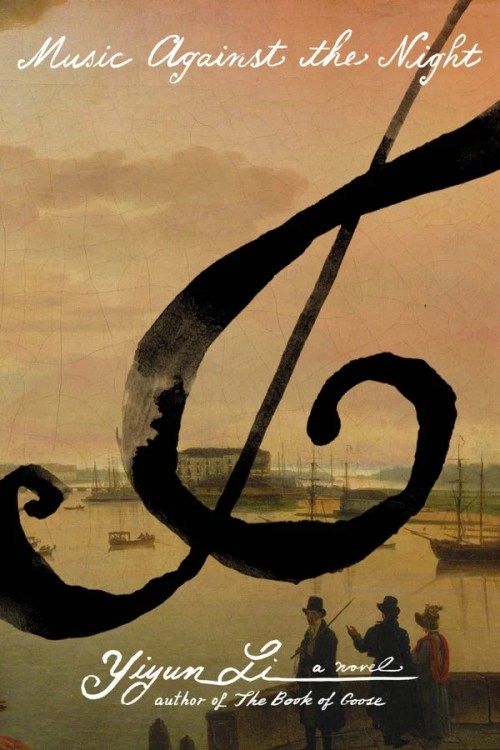
FICTION
by Yiyun Li
Farrar, Straus and Giroux
Published on October 13, 2026


