


Sara Lippmann is an author I’m guaranteed to read; not just her books, but anything she publishes online: stories, essays, social media posts. If Sara Lippmann writes it, I want to read it. Her work is punchy, and witty. But above all, it never shies from the truth—she’s unflinchingly honest.
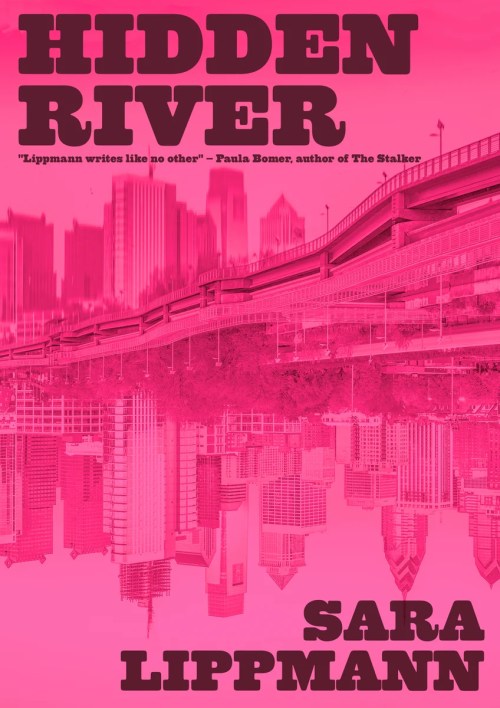
Lippmann’s latest novel, Hidden River, is no exception. It tells the story of Cass, a thirty-five-year-old woman who receives an invitation to an estranged childhood friend’s wedding, which prompts her to remember her relationship with said friend’s father. Set in the summer of 2008 with flashbacks from the late 80s and early 90s, Hidden River is an unsentimental, atmospheric exploration of trauma, grooming, gender and power dynamics consent, and memory written in Lippmann’s singular voice.
I met Lippmann shortly after I had the opportunity to review her iconic story collection, Jerks (which was reissued in December by Tortoise Books, her novels’ publisher), and we have since become friends. It was a pleasure and honor to get to chat with her about Hidden River.

Rachel León
This novel feels like signature Sara Lippmann, but also like your writing has somehow leveled up. I loved Lech, which had multiple POVs, so in some ways Hidden River seems like it’d be a more straightforward, less complicated novel, yet it’s actually super complex, which isn’t a word I’d use to describe many first-person novels. Can you talk about the writing process with this novel? How was it different from your first?
Sara Lippmann
This novel began in a Kathy Fish flash fiction workshop. At the time, I was working (supposedly working) on Lech, floundering around that murky middle. That project took a lot of years and presented a lot of structural, emotional, and plot challenges. Not that I have any idea what I’m doing now, but I had even less of an idea then, and when the voices of doubt got really loud it was hard not to listen to them. What I discovered was, instead of sitting there banging my head against the wall, if I switched gears and worked on something else it could be reinvigorating. Because I always will feel like a story writer, first and foremost, I turn to that form whenever I feel stuck. (It took me so goddamn long to write Lech—with so much time farting around that murky middle—that I managed to sprout a whole story collection, Jerks, like an unwanted growth.) Sometime in all this, I took a workshop with Kathy. Kathy is one of the world’s greatest teachers and she is brilliant at providing smart, generative prompts and a supportive environment. The class was asynchronous, and every day we had to post our little bits.
Flash fiction is a deep love, and one I credit to having pulled me out of many dark places and nonwriting holes, and so I sat with these bits. A few turned into flash pieces. The characters stayed with me. I decided to lean more fully into the flash structure, almost to trick myself—because straight-up novel writing felt, and still feels, somewhat anathema to my restless brain. With the sections broken up in these small chunks it made the process of writing a sustained narrative feel a bit more manageable while reflecting the emotional state of my narrator. It also wound up a helluva lot shorter.
Rachel León
It is complex so I wouldn’t reduce it to a single descriptor, but one of the central forces of the novel is digging into #metoo. The timeline toggles between 2008 and the late 80s and early 90s. How’d you decide when to set Hidden River?
Sara Lippmann
I knew I wanted Cass to be in the spring of her senior year in high school when Senator Heinz’s plane crashed, which was April 4th, 1991, so in that way the timelines, both past and present, were set by that event. That was the emotional fulcrum for me. I knew I wanted the “adult” Cass to be around 35 when she receives Sally’s wedding invitation, which of course is still very young, but far enough into one’s adult years that her development and her outlook feel somewhat stuck. Because it’s such a deeply Gen X story, it was critical that Monica Lewinsky and Chandra Levy’s stories powered those echoes. Time was integral to showing the ways in which it was all so deeply in the water.
Rachel León
The setting is also really important to this novel. It’s set in Philadelphia, where you grew up . It opens talking about the Schuylkill River (whose name means “Hidden River”) and there are references to the 1991 mid-air collision over Merion Elementary School. The novel is so situated in both time and place. Is it fair to say setting served as an anchor for writing this novel? Did you make trips back to check out places again or did you rely on memory?
Sara Lippmann
Absolutely. Place has always been really important to me. Maybe it’s because of my very short-lived foray into journalism, or my brief life as a factchecker, but I feel like I need a grip on something before I begin. I easily can become overwhelmed by the infinity of choices one faces when writing fiction. If I know where I am, physically, in time and place. That provides the tether for me, from which the imagination then leaps. It also helps when a place comes loaded with subtext, and is metonymic like suburbia. Danger often lies under the cloak of safety. Maybe that’s some cheating, some cheap short hand, but if it adds to the resonance, great. To some extent, perhaps I always knew I would write a fraught hometown novel. For better and worse, this is the ground I come from, these are the surrounding waters. My parents still live in the same house where we moved when I was two. As for research, I did a fair amount on the plane crash. I researched Brigantine Castle. I researched Philadelphia circa 2008. London was a challenge. The internet came to the rescue with videos, clips. I looked at maps. I filled in what I felt I needed. But I also did not want to get bogged down by research to the point where I felt beholden to that level of detail or the writing got labored. My hope is that it feels plausible, rings true.
Rachel León
Speaking of memory, that’s also a driving force in the novel. Sally’s wedding is what forces Cass to reckon with the past and what happened with Sally’s father. I’m always fascinated by interesting explorations of memory on the page, but especially when that deals with trauma, which can affect how we remember things. Would you talk about how you approached representing memory and trauma on the page?
Sara Lippmann
When we first meet Cass, she is stuck, caught in her own narrative loop. Despite a level of self-awareness, she is fairly unprocessed, coping on a monotonous diet of running, isolation, and dead-end work. The first part of the book reflects this structurally, in that memories keep circling, repeating, revisiting her. Every time she takes one step forward they are like a bungee cord pulling her back. The challenge in writing the first part like this is its obvious lack of momentum. How do you advance a story when your narrator is stuck in the past? While I tried to capture the emotional state accurately, I also wanted to be mindful of the reader who might become impatient with redundancy (we get it, we get it again) and this lack of movement. Thankfully, as her summer unfolds, Cass begins to break out of this cycle—and for the first time since she was 21, starts to move forward, thanks to human (and canine!) connection and a tenuous but present hope. The frequency of the memories start to recede. We still get flashbacks, but from part two on we start to press a bit more into the present, so in a sense, the movement reflects her growing understanding of her own past.
As an aside, in terms of memory, I found it eerily serendipitous that the Foundation for False Memory Syndrome was founded in Philadelphia in 1992, so the fact that her very memory might be questioned and challenged by the few therapists she encountered made a lot of sense, and would further explain why she never progressed with the help of mental health professionals. I didn’t want to give too much air to this—although the wider culture of complicity is critical—but ps, here’s another element, an underbelly that certainly predates “believe women” and further clouds the waters of her trauma. A word she would not use.

Rachel León
And while I’m using the word ‘trauma’—because what happens to Cass is traumatic—I also loved how she doesn’t see it that way. She believes she was in control, that her sexual relationship with Len was driven as much by her own desire as his—or tells herself this at least. But she’s a literal child when they meet, when these things are happening between them. You handle this all so gracefully and with nuance: grooming, consent, gender and power dynamics… I’m wondering if anything surprised you when you wrote this novel. Did writing it make you feel differently about any of these things? Or understand the issues on a deeper level?
Sara Lippmann
I chose to write about grooming in a time before the word grooming was part of our everyday vernacular. When these dynamics were performed and propagated over and over again through TV, movies, music videos, fashion ads and beauty standards, their ubiquity part of their normalization. I grew up on Brooke Shields’s films (Blue Lagoon, Pretty Baby) and then Little Darlings. I could go on, but the overt sexualization of young girls was everywhere. Of course, this is systemic. This is patriarchy. As a result, we were dialed in a certain way: to expect it, to want it. I wanted my story to reflect this. It was important to maintain both generational integrity and cultural complicity while not erasing desire or complex feelings around agency: the giving and withholding a constant in the groomer’s playbook, the fact that Cass doesn’t understand the damage of her abuse until much, much later. I remember my agent’s intern read the draft. I think it was during the Weinstein trial and she was fresh out of college and rightfully upset that there was no justice for Len—spoiler alert—he is never called to account. This was her critique: His fate is largely immune to consequences. And yet we don’t need the Epstein files to know men like Len were, are, everywhere. Our entire culture was built on it.
Rachel León
Let’s end by talking astrology. As someone obsessed with astrology, I loved how Cass’s mom is into it, so Cass sprinkles little astrological notes throughout the novel. I’ve seen you post Co-Star horoscopes and yet I’ve never asked you how into astrology you are. Is it an obsession or interest for you? Care to share your ‘big three’ [sun, moon, and rising]?
Sara Lippmann
LOL. Yes I think I’ve always been somewhat into astrology, ever since devouring the back pages of teen magazines where the horoscopes used to be for a guide to my future. I am a textbook Virgo, as is my mom, and so I’ve always felt painfully seen and read. By contrast, my sister is the least Scorpio of Scorpios so fine, I recognize it’s not an exact science. The summer I graduated college I worked as a reporter on Long Beach Island. One of my assignments was to cover an Astrology Fair in Forked River, NJ, where I met all these colorful people, and my chart was made, my cards were read. I loved writing that piece. I checked out Linda Goodman from the library in Surf City. First I read Sun Signs, then Love Signs. Classic 70s stuff. But she got so much right—right down to my chronically weak ankles! For what it’s worth, I’m Virgo sun, Pisces moon, and Aries rising but I feel so goddamn hopelessly Virgo most of the time. Over the years I’ve treated myself to astrology sessions periodically, on big birthdays. Come to think of it, now that I’ve settled into 50, I’m overdue for another one.
FICTION
Hidden River
By Sara Lippmann
Tortoise Books
Published May 5, 2026


