


The kinds of conversations I love having most are the ones that weave freely between Big Existential Questions and silly jokes, so it’s no surprise I love the same thing in fiction. Man Overboard!, Kathleen Rooney’s new novel, couldn’t get more existential—it’s the story of Kick Kilpatrick, a man who falls, or possibly jumps, off a cruise ship into the Gulf of Mexico, and is now stranded alone in the water, hoping to be rescued. Kick experiences all of the angst and reckoning you’d expect in his situation. What will people say about him if he dies? What could he have done (could still do?) differently to mend his relationships? He also fondly recalls the dessert pizza at his favorite childhood buffet, and that one time he made the perfect quip about marinara.
It’s a pacy and funny summer read—one of the New York Times’ most anticipated!—with an ocean-deep empathic soul. It understands that what makes humor effective is the fact we’re all stuck here on this planet in these bodies, forced to come to terms with an existence we didn’t ask for and will have to give up some day. But not today.
Since Rooney is a stalwart of the Chicago literary scene—writing and English professor at DePaul, co-founder of both the poetry collective Poems While You Wait and the publisher of hybrid works Rose Metal Press—it’s only fitting we met up at Kopi Coffee, a North Side institution. Sitting on the floor with our shoes off, over hot tea, we discussed survival in all its forms, what’s up with men these days, clowns, and just what it is that makes the sea so compelling.
Our conversation has been edited for clarity and length.

Aaron Wolfson
This book is a very meditative read, with the real-time action almost entirely taking place in the ocean. It was a great parallel for the way we go through our daily life, attending to thing after thing, and then some of us have periods where we’re like, Oh wait, we’re adrift here, and we’re eventually going to die. Something that’s unavoidable when you are treading water in the sea, like Kick is.
Kathleen Rooney
I have the joke that the whale shark makes about how men really will do anything to avoid therapy. But I did want to have a character who had become stuck, and to suddenly have to become unstuck so profoundly that he went from being completely clenched to absolutely adrift. So it wasn’t just like, I write any character adrift in the sea that way, but this particular guy, what is this experience going to hopefully unlock?
Aaron Wolfson
He describes depression as this gulf between himself and everything, and here he is stuck in the Gulf of Mexico. He also says inner experience is an unplumbable ocean, and he finds it easier sometimes to stay on the surface. I love this metaphor of the ocean as rock bottom in one’s life. How did you arrive at that? Did you have the character first?
Kathleen Rooney
I always knew I would love to write, someday, a survival story: ideally a nautical, ocean-going survival story. Because one of my favorite novels of all time is Moby-Dick. Also, much like Kick in the novel, I grew up reading Reader’s Digest, which had a section called “Drama in Real Life,” where people are in these outrageous, seemingly unwinnable survival situations.
So it was in the back of my mind, if I came up with the right character and situation. Who would be the most interesting person to be in this situation? Making Kick a high school and college swimmer was interesting, because I needed someone who could survive, so you’re not just immediately like, Well, he’s never gonna make it. But also who might not, even with all his powers. Kind of like in Lillian Boxfish, where an eighty-four-year-old woman taking a ten-mile walk through New York City is kind of heroic, but not inconceivable. Kick is someone who, if anyone could make it through, it’s probably this guy.
Then there’s also the irony of someone who went from being so ready to end it all, suddenly realizing, I actually do want to live. I did a ton of research, because it’s a comedy but I wanted to be sensitive around that. There’s this documentary that I hesitatingly recommend, because it’s super heavy, and I cried a lot watching it. It’s called The Bridge, and it came out in the early 2000s before they put up the safety barriers at the Golden Gate Bridge, when there was still this debate—horrifyingly—that, well, people are going to kill themselves off this structure, but we can’t put up barriers because they’re unattractive. There was this aesthetic resistance to putting up suicide barriers, and they have now, thank god, and the suicide rate has gone way down, and people still think the bridge is pretty.
But at the time they hadn’t, every year tons of people jumped, and the film follows some of the few people, including this one young man, who survived. In the interview he said that as soon as his feet left the railing, he realized that everything he thought was a problem was basically nothing in comparison to the problem he had just created by jumping off the bridge. So, I just… I sat with all of that for a long time to not just play it for laughs.
Aaron Wolfson
It’s interesting to be like, what if instead of only the distance between the bridge and the water, we had twenty-four hours to spend there? Kick has all that time to think about all his problems, and whether he can change.
Kathleen Rooney
And what the change needed to be besides just, Oh, I shouldn’t have done that. If I do make it out, what needs to change, because it’s not a simple matter of, Well, now I’m fine. There was a reason I did that. As one of the sea creatures says—he talks to a lot of sea creatures, I don’t think it’s a spoiler—but he has this opportunity to talk to them and they make him reflect, like, You’re not just going to get out of this and be fine, you’re going to have to change some things about your life if you want to permanently move on.
Aaron Wolfson
Did it have any effects on you to spend so much time inhabiting a character who was stuck in the sea?
Kathleen Rooney
Much like Kick, I’m very scared of the ocean. I hate it, but I love it. Sometimes people ask, Why do you hate it, and it’s like, because it can kill me. I don’t hate it exactly, but I’m not indifferent to it. I’m extremely terrified.
So that’s my impetus to why I would want a survival story to be in the ocean, as opposed to Antarctica, or a mountain top, or the many other situations…
Aaron Wolfson
It taps into your real fear, and you can put that real fear into the character.
Kathleen Rooney
Then I had to do a lot of research about, like, how long could someone survive? What does that mean, being in salt water, being so dehydrated, being hypothermic, hallucinating, and what are the odds of who would see you, where are the shipping lanes, what are the creatures?
Nothing about my initial assessment of how much it would suck to be in the ocean changed, but my granular understanding of why I’m right has improved.
Aaron Wolfson
I learned in this book that Meriwether Lewis probably died by suicide, which is something I’ve never heard anyone mention, and people talk about Meriwether Lewis quite a bit for someone who died 200 years ago.
Do you think part of the reason, also, that people didn’t want to put up signs on the Golden Gate Bridge is because there is this taboo about even acknowledging suicide? To what extent do you think it helps to acknowledge the fact of people wanting to die, and do you have hopes that people reading this book might… you know, there’s a line in Man Overboard! where Grandpa Tom says, “It’s not the weight of the load, it’s how you carry it,” and Kick at the end, it feels like his load is just a little bit lighter.
Kathleen Rooney
I wrote the book Cher Ami and Major Whittlesey, which is also about someone who kills himself by jumping in the sea. And that’s historical, that’s what Charles Whittlesey actually did, so that’s not me just coming up with a fictional character who chooses to do this. But I think I am broadly drawn to this idea of how it is a taboo. Especially in light of the masculinity crisis, especially with men of a certain type, Meriwether Lewis being a very heroic type. Problematic as it is, because he’s a colonizer—he’s a hero, right? Lewis and Clark, it captures the American imagination, and they did this incredibly expansive thing.
So I think people historically don’t want to talk about how his life went south after that. It didn’t come out of nowhere, as we know: he was depressed his whole life, he was melancholic, it was ill-understood in like 1803 but people who knew him said, Yeah, he was always struggling. And we weren’t there, we don’t know for sure [what happened]. But the thing he said was, “I am so strong. It is so hard to die.” I think that’s the contradiction that if you’re in that position; it is so hard to go on, and you are so strong.
I think that would be something Kick would know about and think about, but really struggle with, and there’s the joke about men avoiding therapy, but I think it’s a joke only so far as it goes, and I think a lot of people—it can get cheesy—are drowning and don’t know who to turn to.
Aaron Wolfson
Regarding the masculinity crisis, Kick has all the hallmarks of somebody who would fall into it. He’s got this sort of ironic disposition, a little bit above it all. He’s got a strong curiosity which seems like it could be easily misplaced. He’s afraid of romantic intimacy. He’s got a mother complex. He’s got this boss who’s trying to get him to listen to Joe Rogan and Jordan Peterson. And his brother-in-law is a tech bro. But he hates his brother-in-law! So what do you see as the differentiator that allowed him to be able to reject the toxicity?
Kathleen Rooney
In Kick’s case, I was interested in the fact that his mom was a beloved English teacher in Nebraska fighting book banning, and opposing that particular narrow-minded approach to what’s obscene or what’s discussable. So as much as he’s got the Mom complex for good reasons, partly it’s because he’s on her side, and I think it’s also partly because he has an interest in the spiritual dimension of life, which expresses itself through this desire to be a performer and a clown. He kind of realizes it’s not enough for him to just be this hunky gym bro, he wants to be understood as having more below the surface.
I think people are drawn to the “manosphere” or to, like, Ayn Rand and Objectivism or things like that, because people’s spiritual needs in this country are not being met. That impulse has to go somewhere, and I think a lot of times, unfortunately, it goes into these ideologies that are quite feel-good, but also ultimately damaging.
So I had this character who was feeling this need in himself and I wanted to see, is he gonna go Peterson, or is he gonna go clown?
Aaron Wolfson
I love that you offer clowning as a solution for him.
Kathleen Rooney
Muriel Spark has a novel called Loitering with Intent, which, of course, is the intent to commit a crime, and I didn’t intend to commit a crime, but when I’m writing a novel, I’m loitering. And if it’s going well, the universe is like, Here’s something that you could give to your character. A lot of people in my life were starting to get into the art of clown, and not just a circus clown—not that there’s anything wrong with that—but the more comedia del arte, or shamanistic clown. I’ve always liked clowns. I know it’s very fashionable to be like, Oh, clowns are creepy, we hate them, yuck.
But here’s why I used it: so much of the masculinity crisis is, men don’t want to look foolish. It’s as simple as that. They don’t want to be laughed at. They don’t want people to laugh at them because they’re too sensitive, or because they love their woman too much, or because they’re acting like a girl, or whatever it is. And so I thought it would be interesting if someone who’s been in that environment, as an athlete and as a physical therapist and as a gym trainer, then has to really be like, What if I tried to be laughed at?
I don’t think Kick thinks of it in quite that literal of a way, but I think there’s something in him that knows: your fear of looking stupid is holding you back, and you need to figure out a way around that.
Aaron Wolfson
Kick’s mom left the family when he was young and it screwed him up, he never forgave her, but he never got over her, either. Reading this book has gotten me thinking a lot about forgiveness, and how it relates to stuckness. He says he misses his mom more than anyone else, yet his actions don’t support that—he has a chance to see her again and he can’t make up his mind.
Later in the book there’s this amazing line: “Forgiveness is a power move.” Which I think is true, but it doesn’t mean you can’t still be angry with someone. I wonder whether forgiveness isn’t actually real. Like it’s not a durable concept, and actually how you relate to someone who has wronged you is always moment to moment. How do you feel that’s working for Kick?

Kathleen Rooney
All of his avoidance stems from fear, like it does with most people, and the fear stems from having to admit what I think is an important distinction between control and power. I think a lot of people feel despair because they feel out of control, or feel they lack control, and control is not something anyone has in a perfect sense, but everyone has power to a greater or lesser extent. I think understanding that even if you don’t have control, you have power, is important to everyone.
I think that’s part of what Kick is seeing, and in that moment, forgiveness is a power move, and to your point about it being fragmentary or fragile or cyclical, that’s part of it. It’s not just, I forgave and the light switch has flipped and the light is on all the time—where once there was darkness, now all is radiant—it might go on and off. But even just taking that first step, and being like, I do have the power to put myself in a position where I can let whatever this person did to me not define everything else about how I think about them or how I want to interact with them.
I try to show in the thing with Mom that, when you hold a grudge—it’s such a cheesy thing to say, but it’s true—it hurts you more than the person you’re holding it against. It seems like Mom feels bad, but she’s out there living her life, and Kick is the one who seems really, really harmed by it. Him realizing he has the power to not let it be the worst thing that’s ever happened to him is important. But I also leave it open. He’s going to see what happens, but we don’t know. I hope the reader’s left with this idea of, like, Yay, he’s gonna give it a shot, but also we’ll see what she does, and we’ll see how he feels.
Aaron Wolfson
The counter example is Kelly, his sister, who has gone the opposite way. She’s like, I’m done with her, no contact forever.
Kathleen Rooney
Kelly asks him, Well, what do you want from this? Do you want retribution or do you want reconciliation?
Aaron Wolfson
If your goal is to be heard, that’s one thing, and if your goal is to change the other person, that’s another. It seems like Kick just can’t quite hear himself.
Kathleen Rooney
That’s why he needs to be in the ocean for such a long time. Listening to the animals, and listening to his thoughts, and really trying to do it.
Aaron Wolfson
He’s craving actual connection.
Kathleen Rooney
I think that’s what draws him to clowning. This book is a comedy, but to me comedy is weirdly sadder than things that are just sad, because life is kind of silly and absurd, and I think you have to have a sense of humor to achieve any form of forgiveness.
Aaron Wolfson
I’m glad we came back to that, because I had to at least mention that if you grew up with Reader’s Digest you must have loved “Laughter Is the Best Medicine,” and I feel like the best qualities of that section show up in this book. I mean, there were some clunkers in “Laughter Is the Best Medicine”—
Kathleen Rooney
But also some bangers.
Aaron Wolfson
Some total bangers, and this book has so many of them.
Kathleen Rooney
Reader’s Digest made me who I am to a greater extent than I’m comfortable admitting.
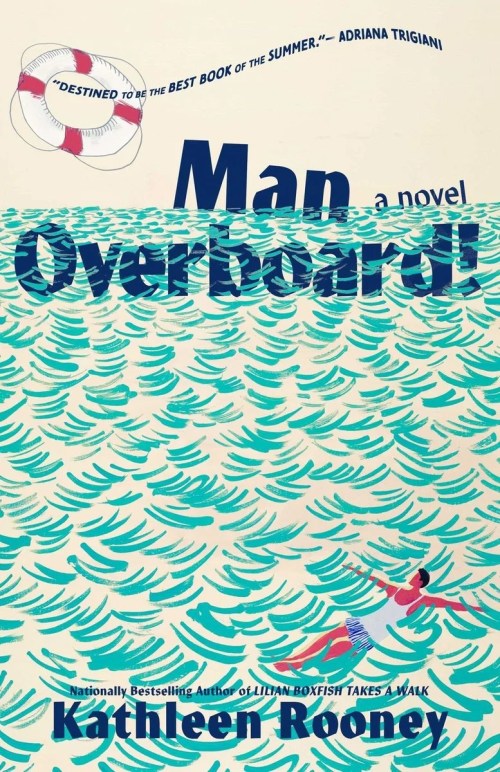
FICTION
Man Overboard!
By Kathleen Rooney
Gallery Books
Published July 7, 2026


