


Here’s a place to begin: what is the point of art? Why is it that we (some of us) want to do it, to create and make it; or that (rather fewer of us) want to engage with it, promote and protect it, hang it on walls and stack it on shelves and insist to the scientists and the politicians that it matters, that we won’t have it any other way? It doesn’t, as those bemused antagonists point out, provide shelter or substance or, god forbid, remuneration; it might even be harmful, corruptive, dangerous.
Plato thought so; his worry was that art, in mimicking reality (mimesis), lured one away from the world, and that this was bad. (It was a different time.) The thing is, sometimes the artists themselves feel this way, or they feel the possibility of feeling this way; the force of the argument leans on them like a rising wind on a darkening afternoon. (The scientists and the politicians don’t seem to suffer this same affliction.) Because it is a strange thing to create, and the only ones who seek such a difficult destination are those with no place else to go.
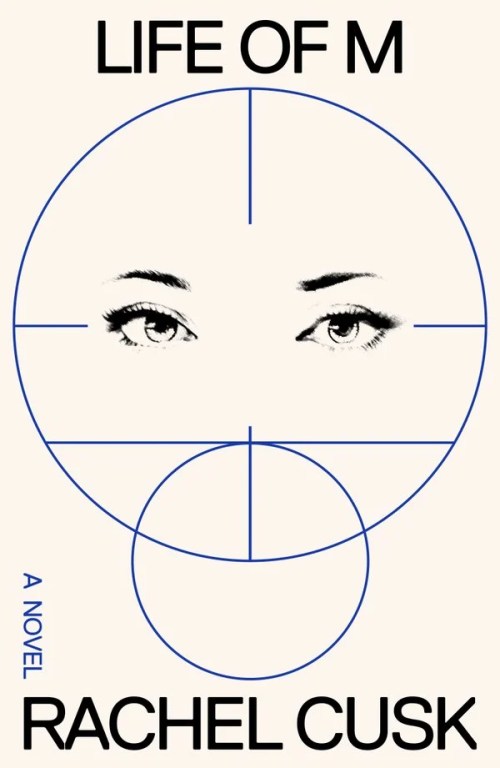
At this point in her career, Rachel Cusk has gone there and come back again, and now has moved in permanently. In 2024, with Parade, she focused her energies on a topic that had always been woven into her work: the situation of art in the world. In fact, that turn had begun with 2021’s Second Place and can be glimpsed in her earliest work. Her latest novel, Life of M, is also about art, but in a way that may cause the reader to feel they’re being asked to side with the scientists: is any of this good for us?
The book is a first-person account of a fictionalized autobiography with the field notes included, in something of a “postmodern” Autobiography of Alice B. Toklas, but with everything pulled back to another degree of fictionality. In other words, it is the narrator’s story of her (we think; more on that later) experience writing the autobiography of M, a famous actress, along with much of that actual autobiography. To someone who’s not read Cusk before—or perhaps has only encountered her memoirs—this might sound a little meta, and not what one may have expected. It is, though, a clear next step in the arc she’s been tracing since Outline, wherein she’s grown increasingly concerned with the dual notions of subjectivity and the capacity of art (or anything else) to capture it.
That her latest novel is written in the first person, then, is no surprise, and is in fact essential to the ontological investigation she’s been conducting since the trilogy, over a decade ago now. Life of M is preoccupied with the possibility of writing about someone who is not the person doing the writing, which seems to be an activity about which Cusk is skeptical, on metaphysical grounds just as much as moral-political ones. Her response is what it’s always been: to turn to the capacities of her art form to grapple with the world. The narrative shape is at the forefront here: the narrator begins by telling us about her commission to write M’s life, then provides some elusive, yet compelling, details of her own life and that of her partner, intermixed with scenes from the autobiography. The result is a novel that explores, on the page, both the situation of the artist in the world and the problems inherent in being one.
Our memories, our childhood, our parents, our native land are all either dead or far away from us. For other people this situation might be a tragedy. But in all these same periods and places we have recorded things. These recordings function like a kind of filter or sieve, retaining one part of us while the rest is allowed to drain away. Our recordings are our memories, our histories. The people who know us, our friends, understand this about us. They understand that we don’t have the same relationship to our lives or the lives of others as they do. They understand that if something goes wrong for us – if there is any kind of personal emergency – it is to some degree a public emergency also. It is a crisis of form, reality recording itself on us rather than the other way around.
The self-deprecating self-assurance is like an electric charge; as was seen in the end of Parade, this novel describes a maneuver into the first person plural that, first, separates the artist from society before, second, positing the artist as some sort of enclave collective; by blurring all this amongst language, artists are cast as together in their remove from society. Some of the most poignant moments in Life of M appear in these sections, where the narrator admits to us the isolation felt by the true artist, the ways in which one must isolate herself from the world in order to attain it in their art—and not a little angst over the broader implications thereof. It is hard not to feel the voice of Cusk herself in these passages, an admittedly dubious critical move which nonetheless compels this reader; with such a prodigious literary output behind her, Cusk seems to be offering (some?) readers a window into her own uncertainties with regard to her career.
Much of the attention towards the novel will be about its commentary on fame and celebrity, which are secondary issues in that they’re presented starkly as content, rather than form. Because the great narrational joke of Life of M seems to be the idea that anybody can write about, or depict in any manner, anyone else at all. However, she remains undoubtedly an artist, and although Cusk increasingly seems discomforted by what that might mean as her career progresses, she nonetheless continues to assert her work as artistic, first and foremost. This most recent book perhaps is an attempt at threading that needle, or at least whetting it, by asking the question of how an artist might be able to continue to practice their art even if it’s morally indifferent or worse, and even if it claims insights into the world, and the world of other people, that it can’t possibly truly know?
Within the threads of the narrator and M—which comes to a rather fascinating, possibly gender-agnostic conclusion—there is very little narrative linearity happening, which, alongside the spare, deeply perspicacious first-person prose, continues another theme that Cusk has been elaborating since Outline. But this time the formal insouciance is a bit more playful than subversive; that is, where Parade worked hard to eradicate a linear narrative, Life of M, in building upon that work, need not expand such an effort. Instead, the novel is comfortable, cultivating epistemological self-doubt from the very beginning, and brings all its attention to bear on those deep questions of art and representation that cash out in the narration itself. The autobiographical mode which appears in fragments and in sections is where Cusk levels her descriptive abilities and fluidity with scenic detail, rendering with depth and conviction not so much a character but the status of M as an artistic subject:
The sphere of intimate relationships is where in truth M feels she has a double, a soul in darkness who dreads revelation, who observes in the gradual slippage of formality and caution a fiction in the terrifying process of breaking down. It is almost impossible for M to negotiate this obscure and complex terrain between pretense and reality, since acting has generated a fund of cynicism inside her that is always reinvested in her next role, leaving no trace of itself. She is, but doesn’t experience herself as, cynical.
By separating reality from art, and mixing in the ongoing ontological crisis of subjectivity, Cusk comes up with an account of art, of artistic practice, and of the artist in the world that seems to generate the inherent problems of art as both justification and imperative to go on. In other words, she is again and always—and perhaps here, in some ways, more than ever—concerned with form. Life of M ultimately seems to claim for itself an assertion that there is no truth possible in art, for reality is far too hard and too distant—but there is the truth of representation; there is an artistic truth that happens via the process of rendering the world as the artist thus makes it in her own image. Thereby, Cusk has now attained the status of some sort of devious Plato, one who similarly sees art as dangerous representation, yet wishes not to repress it but to unleash it, to give unto reality a world of her own form.

FICTION
By Rachel Cusk
Farrar, Straus and Giroux
Published August 25, 2026


