


What is it to be obsessed? In clinical terms, an obsession is marked by “recurrent, persistent thoughts, urges, or images that are involuntary, intrusive and unwanted.” Obsessions can cause significant distress and anxiety. Even when an individual recognizes these obsessive thoughts as unreasonable, they often feel unable to control them. But the clinical definition has lost some of its power or gravitas. In our contemporary lingo, obsession is used as hyperbole to describe an interest, however passionate, in something, someone, a trend, an object. Obsession gets stripped of its darker context. And instead, we’re obsessed with our new shoes; we’re obsessed with a new show or movie; and we’re obsessed with other people: celebrities, friends, even strangers.
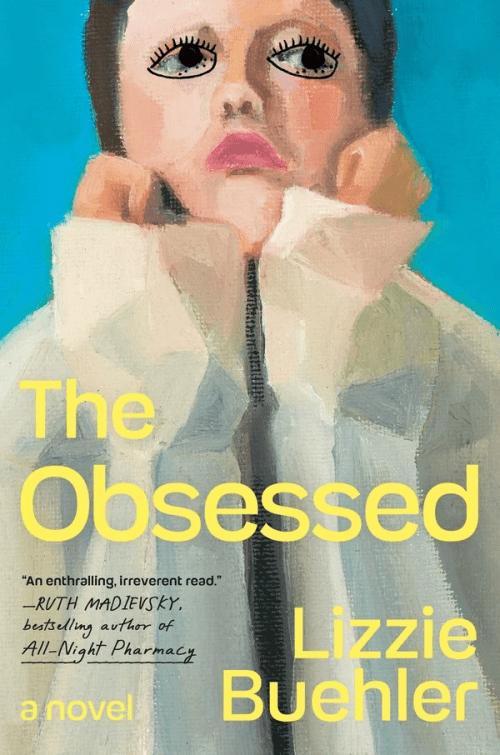
Literary translator Lizzie Buehler’s debut novel The Obsessed rides the line between clinical obsession and contemporary tossed-off jargon. Astrid, the protagonist of The Obsessed, is both lovable and infuriating, brilliant and clueless; she’s self-aware but also can’t get out of her own way. Her obsessions seem like harmless infatuations until they aren’t. She is a fully realized character through whom we see not only the world she inhabits but also slivers of our own. A wincing relatability as we recognize similar past mistakes. Astrid is a translator and first year PhD student in comparative literature at Harvard. She is soon to be out of a long-distance relationship. And she has an obsession with the Russian American novelist Sofiya Sova. She sees their lives as something parallel. Sofiya Sova had also started a PhD in comparative literature, was also a translator, and was, presumably, of a similar height to Astrid. As Astrid says, “I wanted to be her. I was her, a little—I hoped. In some ways, my life was a copy of Sofiya’s.”
Astrid has an obsession with another Sofiya, the Sofiya who is the ex of her soon-to-be ex. She also goes to Harvard (a grad student in the art department), and it appears as though Astrid is living in her former apartment. The other Sofiya, Sofiya the ex, also bears a physical resemblance to Astrid and Sofiya the novelist. As much as Astrid is a fully realized character, she is also a pastiche: she is a mixture of others, if not a full imitation, then a kind of echo of the two different Sofiyas. Astrid and the novel become a kind of Matryoshka doll. Characters and themes are repeated, mirrored; near doppelgängers are found throughout.
Astrid bears more than a passing resemblance to Buehler in terms of profession, education, and physicality. The nesting doll structure of The Obsessed allows for the metafictional aspects—the most interesting parts of the novel—to come to the fore. As Astrid starts to date again, she meets Elijah, a medical student at Yale who is also a super fan of Sofiya Sova. “I had never met someone as obsessed with Sofiya Sova as me,” Astrid says. Elijah is also a former-but-brief lover of Astrid’s other Sofiya obsession. A revelation he does not dismiss or admonish her for. During their texting sessions, which grow to “all day, every day,” they start using the language and affectations of the characters in the Sofiya Sova novel they both love. Part of that novel’s plot involves two lovestruck students sharing a favorite book. Their exchanges become epistolary communications modeled after the text itself. So much so, that we start to see that there isn’t much of a foundation for a future relationship beyond the shared obsession.
Why can’t this be enough? There is, in keeping with contemporary language, “main character energy” in Astrid wanting to live her life like she’s in a novel. One of the things art allows us to do is to reflect on our lived experiences in a new, different way. Art has the capacity for transcendence—to break through our mundane everyday perceptions of the world and crack open something raw and primordial in terms of our structure of being. Maurice Merleau-Ponty writes about the world and the perceiving subject (us) as intertwined. Art is able to capture this blending and gaze back at us, blurring the lines between seer and seen, subject and object. Astrid experiences the Sofiya Sova novel through the lived body. It isn’t just a reflection of the world; it allows her to reorganize her experiences. And it takes Astrid’s interpretation of Sova’s novel being shattered by Sova herself near the end of the novel to let her make the invisible finally visible. If Astrid has lost herself in these obsessive relationships, it’s through this artwork she can learn something new.

In the end, The Obsessed provides us with an endearing portrait of a young person moving past a series of parasocial relationships to start a process of building something new. The novel ends in an ellipsis, a dot, dot, dot, of “where does Astrid go from here” now that she’s dismantled much of the scaffolding she had built around her life. Astrid, like Buehler, is a literary translator. According to Walter Benjamin, the purpose of the translator is to liberate “pure language” so that it might “shine upon the original all the more fully.” In this sense, Astrid is embarking on a new translation, not just of Sofiya Sova’s novel, but a translation of the self. A translation that ensures the “afterlife” of the original, but one that also allows for growth, maturity, and evolution in different cultural contexts.
FICTION
The Obsessed
By Lizzie Buehler
G.P. Putnam’s Sons
Published July 28, 2026


