


In 1842, the twenty-five-year-old English artist Richard Dadd and his older patron, Sir Thomas Phillips, set out on a journey through Europe, Syria, and into the heat of Egypt. It was a trip of inspiration for Dadd, who was beginning to establish himself as a painter.
The journey, however, would take an unexpected toll. After absorbing an ecstatic variety of cultures and images, Dadd fell into schizophrenia. Shortly after his return to England, Dadd committed a hideous crime, and he was interred in the psychiatric asylum Bedlam for the rest of his life.
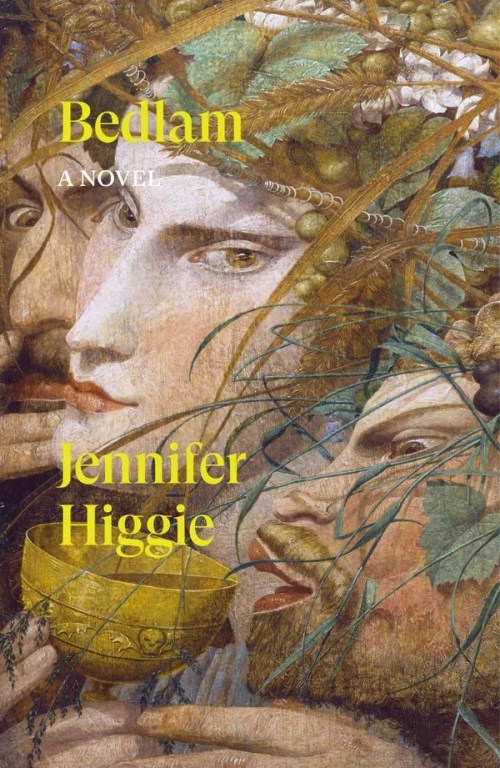
Jennifer Higgie’s Bedlam is a fictionalized account of Dadd’s fateful journey, told in the first-person perspective of the artist himself. Over the course of the novel, poetic and uncanny observations give way to increasing agitation, confusion, disputes with Sir Thomas, and an ominous obsession with the Egyptian god Osiris.
The text itself is divided into a series of short scenes ranging from about one to four pages and presented in a poetic, irregular fashion. Dialogue goes without quotation marks. One often gets the impression of Bedlam as being as much of a novel as a long free verse poem. Psychologically, we get the notion of an open-minded artistic spirit taking in a large—and ultimately overwhelming—amount of sensual and intellectual data. This is applied in a productive sense toward the ends of creating new art (Dadd’s paintings), and in a destructive sense toward the disintegration of a psyche not keeping grips with some rational foothold.
Bedlam’s opening quote from poet Seamus Heaney stands as a guidepost: “Yeats said, To those who see spirits, human skin / For a long time afterwards appears most coarse.” The visionary artist—and Dadd was certainly a visionary artist, as a browsing of his paintings will show—must deal with “spirits.” Dadd’s work may be compared with the work of Hieronymous Bosch, another artist of fantastical settings depicting malformed and wondrous creatures. Bosch and Dadd are depicting entities that do not physically exist and are unique to their own artistic styles. These visions may appear in the mind’s eye and “insist” on being visually represented. Unique art in any form, be it painting, literature, or music, carries an otherworldly tinge. In these works, the artist presents remarkably unfamiliar forms and scenes to the viewer, reader, or listener.
If our everyday world makes up a sphere of conscious ideas and norms, someone like Dadd is working at the edge of that sphere, reaching into the unknown beyond the boundary, and bringing back “new” forms into the light of consciousness. It is a familiar idea that genius and madness are divided by a thin line. Disaster comes when the artist spends too much time beyond the boundary of “our world,” and forgets what it means to exist as a rational, ordered human being. In the metaphorical language of English fairy lore (appropriate for Dadd, as much of his most celebrated work involves fairy scenes), the individual is no longer simply observing and communicating with the fairies, but has been kidnapped by them—or has become convinced they are a fairy themselves.
The faculty of imagination is enchanting and potentially empowering, but the artist must be careful that the imagination does not overpower them. In more psychological language, C. G. Jung referred to this cataclysmic event as being subsumed by the “collective unconscious”—the collective unconscious being something like the overarching sphere of all possible ideas accessible through the mind.
We can never know for certain what the real Richard Dadd personally experienced during his journey through Europe and into the deserts of Egypt. Bedlam is a beautiful and at times frightening interpretation of this journey, and a fine archetypal study of the adventuring artist losing control of their perceptions and the ability to integrate the world into a comprehensible whole. (“Study” must not be taken in a dry sense here, as this is a work of organic and living feeling.) Every artist, in some sense, seeks to expand consciousness and the availability of ideas in the world. They must be careful how they cast their net, however. There are many beautiful fish to catch and show the world. There are also sea creatures of such strength that—for the unprepared fisher—can drag a boat down altogether.
FICTION

by Jennifer Higgie
Verso
Published July 14th, 2026


