


I first met Julie Buntin some years ago in New York City. We traveled in overlapping literary circles of young, aspiring writers. For a brief period, we lived off the same Brooklyn subway station. Time passed. She relocated to Michigan where she now works as an Assistant Professor at the University of Michigan, and she is also the co-editor, with Rebecca Knight, of a forthcoming essay collection, Notes to New Mothers.
Her first novel, Marlena, is a story of friendship between two teenage girls in rural Michigan. The protagonist, Cat, tells the story as a reflection on her past, overlapping the two timelines with the effect of braiding together the trauma with the results.
In her latest novel, Famous Men, the protagonist Wilhelmina leaves behind Greening, Michigan hoping to find her father. Her search is as much about her escape from the small town she has grown up in. She arrives in New York City and meets Nathaniel Fellows, the famous poet, author, and occasional screenwriter. He takes a liking to her, and hires her as his assistant, paying her under the table and helping her find housing. Then amidst the revelations of the #MeToo movement, former students accuse him of improprieties.
Late last year, Julie was back in New York reading an essay from What My Father And I Don’t Talk About, a collection edited by Michele Filgate. The essay examines Julie’s relationship with her biological father, and introduces him to her son. After the reading, we compared notes on becoming parents during the pandemic, and she mentioned the forthcoming release of Famous Men. Last month, we met on Zoom to discuss it.

Ian MacAllen
I could not help but think in reading Famous Men that they are similarities with Marlena. Both these female characters are looking back as a way of framing the books. What is it that you find powerful about these reflection narratives?
Julie Buntin
Both books do have a retrospective first person narrator who’s telling a story of a thing that happened to them, and they both have a confessional quality. I like the retrospective mode because it’s a little bit more elastic as a first-person point of view.
You can have a narrator who can inhabit the scene as if they’re living it, but then there’s also a space in the narration to foreshadow or punctuate with some kind of reflection or interpretation or analysis. Both stories are about women who are trying to make sense of a relationship that has impacted their life, for better or for worse.
In Marlena, we have a woman who is in two timelines that are braided together. Famous Men is a book that has a really different relationship with time. We have a character who knows the end from the beginning but she starts at the beginning and catches up with where she is in the telling.
While I was writing it, I wanted it to have that kind of a long journey feeling, where you’re experiencing the life of a character and don’t know where it’s going to end up, as if the character is telling you this because they’ve reached the destination and it might be somewhere you – or they – don’t quite expect.
Ian MacAllen
When it comes to Wilhelmina’s journey, do you think she was running away from Michigan or do you think she was running towards something?
Julie Buntin
That’s up to the reader, in the end, but I suppose my answer would be that she’s doing both. I was really interested in this idea that we try to outrun these things from our past or these inheritances from our family, we try to escape them. But there are ways that in trying, we sometimes inadvertently just repeat the same patterns over and over.
They can be so hard to shake. And I do think this is a book that’s about that, how these things that happen to you when you’re young, that you think you’re reacting against, can be the very things that drive you towards the worst sort of decisions in your adult life. They create a different kind of trap for you later.
But is it possible even if you’ve backed into the same mistake, to ever start the cycle in a different way? That’s one of the questions that I want readers to be left with at the end of the book.
Was something learned and gained? Was there transformation or is she actually just repeating her mother’s story? I was really interested in that.
Ian MacAllen
Are you pensive about having left Michigan, came to New York, and then returned to Michigan?
Julie Buntin
I’ve been writing this book for a long time. I started it in the summer of 2019. I knew I was going back to Michigan, and I moved back in January, 2020.
There are a lot of things that draw me towards a story or that motivate me to take on the long, complicated project of writing a novel for years and years and years, but in order to actually do the day to day work you have to be interested in a lot of things, like big questions, the characters themselves, the small details, the way the voice works. But one thing that’s always been very motivating to me on a kind of personal level as a writer is homesickness, for lack of a better word – the longing for a place I’ve lost or departed from.
I’m always sort of perpetually missing northern Michigan, where I grew up. It is a place that isn’t even real anymore. It’s changed so much from tourism, time – it’s not the up north of my childhood, and it’s hard for me to get back there at all, it’s so remote.
But I don’t think it’s a coincidence that I wrote Marlena when I was in New York, missing Michigan. And I wrote most of Famous Men when I lived in Michigan and was really missing New York.
Ian MacAllen
Wilhelmina describes Nathaniel as – “His women were mostly based on women he’d known. His men were mostly based on him. Versions of him, he said.” Are you concerned that readers will confuse Wilhelmina and Julie?
Julie Buntin
I wrote a book already where people did assume it was me. I know now that people will do that.
I am from Michigan. I worked in the literary world for a long time. I wrote a book, two books, that have confessional energy.

My desire for privacy around how and why I write the things that I write is maybe one reason why this book took so long. There is a little extra energy that comes off of a text where you think there is something true being disclosed to you. Neither of my books trace events that happened in my real life, but I couldn’t have written either of them without having had the specific life experiences I’ve had.
One of the things this novel is looking at really directly is: what does it mean to make art that has intersections with real life? What assumptions do we make about artists who do that? Who gets to do that and retain a private life?
Nathaniel gets to do it and still be thought of as an artist who makes art that is great fiction. He is a jack-of-all-trades. But I think when women do that, it’s often thought of as like a diaristic: You’re not using your imagination enough or there is the assumption of autobiography, or a lack of ambition or seriousness.
This is the space that I’m very interested in as a writer.
Ian MacAllen
At one point there are allegations against Nathaniel and “the internet” challenges Wilhelmina’s response. In a lot of ways, she is clearly a victim. Where do you see that line between victim and enabler?
Julie Buntin
That’s the uneasy space that the book lives in. I do think that is a really complicated zone. Will would have a different answer than I would, at many, many points throughout the book. What do we make of women who are the enforcers of the silences that hurt other women? What do we do when we have a character who says: I didn’t suffer, but we can see that they did. What makes you have that reaction? What might make you make those choices? Where can you go from those choices? Can you come out from underneath them?
This isn’t the story of Will and Nathaniel. I think of this book really as the story of Will. It’s Will’s story from adolescence until this turning point in her life. It’s really the story of this particular woman who grows up in this particular circumstance with this particular kind of family situation, certain questions, especially this search for a father figure, this lack of any kind of male figure in her life that is trustworthy. How might that distort her sense of what she would accept and what she wouldn’t?
There’s a million stories about somebody, the teacher- student relationship, where power has been abused. They happen in fiction again and again just as they happen in life. And much as I was reading those things and processing the aftermath of my own girlhood and early adulthood, I still hadn’t seen a story that wrestled specifically with all of the details that would go into why one might make some of these decisions on this question of complicity. I’m not interested in writing novels that give the reader an answer.
Ian MacAllen
Wilhelmina observes: “The thing about living in New York was that no matter how bad an event was, when you left, you were still in New York” — is that how you feel now?
Julie Buntin
Yes. I lived there for almost fourteen years and have been gone for six, and I believe more than ever that New York is the best place to live.
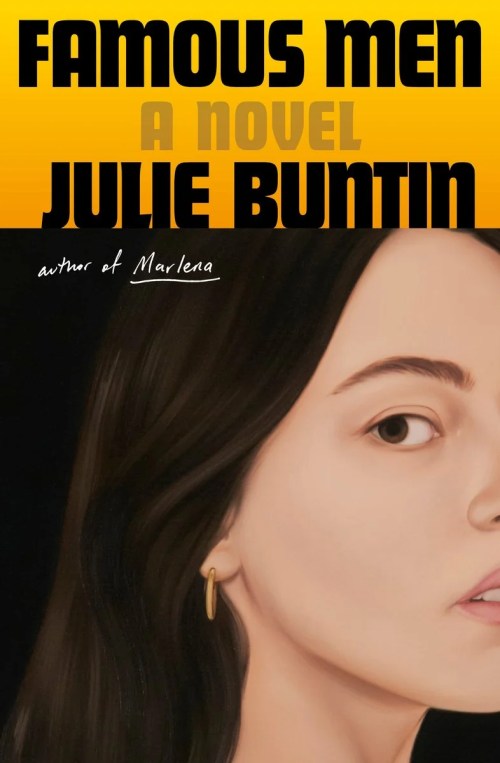
FICTION
Famous Men
By Julie Buntin
Random House
Published July 14, 2026


