


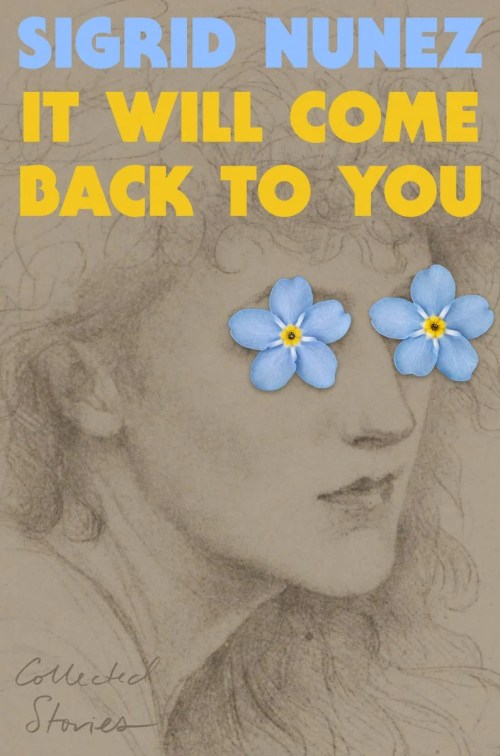
Sigrid Nunez is such a fixture in American fiction that it’s hard to imagine someone not closely encountering any of her nine novels, which have earned her a National Book Award, a Whiting Award, and a Guggenheim Fellowship. I wanted to take on this review precisely because I fit that category, which allows me to participate in an intriguing thought experiment. How does a reader’s first encounter with Nunez feel when the only work of hers they know is her short stories, collected in It Will Come Back to You?
My answer is that Nunez comes across as a writer particularly concerned with veils and their consequences. The veils we put over our own eyes about ourselves or others, and the veils others put on our eyes for us. She revels in exploring the many ways that holding secrets—many of them old and, in keeping with the title, returning to her characters with enhanced force—shape those who maintained them. Nunez is also especially invested in the unsaid, both in the lives of her characters and in the textures of her stories, which love to pull the reader into them by hinting at information that other writers might prefer to announce with dramatic fanfare.
Nunez often moves us from one blank spot in her storyworld to the next, gradually piecing together the lives of her characters, and clearly expects us to read between her lines. Key facts are veiled from readers until the right moment, or sometimes permanently—especially when the characters themselves are stuck in a state of not knowing about themselves, unable to come to terms with the pasts that have shaped them. Their veils typically obscure truths about lovers and family members, the very people who are so close to us that we have limited choice about the roles they play in our lives.
The stories in It Will Come Back to You take place in New York City and environs, a setting sometimes announced and sometimes implied from cues. They cover a wide swath of socioeconomic circumstances, from cleaning ladies to literary socialites, with some common threads. One-time affairs and husbands dying young recur throughout the collection. But the unifying theme of the collection is straight out of Sigmund Freud: the return of the repressed.
“Philosophers,” the opening story, is narrated by a woman remembering her high school boyfriend and the teacher he also dated—and later married. One of her lines sets the tone for the entire collection: “[T]he way to live, of course, was to avoid looking back…. [T]he way to live was as if you had just been born: a person to whom anything might happen.”
At her finest, Nunez deals with characters who walk through their lives this way. Her sentences guide us through their tales in the same spirit, so that we feel we’re flying by the seat of our pants alongside her narrators and protagonists. Her purposeful obscuring of facts—how she uses the veil as a tool of fiction—is consistent with the way her characters often miss opportunities to see their own lives. They rarely have revelation moments when they see a clear picture of what’s going on, which means that we as readers don’t necessarily get traditional epiphanies either.
The strongest stories in the collection follow this pattern. In “It’s All Good,” the struggle between two polar opposite siblings about how to deal with their mother in a memory care facility exposes their uncertainties about what their own lives mean. “Worried Sisters” features a troubled artist who has normalized herself with medication, but hasn’t quite convinced her sisters that she’ll be truly happy with the man she once dumped and now plans to marry. Nunez likes to walk us through moments when people rush to the edge of a cliff that they may never step back from, then hover there. She often ends stories at precisely the moment when her readers—and her protagonists—are about to experience an epiphany that she ultimately withholds from both. Their lives will be informed by the moment that the story shares with us, but neither we nor the protagonists know exactly how. This is no small feat to pull off in fiction, but Nunez consistently handles it with panache.
My very favorite piece, and one that exemplifies many of the collection’s themes, is “Imagination.” It features Elsie, an economically advantaged teenager suffering under the thumb of an exasperated mother for her impulsive behavior and “inappropriate laughter.” Elsie is an atypical character for this collection in that she lets herself say what other people do not want to be caught dead saying. She hasn’t met a veil she doesn’t want to tear off, which highlights exactly how invested other people around her are in keeping them in place. In her struggle to understand herself, she comes face to face with the fact that the quest necessarily involves risk—the prospect that who you are, when you finally see yourself, will not match the image you have kept behind your own veil.
These stories cover a wide swath of Nunez’s career, having been published between 2011 and 2024 (with one earlier outlier) in a variety of magazines ranging from Prairie Schooner to The New Yorker. Precisely because of its construction, It Will Come Back to You can come across a bit like a greatest hits album from a renowned band. (The subtitle Collected Stories amplifies this impression). On such projects the elements are uniformly excellent, but the overall thematic cohesion takes some digging to find compared to collections in which the stories are more tightly bound in conversation with one another. In this book, those conversations take place at a deep level, clustering around the author’s consistent preoccupations over a long career. I would love to see a Nunez short story collection in which the thematic cohesion is tighter and more fully embraced, and I hope she writes that book someday.
But make no mistake: these are terrific short stories from a writer who knows how to pull us into them by selectively removing the veils on her characters’ lives, or sometimes by leaving them exactly where they were and getting us to wonder how those lives will unfold after we have turned the page. We learn a lot about her authorial imagination by looking at these many small slices of it in one compact collection, which is an ideal way to get to know her work if you are not already an aficionado.

FICTION
It Will Come Back To You
By Sigrid Nunez
Riverhead Books
Published July 14, 2026


This sounds like a wonderful book to discover!
It was indeed! And an excellent way to discover its author.