


Writers will never tire of retelling Frankenstein, for Mary Shelley’s masterpiece will never stop speaking truth to humanity’s tremendous ambition and folly. The primal myth is so malleable, so adaptable, because it underpins what makes our species both remarkable and dangerous: we dream, and then turn our dreams into reality, no matter the cost or the monstrousness we bring to life.
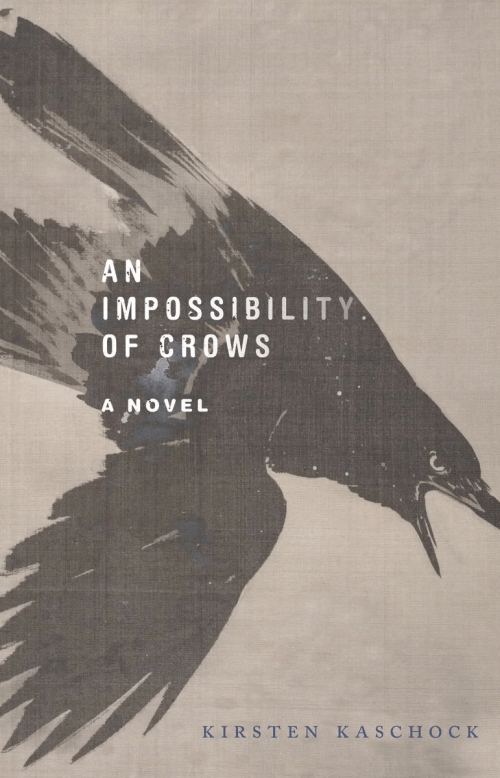
Kirsten Kaschock has twisted the old story into wonderfully horrifying new life in her second novel, An Impossibility of Crows. When Agnes, a former chemist, inherits her parents’ bleak Pennsylvanian farmhouse, she returns with her husband and daughter to clean the place up and put it on the market: “a repository for six generations’ distrust of outsiders and otherness, science and self—that’s what we were fixing to sell.” The house is a horror story waiting to happen, drafty, severe, and haunted with memories from Agnes’s tragic childhood. She is a distracted, damaged partner and parent, and soon drifts from her husband and child and housecleaning into the barn, where she begins to breed the crows which the property is infested with—breed them for size, docility, intelligence. Within a few generations, she has created Solo, a horse-sized crow, the only descendant left of an increasingly huge and familicidal lineage.
The story unfolds through Agnes’s progress log, her mother’s diary, discovered in the attic, and Polaroids of her childhood, gorgeously described as “layers of time, picked off a body of a life. Small thickened moments. Scabs.” It is the wounded, hardened existence that tends to create an inventor of inadvertently terrible things, someone who doesn’t consider the consequences of what they make until it’s too late. Agnes’s negligence has already caused one casualty: at her former laboratory job, pregnant and not knowing it, she spilled some chemicals and cleaned up the mess without protection, exposing her unborn daughter to toxic fumes which led to birth defects that prevented her girl, Mina, from walking.
Her unprocessed guilt and grief over Mina’s disability is what drives her to breed Solo. “Mina will be able to get away,” Agnes writes in her log. “Working legs or no, she will have an escape hatch. She will have Solo and Solo will be better for her than any mother.” A girl flying away on a giant crow—it’s a beautiful fantasy, part absolution, part creation, freeing two tethered creatures at the same time. But like all beautiful fantasies it loses touch with reality, pulling Agnes from her family into a disturbing obsession, and by the time Agnes finally allows Solo out of the barn, on a harness, her husband has already taken Mina back to the city and filed for divorce, so there is no one to check her recklessness. Solo rips the harness from her hands and flies away and begins a reign of terror.
This is always the core of any Frankenstein story—the scientist, possessed by their fabulous idea, can’t see they’ve created a monster until it’s too late, until the aberration is already loose upon the world. It’s a metaphor that can stand for any of humanity’s inventions, at any period in history, because it’s a metaphor for technology itself. Even the earliest human tools, made primarily to kill and eat, have spawned into our deadliest weaponry. Every machine, every kind of currency, every social structure, has grown and grown beyond its relatively innocent inception, until it becomes too big and powerful to stop, and then it controls us. But of course, the metaphor has never been more apt than now, in our age of A.I., when the potential monsters have already infiltrated every crevice of our daily lives, and the scientists just keep making them smarter, stronger, more immortal, without any legal or moral limitations. They make the monsters because they believe they are trying to help, and trying to help while blinded by self-absorption and greed will always end badly.
Agnes is a sympathetic Frankenstein, though, with her terse, bruised lyricism and moments of wry humor. Of her husband, Bruce, who is a poet, she writes, “My husband has written some excellent poems but tends toward the self-indulgent. To be fair, it’s a danger of the trade.” Kirsten Kaschok is the author of five poetry collections herself, and her prose has the surprising, compact beauty of poems; even as Agnes scorns her husband’s profession, she inserts Bruce’s crow poems into her patchwork of narrative. An Impossibility of Crows is a Frankenstein’s monster in its very form, stitched together from different mediums, frightening and heartbreaking and achingly human.

In the end, the inventor always realizes they must kill their invention before it wreaks more havoc on the tender world. Some have the insight to recognize their worst selves in their creation. Agnes comes to this profound observation on the brink of her own reckoning: “The structures built to protect the self from recognizing itself are fragile and monstrous.” Isn’t that the perfect description of our own impending judgment? Though we deny and deny what we’ve done, our structures are breaking and soon we will see ourselves in the mirror of our machinations. Kaschok’s urgent book is such a mirror, but one that offers the hope of self-forgiveness, and maybe even redemption.
FICTION
An Impossibility of Crows
By Kirsten Kaschock
University of Massachusetts Press
Published March 3, 2026


