


T Clark’s debut short story collection, All This Want (and I Can’t Get None), is thoughtful and thought-provoking, heartbreaking, strange, and moving. It centers Black working class characters and their vibrant aches and yearnings. The characters’ humanity is bright on the page, and Clark treats their voices with dignity—even if they’re young, even if they’re struggling, even if they know what they should do, but simply can’t, because of all they’ve lived through. With compelling settings and plotting, Clark asks: What are these peoples’ dreams and small, sharp desires, or as Clark calls them, “micro-wants”? And where do those micro-wants lead them, and how? With stories about teen girls and solidarity, older brothers and the wakes their reputations leave behind them, parents and the spaces parents should be, and kids reaching for safety, belonging, and freedom. All This Want takes readers to new cities, back to the chaos and thrill of childhood, and to questions that feel more compelling than answers. It left me wanting more of Clark’s work, and I was so happy to talk to them about this stunning debut.

Jen St. Jude
I’m curious about how this collection started. Were there a handful of stories that sparked the themes that run throughout?
T. Clark
It’s the culmination of years of writing stories, and the themes of my heart and my life all that time. I wrote most of these stories between undergrad, grad school, and post grad, and the ones included here are the ones I was able to bring to completion and, together, felt like a collection that was ready and done.
Jen St. Jude
That makes sense, because the collection feels cohesive but never repetitive. Each story really stands on its own, and each of the characters bring something new. And each story felt in conversation with the title in different ways. All This What—financial security, hunger, attraction, and desire for belonging. How conscious were you about “want” as a theme?
T Clark
In terms of writing and craft, I’m always writing from a place of motivation and desire, and it feels overt in many of the stories. There are other things I’ve written where the desire is more embedded and not really on the surface, but it is how I think about finding the truth of a character.
Jen St. Jude
There is all this want, and the second half, of course, is, I Can’t Get None. Many of these characters are young, living in poverty, Black, queer, or otherwise marginalized. Even when it feels like they’re winning, as readers we feel unease, or pick up on red flags, and in moments, can see how their winning might also lead to a type of losing. But what else can they do, despite that? I was curious to hear your thoughts on the impossibility of being satiated when you don’t live in a world that wants you to win. In a world where it’s not even safe for you to win.
T Clark
Autonomy is very important for these characters. I want readers to understand how someone could end up in a lifestyle like these characters. The story is both a journey towards and the backstory for why someone might be in such a harrowing situation, or why they’re chasing something they hope satisfies them. Someone might read it thinking, “I would never wish that for myself, my child, my friend,” but it doesn’t mean that the character can’t or doesn’t want it.
Jen St. Jude
Along those lines, these stories made me think about safety and belonging when it’s unclear where power lies. In “Nutcracker,” the main character, Shelly, feels like this “good girl” but she so badly wants to be desired and accepted by her peers who work at the sneaker store. But Shelly, like some other characters who play by the rules to keep themselves safe, ultimately find themselves in a world where that safety is no longer protecting them if their goal is to be accepted socially. I loved that tangle of confusion and desire.
T Clark
That’s interesting that thing you picked up in “Nutcracker!” I’ve always thought of that story—in terms of power—as a sort of nesting doll. There’s the interpersonal, then outside of that is the world of the store. Outside of that is the world of the parking lot. Outside of that is the greater city of New York. As the world gets bigger and the people in the middle become comparatively so small, their power just diminishes and it affects the way that they interact with each other. It’s all about power.
Jen St. Jude
When I finished reading the collection, I messaged you to tell you how much I loved it and also used the word strange to describe it. The biggest compliment from me of course, and what I meant was that you let characters be really honest about their wants in private moments; things that nobody wants to talk about. It gave these characters such humanity, and it made me wonder all over again about belonging and safety.
T. Clark
Yeah, you used the word strange, and I’m now equating it to what others have called messy. I keep hearing people say that the characters are allowed to be messy, and I think that’s very, very apt. And so, yes, strange. I hear you. I agree. And thank you. I still think it’s a great compliment. And as far as the micro wants, I guess we can call them, I think this goes back to me as a writer in that it is the way that I understand characters. These micro-wants show me where the characters need to go. What they might be hungry for. And that’s probably how it got on the page.
Jen St. Jude
Many of the main characters are teenagers, or young adults, but I’m curious about the adult characters, too. More often than not, they’re in a parent role, whatever that means for them, and they’re struggling. I wonder how you thought about age and autonomy and power?
T Clark
Adults are largely absent in the book, and the ones that are present kind of do a bad job. If you had a parent who insisted that you eat dinner at the table every night, you wouldn’t be out in the world doing XYZ, but these parents are busy. Power and capitalism take parents away from their ability to parent. I hope in the empathy you feel for the younger people, you can find some for the parents, too, because none of them are making a choice because they want to. People make choices because they’re pushed into certain positions.
Jen St. Jude
There are a lot of characters in these stories who are presumably young women, some of them queer. I saw in some of them pieces of my younger self, who only wanted to be desired—by men specifically—but didn’t know how to desire, or that I even could. I think that’s common when living in the patriarchy, honestly, but was wondering if you had any similar thoughts while writing these characters.
T Clark

In some ways. Not to say being queer is a decision, but pursuing queerness and one’s own truth is a decision in a lot of ways. And for queer people, sometimes being honest about that is one of the first times you’re actually making a decision for yourself. It’s instant autonomy, sometimes. Suddenly you’re doing something that hasn’t been handed to you. And then, like you were saying, you decide to want…and then what? Where do you go? How do you do it? It requires all this research and deeper digging and self-interrogation, and a lot of things that I feel very grateful to have done as a queer person.
Jen St. Jude
I loved how you described micro wants, and how that drives your craft and the shape of these stories. This might be a hard question to answer, but do you think want, then, is a good thing? Or is it always complicated?
T Clark
It’s always complicated if you are an active, thinking person, because there’s a cost for everything. I have a crush on this person that works in the store with me—at what cost? If we end up together, are people gonna judge him for being with me? Are people gonna ask me what we did last night? Wanting and achieving opens up a whole new can of worms, no matter what direction you take.
Jen St. Jude
I wanted to ask you how you decide a story is finished, because I feel like you nailed every ending. Each of them was surprising, the final page always left me in a place where I felt satisfied, but also a little bit disoriented and unsure of exactly what might happen next. I was wondering if you had any tips, because I really just thought each and every ending was so right.
T Clark
Endings are one of the hardest things for me to conceptualize. I start way more books than I finish, so I feel very equipped to enter a story. And to exit a story, I’m kind of like, did we do it? Is it done? I guess it’s done. I definitely want to end as quickly as possible. I want to get the reader out of there once the question of the story is answered. I would say also big props to agent, editors, friends, people who have read these stories, because I can’t really remember how I ended them, but I know I didn’t do it alone.
Jen St. Jude
Who are you hoping will find this book? In other words: Who did you have in mind when you were writing?
T Clark
I’m excited to see who gravitates towards it in ways I can’t even imagine, who find things I didn’t see on the surface. But mostly: Myself as a young person, and my peers from back then—especially people with messy childhoods in the early 2000s. When I hear an adult woman talk about the mess of her youth, I’m like, I hope she finds my book, you know? People who have come into a different version of themselves as adults, or people who are still exploring their identites and probably will til the day they die. That’s what these characters are hopefully moving toward. That’s what I hope for their futures. And I definitely want Black people to read it. I also want working-class people to read it. These stories could only exist in a world where money is an issue. In working class neighborhoods, you can’t just buy your way out of problems. Time is different if you’re working class. Money is different if you’re working class. Everything is different.
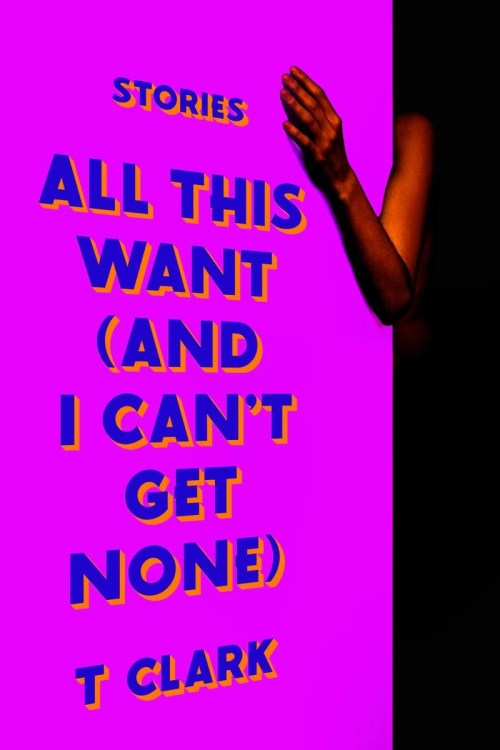
FICTION
All This Want (and I Can’t Get None)
By T Clark
One World
Published June 23, 2026


I really loved your interview with T. Clark! It’s so interesting how you delved into the connection between gaming and creative writing. It instantly reminded me of my own experience creating a narrative for a tabletop RPG session; those small, character-driven moments can turn into such rich storytelling! Hearing about Clark’s unique approach to integrating game mechanics into literature just resonated with me. It’s amazing how both worlds can intertwine to spark creativity. Thanks for sharing this perspective Snow Rider—definitely gave me some ideas for my next game night!