


Long-time readers of award-winning novelist Ruth Ozeki might have been surprised to learn her newest offering is not a novel, but is instead her debut short story collection. However, The Typing Lady is a captivating continuation of Ozeki’s work.
The author, filmmaker, and Zen Budhhist priest’s previous fiction covers a range of subjects from television-making and meat-processing to genetically modified crops to an epistolary story about a suicidal teenager’s diary washed ashore in a Hello Kitty lunchbox after a devastating tsunami. Two of her prior nonfiction projects, including a memoir and an earlier documentary film about a can of inherited bones, examine culture, race, family, and the art of storytelling.
In all she creates, Ozeki moves seamlessly between the personal and political with her unique humor, gravity, and stylistic flourish. She writes somewhere between fact and fiction. Characters share her career, such as filmmaking in the debut My Year of Meats, or her name as in A Tale for the Time Being. In this latest story collection, the final story features a grandmother novelist whose previous book was about “a kid who hears things and talks to books,” an endearing wink at Ozeki’s most recent The Book of Form and Emptiness.
Ozeki’s short-form fiction is expertly rendered in this collection with warm and engaging narration, eccentric characters, and the poignant situations they find themselves in: the child of an anthropologist navigates power dynamics, a young writer cares for an elderly couple, a boy consumes only plastic, expecting parents must defend their roost, a mother-daughter duo relocate based on the mother’s romantic whims, girlhood imagination has its pitfalls between two friends, a student falls in love with a visiting professor, a famous poet haunts a young publishing professional, ambition takes a ghostly form, and an elderly writer forays into online dating to help her granddaughter not only navigate familial deaths but also connect to people her age after a worldwide pandemic and exponential technological change. Themes span from philosophical concepts to the effects of climate change to creative empowerment to intergenerational bonds. Established readers of Ozeki will be able to track an orbit around the author’s broader solar system through these stories, while newfound readers will discover her trademark wit and compassion are wholly interconnected in a gravitational pull.
I spoke with Ruth Ozeki about creating art, the rituals of language, ideas of suffering and joy in Buddhism, how technology and loss change humans, and hope for what comes next.
This conversation has been edited for clarity and length.

Cait O’Neill
I’d like to start with your author’s note. It sets the tone for the collection with its conclusion: “Stories are like that. They are collaborations between people who read and people who type. They are how we co-create each other and dream ourselves into being.” What does this act of co-creation mean for you, as both the typer and as a general reader?
Ruth Ozeki
When we start as writers, we don’t really have an idea of readership. I thought I was writing for myself, and I do write for myself. I am my first reader. In the initial phases of a project, of a story or a novel, it’s my relationship with the characters, my relationship with the page. But now I’ve been doing this for long enough to have a sense that there are readers out there, and we’re entering into a kind of dialogue. It’s a conversation that to some extent I’m having with a future reader who I don’t know but who I imagine is out there somewhere.
I enacted that with A Tale for the Time Being. Nao—that’s exactly what she’s doing. She’s writing a diary for herself, but she also has a sense of a very specific reader out there and she has faith that if she writes these words and casts them out into the world that somebody will be out there to pick it up and read it. So she’s engaged in a one-sided dialogue. Increasingly, that’s my relationship with this idea of a reader.
We think of a book as a singular object, but it’s actually not. Every single reader who picks up the book and reads it is bringing their life experience to the page, to the story. It’s a collaboration between me and the reader, whoever that reader might be. The book that they read is very different from the book that I’ve written. They interpret it differently, the images that they see are different, the meaning that they take from it is different. There are as many different Typing Ladys as there are readers who pick up the book and read her, and that to me is a really beautiful thing. It’s a magical thing. I can’t really control it. All I can do is be as authentic as I can be, and tell the story as best I can, and then trust that the reader will pick it up and interact with it. Together we’ll create a completely unique and perfect object that doesn’t belong to me, and it doesn’t belong to them, it belongs to both of us.
I’ve always really liked this quantum metaphor: light can be either a particular, singular particle or it can be an array. That’s what books are too. It’s both a particle and an array. I have a very Buddhistic view, which means a loose sense of what a self is. My feeling is really that we define ourselves by the stories that we tell ourselves. We dream ourselves into being, in relationship to others.
Cait O’Neill
There’s a throughline of interest in individual words and their etymologies throughout this collection. The typing lady in the author’s note hoards typewriters, while protagonist Mel in “Leafblower” creates “word-hoards.” You write about the origins of words such as “leaf” and “blower” and “compassion,” and your own name in Old Norse meaning “rue” or “grief.” Why do you think it’s important to appreciate the histories of language, and what do these histories of words tell us about ourselves?
Ruth Ozeki
It’s so funny because you’ve seen something in the story collection that I hadn’t ever quite articulated. But you’re right, there are all of these etymologies constantly coming up in all of the stories, and it was not something that I was intentionally putting in there, but it’s certainly an interest of mine. I’m the child of two linguists. This interest in words and the history of words is in my DNA.
It’s more than that, too. Two things come to mind. One is that every word is a story.
The way that words change pronunciation, the way the word is different in my mouth than it is in your mouth. Every word tells a story in a way, and it has a history, and it changes, just like we do. There’s a Japanese belief that some words have spirits. They have an animating force. The other thing, though, is that language itself does not. Language is a kind of ritual.
I mean, being a Buddhist priest, too, one of the things you have to do is perform rituals. Some of the rituals are very elaborate, and there’s lots of rules that you have to follow—you don’t quite know why you have to do it a certain way, but you do have to do it a certain way. It’s in the tradition and there’s a legacy involved: a passing down from the ancestors, a tradition, legacy, heritage. And that’s where it accrues meaning. Language is exactly like any other ritual. It’s something that is passed down from the ancestors. It changes slightly, but in order for it to pass down and continue to mean something, it has to have a historical and rule-bound nature. It’s this beautiful ritual act that we’re involved in, but we don’t really ever see it that way.
As typewriters are concerned, I’m fascinated by technology, and the way that technology changes the way we think about ourselves, the way we express ourselves. There was a writer in the US who collects typewriters, and I don’t know where I read this, but he said to think about the number of computers you’ve owned over the years. He was saying we go through computers, but typewriters go through us. They outlast us. This beautiful Underwood Olivetti machine [Ozeki holds up a beautiful avocado green typewriter] has had many owners. It’s solid. It’s well built. After I die, it’ll go to somebody else. And each owner will use it to do different things. I have no idea what this typewriter has typed. I got it used. It’s had other owners and it’s written other things and who knows what stories it has in it to tell. I will contribute to that and it will survive, it will outlast me. Computers aren’t like that. We use them and discard them, throw them away. But not typewriters.
Cait O’Neill
The fact that you’re a child of linguists feels significant, too. This collection strikes me, of all of your writing, as overtly autofictional. There are a lot of nods to an “Ozekiland” or “Ozeki-verse” with parallels between characters in other novels and the parts of your life you’ve shared in public. For instance, you spoke previously to Lit Hub about a professor named L whose Old English class you took in junior year of college. “One Art” in this collection plays out a version of this personal experience. Are you interested in drawing those parallels in your fiction?
Ruth Ozeki
Yeah. There are certain parts of one’s life that are particularly vivid, and they linger in one’s memory as turning points. What makes them vivid was how difficult they were—times when I suffered tremendously. These pivotal moments where some kind of real change occurred. High school and college were very, very vivid for me. It was a period when I became a writer, even though I didn’t quite know it yet. I had always read, I’d always written. But in college I got really serious about it and developed an uncompromised love for literature and for language. I wasn’t holding back anymore: I was leaning into it and understanding that, oh yes, this is what makes my life, this is who I am, this is what makes my life meaningful.
The class that you mentioned—this one professor was a pivotal part of this, but there wasn’t just one. There were several teachers throughout my life who have had a profound impact on me as a writer. So that story is autofictional in a way, but it’s also heavily leaning into the fictional part of it. What I was really trying to evoke was the full-on sensuality of “story,” the way that it is like falling in love. Like in “Feelings”, two little girls were just so enthralled with the story that they were telling that it was a complete projection onto this person who they didn’t know. They don’t engage with her, so there’s no way that they can know her. It was entirely their own story that they were projecting onto her, and it was for their own benefit. It was the sensuousness of their own imaginative world as young girls. In the later story [“One Art”], it was the same kind of thing except the girl is older. So there are these moments where, I think in the life of any writer, you become very aware of the power and the sensual nature of the imagination and these imaginative worlds that we create. They’re full-on worlds and, as writers, we inhabit them and we try to evoke them for our readers.
Cait O’Neill
I didn’t initially connect those two stories, but they do map onto each other in very interesting ways in terms of reality and projection.
I have to tell you I had a meta moment while reading “Dead Beat Poet” as a Caitlin who works as an editorial assistant, albeit not at a publishing conglomerate. And younger me was admittedly very inspired by the idea of Beat Poets like Ginsberg. It’s also not lost on me that naming that character with a name like mine works because often the type of person you find in those roles in publishing look like me and probably had the privilege of the same experiences and opportunities as I did. The story, to me, is a meditation on creativity in a world that feels set up to discourage art and uncertainty in art. When you’re writing, do you set out to explore these broader questions or does it start with a character, the motifs?
Ruth Ozeki
It depends on the story. Every story starts from a different seed. Very often I will write from remorse. So remorse is the seed. I’ll have done something, or said something, or felt something, or believed something, and then later I’ll think about it, I’ll remember it, and I’ll feel a sense of how could I have thought that? How could I have said that? How could I have done that? That’s a good sign that there’s a story there, that I need to dig more deeply into that feeling and try to understand the circumstances around it. Remorse is a seed for many stories and books.
The phrase, the title, “Dead Beat Poets” was funny to me, and so that little thing got lodged in my head. Then, of course, I’ve known many editorial assistants. I’d heard enough stories about the way that these editorial meetings are run, and I honestly can’t recall how the dead Beat Poet got into the head of poor Caitlin. The location that I described, it’s my neighborhood in New York and that certainly has changed over time. I think generally, too, so many people who get into the publishing world are creative. They’re people who love literature, and who probably want to write but also need to pay the rent. So how do you do that? It’s like Mel in “Leafblower”: she knows what she wants to do, but is the world gonna let her do that? How is she going to survive and also tend her word-hoard?
It’s an old, old question, and I certainly struggled with that for years myself, having to pay the rent and also wanting to write and wanting to be a creative person. My students now are struggling with the exact same problems. I wasn’t involved in publishing, but I was involved in the film business and commercial television, so I’ve sat in many meetings thinking “what are we doing here?” The contemporary aspects of those characters are inspired, to some extent, by my students, and seeing them struggling with these same problems.
Cait O’Neill
It’s depressing that not much has changed.
Ruth Ozeki
Yeah, but here’s the thing. I mean, it’s true. But if you feel the burning need to create something, you will figure out a way to create. I didn’t publish my first novel until I was 40. It took me until then to really understand this is what I need to be doing. This is what I want to do. All of the other things that I’ve done have contributed to the material, this treasure hoard that I have, that I can tap when I write. Of course, I wanted to be a writer when I was in college. I wanted to be a writer after college. I tried to write. I did write. I wrote many abandoned attempts at novels all through my 20s and 30s. I was also making films, and that was really hard, but it was good to exercise my creativity. I learned about storytelling through filmmaking, because I never went to an MFA school, so it was through editing images that I learned how to move a story through time.
Nothing is wasted. That’s the beautiful thing about being a creative person, and being a writer in particular. Even the things that are hardest in your life, as long as you’re a writer, you will always be able to make something out of it. It’s a very encouraging part of suffering.
Cait O’Neill
It makes me think of the epigraph of this book, Elizabeth Bishop’s “One Art.” Much like our shared reality, the characters throughout this collection are grappling with personal and shared disasters: defunct technology and terminology; heartbreak and grief; power dynamics; and the mechanisms of capitalism.
Ruth Ozeki
And AI.
Cait O’Neill
Yes, you could go down a rabbit hole. It reminds me of The Book of Form and Emptiness, too. Your character Benny learned that his suffering is not only his own. Human suffering is a shared thing. So, to put it in Bishop’s terms, what does “the art of losing” mean to you?
Ruth Ozeki

I think you put your finger on it. I love that poem. It’s such an important poem. I tend to read it every couple of years, usually right around the time of yet another grievous loss. This is what she’s telling you. Life is change, life is loss. We’re gonna lose one thing after another until we are lost ourselves. The way that we can cope with that, sit with that, and live with all that loss is in her wonderful parenthetic: “(Write it!)”
In Buddhism, impermanence is a big deal. We’re always talking about impermanence. That poem is about the impermanence of our relationships with things, people, and places. The homes that you lose, the continents that you lose, your keys, your mother’s watch, and then you lose people. The you in that poem is so poignant.
The first noble truth in Buddhism is the truth of suffering. Duḥkha (दुःख) is the Sanskrit word for it. It sounds terrible, but all that means is that human beings, as you said, suffer. Suffering is a part of life, you’re not being punished. It’s just a natural thing for us to suffer. It’s undeniable. So the first noble truth of literature is also suffering. I challenge you to think of a single book or a single piece of literature that doesn’t have suffering at its heart. Without suffering, we would not have literature. Literature works because this is a shared human experience.
There’s certain things in Buddhism that keep coming up: suffering is one of them, impermanence, interconnectedness, interdependence. We don’t live in isolation, we live in a mutually co-creating relationship with each other and with the world around us. If I write about suffering, and you read it, that bonds us. You appreciate literature because you understand what it is to suffer. You also understand what it is to be joyful.
Cait O’Neill
They coexist. I also admire the way that you explore environmental loss, such as climate change and technological destruction at the hands of something like AI, often in a tongue-in-cheek, humorous way. The “natural world” exposes the unnatural motions of human society in these stories. A male cardinal has a standoff with a jealous Professor-husband in a red sweater. “The Last White Male” questions hegemony and manufactured luck. The final story employs literal turtles to introduce the philosophical concept of “turtles all the way down,” an infinite regress. Through time we lose traditions, ambitions, ourselves. Everything has a knock-on effect. Do you think writing has the power to regenerate and steer the narratives that we’re going to tell in the future?
Ruth Ozeki
I think it does, yeah. I’m not going to make any generalizations, but for me writing is essentially a hopeful act because it’s collaborative and communicative. As soon as you invite another person into conversation, even if it’s in writing, you don’t know when the meeting is going to take place. It could take place immediately or it could take place hundreds of years down the road. Not that I dream of immortality in that sense, but I read Dōgen Zenji, who was writing in 1223, 1224. We all read Western philosophers who were writing even longer ago. And that’s a hopeful endeavor, I think, to be able to be connected with minds in the past and to somehow be casting your words out into the future like that. You have to hope that there is a future, right? You have to assume that there is a future. That seems to me to be life-affirming.
I don’t write in order to change people or to change the world. But on the other hand there have been books and poems, for example, that have certainly changed me. We don’t know what the impact of what we write can be, but we can be hopeful. All we can do in the moment is our best, and we can try not to create harm. As a Buddhist writer, I write about suffering, but I also try very hard to not cause harm in my writing. You can’t control that, but you try, and that to me is the most important thing. I try not to cause harm.
Cait O’Neill
Has foraying into the world of short fiction prompted you to want to write more short fiction?
Ruth Ozeki
I’m working on another novel now. I’m hoping that some of the lessons I’ve learned from writing short fiction will help me with the novel. In an ideal world, I would like to write shorter novels. I would like to write more, dare I say, quickly. There are many reasons, but I do think our attention spans are dwindling—again, I’m speaking for myself, my attention span is being taxed—as a result of all of the digital noise.
The other thing, too, and this is, again, very specific to me, is that I’m 70 now. A Tale for the Time Being took somewhere between 8 and 10 years to write. If I embark on another 8 to 10-year project, I’m gonna be close to 80. Very practically speaking, I would much prefer to write shorter, faster novels, and more of them, than to gamble on surviving long enough to do another really long novel. The worst thing in the world, I think, would be to be almost finished with a new book, and then suddenly die before you finish. That is a really painful thought.
Again, I’m a Buddhist, right? Buddhism is a non-theistic religion, we don’t believe in an omnipotent God. But when I’m nearing the end of a project, I suddenly become very theistic and I find myself praying all the time: “Dear God, please don’t let me die before I finish this book.” I don’t know why this happens, but it does. So far, so good is all I can say. I’ve finished all the books that I’ve started so far. I hope that continues.
I’m not teaching anymore, so I really have no excuse. I’m gonna spend the rest of my life writing books until I no longer have any books to write. That makes me happy. You keep going as long as there are questions to answer.
Here’s something else that was interesting: I’d never tried to put together a collection of stories before. I’d written one-off stories, and I love doing it. It’s so satisfying to finish something. Finishing is such a great feeling. And you get to finish more when the short stories are shorter. When you’re putting the stories together into a collection, suddenly the stories have to talk to each other. They’re going to be under the same roof. They’ve got to live with each other. I sent an early draft of the stories to my friend, Karen Joy Fowler, who is a wonderful writer, and she writes a lot of short fiction. I asked her. I’m not seeing any connections between these stories, and she wrote back and said it’s obvious that they’re all stories about the creative process, about writers at different points in a life. I hadn’t noticed that yet. That’s when the idea of really bringing out that throughline occurred to me. I went back and edited all of them as a collection. That is a metaphor for a writer’s oeuvre, to use a very pretentious word. But all of the books that I write are talking to each other. They are preoccupied with very similar kinds of questions. So my feeling is, at this point, even if the books are shorter, they’re going to gain something from being a part of this larger container of a life’s work.
Cait O’Neill
Your “Ozeki-verse.”
Ruth Ozeki
Yes, the Ozeki-verse. Exactly. That’s great, I love that.
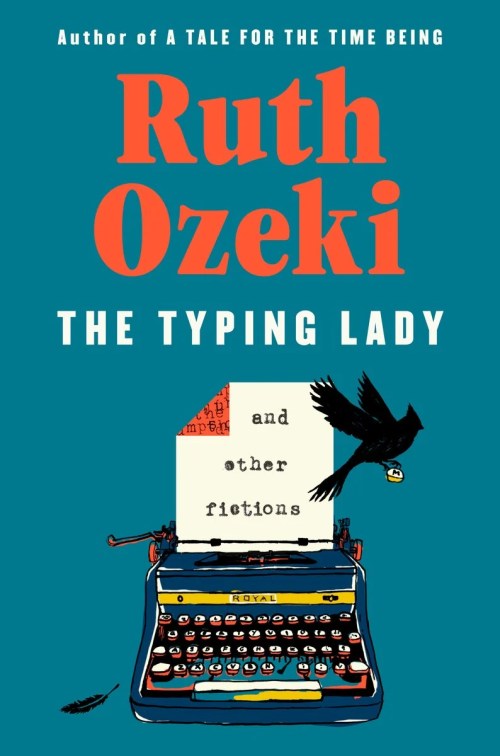
FICTION
The Typing Lady
By Ruth Ozeki
Viking
Published June 2, 2026


