


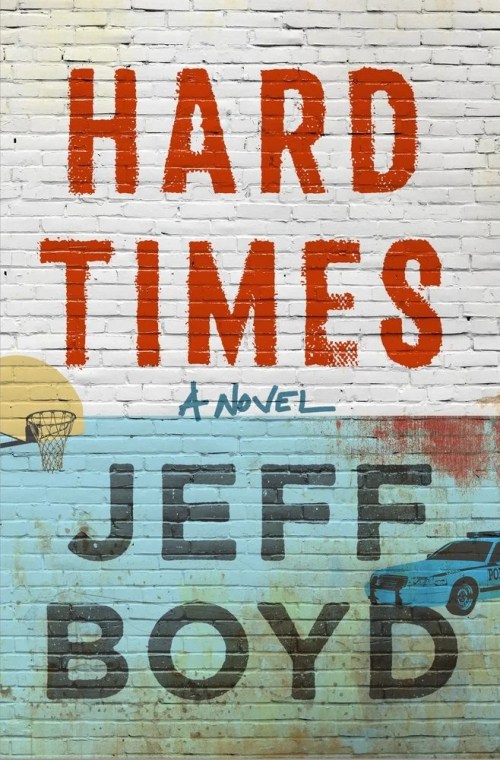
While he has a buzzcut, Jeff Boyd, whose second novel Hard Times is out this month, has the humanity of a long-haired hippie do-gooder. He describes himself as “pretty empathetic”—not to give himself a gold star for good behavior,but to admit that his empathy made him a bad English teacher, just like Buddy Mack, the protagonist of Hard Times. Teaching at Chicago Public Schools in Bronzeville, if Jeff’s students would confide in him about their parents never being home, not having enough food, or just general safety concerns, he’d think, “This poor kid. Let’s not worry about that assignment.” Similarly, Buddy is splat in the center of drama: His cop brother-in-law shot one of his Mayfield High students, and although Buddy wants to be there for his kids, he’s sworn to secrecy by Curtis.
Buddy has the moralistic anxiety of someone who is always (always) trying to do the right thing; Jeff brings a big heartedness to serious lit-fic about South Side safety. Specifically: He made sure each of the characters in Hard Times was able to speak for themselves. We hear nearly everyone’s perspective, from a Trump-supporting Uncle Rob, to Truth and Zeke, two of Buddy’s students; Kirkus sums up the book by saying, “The novel’s heart and its smarts are almost as big as Buddy Mack’s own.” Though Jeff didn’t consider fictionalizing his students’ stories until he stopped teaching, when he lived off the pink line in Pilsen and was a recent admit to the University of Iowa’s MFA program, each week, driving the 222 miles from Chicago to Iowa City, Jeff thought about them. (On his students: “They’d code switch between being a child and being this tough guy in the world, but when I would talk to them one-on-one, I’d realize, ‘You’re a sweetheart, you’re just a vulnerable kid.’”) And although Jeff now lives in Brooklyn, he said he wrote Hard Times while missing home, hoping readers see the book’s “Chicagoness,” because “I really did try to capture my understanding of it, the truth of that place and of those people,” he said. “There’s a resilience and love that’s unique to Chicago.” I recently spoke with Jeff over Zoom about his new novel, Chicago, and truth—both real and fictional.
This conversation has been edited for clarity and grammar.

Ruby Rosenthal
What did driving so often from Chicago to Iowa City teach you about Chicago?
Jeff Boyd
I started getting this understanding that people had a very different view of the safety or the beauty of Chicago that I found surprising, but also made me really think about place and what it means. It gave me more Chicago pride, too.
Ruby Rosenthal
I understand that—I’m from a very safe suburb in South Florida, and sometimes, when I go back, people are like, “I can’t believe you’re alive!”
Jeff Boyd
People have this idea that Chicago has this mass hysteria of violence that any person can get caught up in. My students didn’t say the word safety aloud so much because that’s a sign of weakness—being outwardly scared is a sign of weakness. As I taught and as I got to know students more, I got to really understand the ways that people act out, or even cause harm to others, as a way to keep themselves safer, so they think. And a lot of my characters are motivated by that, but I think a lot of people are, no matter where you’re living.
It also helps build the humanity of the characters. I really try to take people as individuals: What does this individual person’s capacity for safety and violence and love look like? Even when we talk about violent things that happen in Chicago or anywhere else, a lot of times it is very personal. It’s related to a family member, or a rival gang, or their own safety. But it comes from this place where it’s like, ‘well, if I don’t get someone, they’re going to get me.’ Senseless violence has happened, but it’s usually not so senseless when you start breaking it down. And I think that’s what I tried to do with this book. I wanted to give it meaning, an understanding where you could connect the threads.
Ruby Rosenthal
Is your perspective on “safety as a weakness” coming from what you saw when you were a teacher, and that’s why it was integrated in the book? Or are these things you saw living in and outside Chicago?
Jeff Boyd
It’s a little how I’ve had to navigate things being a Black man in America, and also just a boy growing up, having this hardness, because people usually mess with you when they think they can. I had students who I saw on both sides, but also, these are 14-year-olds, so you see them oscillating between being a child, and acting like, I have to act this way, because that’s what ‘men’ do. I started to see the depths of their humanity and also my own. And so that was always on my mind, even after I got done teaching and went to Iowa. That’s when I realized I wanted to write this story, when I had to kick and go in the memory bank to see what I could pull from, from experience or inference.
Ruby Rosenthal
From what you’re saying, and also just from reading the book, it seems it was very important for you to let every character tell their own story.
Jeff Boyd
My first novel was in first person, but sometimes I wished I could jump into someone else’s head; I liked the idea that I could start having other characters speak for themselves. I started out with Buddy and the school, and at some point, he was talking to a student, and I was like, ‘Well, wouldn’t it be nice if we could just get that student’s side of the story?’ Besides, you have a harder time making quick moral judgments about who’s good and who’s bad if I show every side of the story. Like I said, I think I’m pretty empathetic. So even if I’m in a fight with someone, half the time, I’m like, ‘Oh, well, I do see your side of this.’ I like the idea that we get to see where [every character’s] coming from. We get to let everyone speak for themselves.
Ruby Rosenthal
So thinking about perspectives, there were a few times I noticed where Trump came up. I was curious why you decided to set this book in our current age, and to use his name in it?
Jeff Boyd
Uncle Rob [in the book], he’s a Trump fan, which also works with my concept of people in the Black community who are fans of Trump like him because of his bravado, and because he’s not held to the truth. And so I think it’s a good counter to these characters—like, what is the truth? What’s real? The idea that the person who wins is the person who controls the narrative, the person who can control the spin. And some of what these characters are dealing with is the spin. It is the lies that maybe someone else has told about them. It’s someone else’s fear, or grasp for power getting in the way of what the common good is.
Ruby Rosenthal
Why did you decide to name a character “Truth”? At one point near the end, you write something that says “shooting of truth,” and there, it feels heavier than any other moment in the book.

Jeff Boyd
I had a student with a name kind of like that, and he was pretty untruthful; I always thought it was such an interesting name for someone [with a trait like that]. And then I got to this point where I realized maybe one of the problems this kid has is that he is always so truthful that he doesn’t hide away, wears his heart on his sleeve, tells a student or a teacher exactly what he thinks about them, and how that rubbed people the wrong way. I thought the same thing with [the character] Truth. As the book went on, the name kind of did feel a little more symbolic. I was like, ‘Oh, like, yeah, we started shooting a truth.’ It started to feel more important and more apt as I went on with writing it.
Ruby Rosenthal
Yeah—there’s so much kind of blurriness around who knows what. The whole book was all these different questions of misinformation, disinformation. You’re hearing different stories.
Jeff Boyd
One of my old writing teachers was always talking about how the fictional truth is somehow more true than the actual truth, it’s also about owning it—and who owns the truth? But it’s the same thing with history and the narratives that we have. What do we hold as being true? Ours is usually just the prevalent story of the person who won. Then, there’s this interrogation of what the truth actually means, and who gets to tell the truth, how do we determine that they’re right and that the other person is wrong or lying?
Ruby Rosenthal
What do you hope people take away from the book?
Jeff Boyd
I hope when people read it, they can feel empathetic or sympathetic to their fellow man’s plight, and not see Chicago as this monolithic place where people are like ‘this,’ or people like are ‘that.’ In our country and in our world, people are missing the joy that can come from really understanding other people, and giving other people space and grace. Despite anything he wants, Buddy is one of those characters who can’t help but try to help people when he can see a space for it. Maybe it’d be nice if people tried to do that more often in a more altruistic way. I hope that people find a hopefulness in the book, despite its high stakes stress. By the end, we can find comfort in the fact that there are people who really do care about each other, and maybe we can find ways to do the same thing.
FICTION
Hard Times
By Jeff Boyd
Flatiron Books
Published March 17, 2026


