I first came across the work of Shasta Grant more than a decade ago, albeit anonymously, when I judged the Turnbuckle Chapbook Contest from Split Lip Press in 2015. Grant’s razor sharp flash stood out from the pack, and her runner-up manuscript, Gather Us Up and Bring Us Home, was selected for publication by SLP in 2016. From there, our connection grew across continents (Grant was living in Singapore at the time) and later across states, once she resettled with her family in Indiana. Somewhere in all of our exchanges, I must have learned she came from New Hampshire, but I hadn’t fully realized the rootedness of place until I encountered her transporting novel When We Were Feral. Set in her hometown in the early 1990s, the affecting coming of age story opens when a neighborhood teen drowns in the local lake, and takes off from there, exploring adolescence and all its attendant mess: friendship and family, desire and envy, longing and trauma and grief.
Sara Lippmann
This is your debut novel. How did the book take shape? Did it always start with the drowning incident? Or was there a different seedling from which it grew?
Shasta Grant
The seedling was Maggie’s mother taking off, and that was always what I would consider the emotional center of the book. The first draft was a dual timeline and it originally opened shortly before Maggie’s ten-year high school reunion. She gets a phone call from an attorney who informs her that her mother, whom she hadn’t seen in fifteen years, is dead. And then the adolescent and adult stories unfolded from there. After I finished the first draft, I realized the girlhood timeline was what interested me the most, so I cut the other half and developed the story from there.
Sara Lippmann
I am always a sucker for a good loss of innocence story. What is so remarkable here is that faultline of before/after keeps shifting, so that the narrator’s footing is destabilized again and again. All of which serves as a sort of deflection from the primary rupture: the disappearance of the narrator’s mother. Why was it important for you to map the emotional experience of grief through this kind of displacement?
Shasta Grant
I was trying to constantly destabilize Maggie’s life, so once she thinks ok, this is my new reality, something else happens. This prevents her from processing the initial fault line, which is her mother taking off. For me, everything in the novel comes back to that. But I wanted the emotional terrain of that specific grief to be in the background rather than the primary story—because it underscores how Maggie wasn’t provided with space to grieve her mother’s abandonment.
Sara Lippmann
Motherhood becomes both a repository for loss and a scapegoat for blame. Two out of the three girls in the friendship triangle have mothers who go missing, while the third girl’s mom becomes the compensatory uber mother to them all, almost godlike in her reign. Together, the three present an ambivalent portrait. The irony is inescapable. Overbearingly present or absent, perfect or lacking, mothers carry this burden, while the fathers escape such judgment despite their nominal involvement. Why are the mothers always at fault?
Shasta Grant
Your mother is supposed to love you more than anyone in the world. And she’s certainly not supposed to leave. That’s the terrain of fathers. We expect very little from fathers, and this was even more so in the 90s. So just the fact that Maggie and Erin’s fathers are present, even if they are emotionally distant, they get a free pass. No matter what demons the mothers in this story are facing they are at fault because we expect motherhood to be enough for them.
Sara Lippmann
Something I think about a lot in my own writing is “the intimacy of unknowability,” a phrase I first came across in an essay by the late Anthony Veasna So. Your decision to honor the elusiveness of Maggie’s mother, to keep her in shadow, largely off the page, pieced together through glimmers, feels like an expression of this grace. As a result, penetrating details like her hooked rugs hold tremendous weight and ache. Especially for mothers, onto which so much is projected, this feels a critical choice. Was she always this present in absence? Or did you write her out more initially, then cut away? Are we—is anyone—ever truly knowable?
Shasta Grant
Maggie’s mother was always in the shadows of the book. But it was important that readers feel her absence—and so I knew she had to be both on and off the page. I wanted a few scenes to carry the full weight of the mother and her unknowability. Maggie is constantly thinking about her mother because she’s gone. The hooked rugs represent a way for those thoughts to have a physical manifestation. And she literally rescued them from the trash. Her father tried to cull any sign of her mother from the house. That’s how he’s coping with her disappearance, by erasing her. Maggie is trying to hold onto her. But she’s doing so with this part of her mother’s life that was discarded. Maybe she feels a connection with the hooked rugs because they were one of the things her mother also left behind.
Sara Lippmann
Grief is central to this story, yet it’s not allowed room to vent. Both Maggie (the narrator) and Erin, (who experiences multiple, unfathomable losses) keep their emotions contained, tucked under the guise of silence. The veneer of politeness and decorum persists. Sarah, the third girl, is raised as a good, diligent Christian. Is repression a necessary prerequisite, a sort of powder keg, that finds release in teenage rebellion?
Shasta Grant
This emotional containment feels very New England to me, to be honest. Grief is a weird thing. It’s both private and public. We have this brief period of public condolence, where you’re given space to have all these big feelings, and then you’re supposed to carry your grief in private. For Maggie and Erin, there is this period of unknowing—they don’t know where their mothers are—and people don’t know how to react to it, so they don’t even have access to those public rituals of mourning. Meanwhile their friend Sarah and her mother, whose lives seem enviable, are encouraging them to not only move on but be these good Christian girls. Had they been given freedom to vent their anger they wouldn’t need to find release in rebellion. The repression nearly demands it. Something has to give.
Sara Lippmann
Speaking of rebellion, I want to ask about agency. When the girls head to the woods to conjure and sleuth, their Harriet the Spy efforts become an attempt to assert power over situations in which they feel powerless, to stake a claim, to fill a void. Yet whatever measure of freedom they may feel in the wilderness, which finds further outlet in their performance of “wildness,”rapidly becomes usurped, which may be an accurate portrayal but it’s a helluva depressing one. What does it mean to be feral? Do we become closer to or farther away from our deepest, most elemental selves? Is it an approach or a retreat?
Shasta Grant
Agency was something my agent and I discussed and how to give Maggie more of it. In earlier drafts, things were mostly happening to Maggie. So having her lead her friends to the woods was one way to give her control and power. I don’t think readers will believe their investigation has any legs and that’s not the point, it’s just the only thing she can do. She carves out a place where she can feel both powerful and free, until outside forces come into play. I see how that can be read as depressing. Yet it feels like an accurate portrayal of the power dynamics for thirteen-year-old-girls. For Maggie and Erin, being feral means allowing space for all their emotions, especially the darkest and ugliest ones, to exist. So, in this sense, they become closer to their most elemental selves.
Sara Lippmann

As a reader, I was grateful to slip into the analog world of the early 90s and to be grounded there. Ferality seems like it would be harder to achieve today, when everyone is tethered to their phones. Invention and imagination often take flight from boredom, which is filled by endless scrolling and streaming. No one can go missing, be unaccounted for. On the other hand, I shudder to think how bullying elements might escalate in cyberspace.
Shasta Grant
It would be much harder for the characters in this book to go missing now. I suppose the mothers could turn off location sharing on their phones but to disappear from the internet entirely would be difficult. The way information becomes available in the novel also plays a factor—the newspaper only comes out twice a week—so information is slow to surface and that would change with our 24-hour news cycle. For the girls, there’s really no way to disappear into the woods if you have a smart phone (other than leaving it behind). I shudder to think about the potential for bullying if all these kids had social media. I can imagine how photos and messages on Snapchat would spread like wildfire.
Sara Lippmann
Time—but also place—contribute to an innate sense of longing. Longing for childhood, longing for an unbridled youth, longing for this moment. We’ve all lived long enough to know that even when you go back, you can never go back. It is forever changed. More, the pervasive longing the reader feels is torn asunder by a cruelty that haunts this story. The rose colored glasses are shattered, yielding a rude awakening: that which we may long for was actually quite terrible. It feels like a direct admonishment to my Gen X heart. What was it like for you to revisit the past in this hometown novel?
Shasta Grant
My grandmother used to say that high school was the best time of her life. I thought she was crazy but now that I’m older, I understand what she was saying. Those weren’t the best years of my life (they might have been some of my worst) and yet, there was this feeling that anything was possible. There’s an intensity to your life as a teenager that fades as you grow up. I have profound nostalgia for my hometown and my childhood. It hurts my heart to think about it too much because, as you say, we can’t go back. Writing this novel was an attempt to return to that time and place. And yes, what I discovered was a lot of cruelty. 90s nostalgia is having a moment and maybe things were simpler back then, but we’re romanticizing it. To begin with, we had no language for consent, which is something your new novel also grapples with.
Sara Lippmann
The cruelty of the ending is haunting. For a book told through retrospection, I imagine it continues to haunt Maggie (and Erin) as well. We’ve all seen the Kavanaugh confirmation hearings. And I can’t help but wonder how this event has steered the adult lives of these girls. Threads hang intentionally loose. How does Maggie make it through? What becomes of her mother? Will Erin ever process her grief? Will Maggie reckon with the past? Will Sarah ever forgive her friends? How have they all survived (or have they)? Are these characters going to be revisited in another project? What is next for you?
Shasta Grant
I wrote the first draft before the Kavanaugh hearings, but this thread was already there because, let’s face it, Christine Blasey Ford’s story did not exist in a vacuum. This kind of thing was happening to a lot of girls. But I did add a passage nodding to it and I’m glad you picked up on it! I do think Maggie and Erin and Sarah will be haunted forever. I can imagine a Kavanaugh-like situation in a present timeline, where this trauma resurfaces. I’ve thought about writing that. I’d love to revisit these characters. After revising the novel into its current form, none of what I wrote for the reunion timeline in the first draft feels right anymore. I don’t believe Maggie’s mother is dead. I imagine she reappears every so often, just enough to keep Maggie’s hope alive. I think Maggie makes it through largely by tamping it down in that New England way. I hope every now and then she can let her feral-ness surface. I can’t imagine Sarah would ever offer forgiveness. I’d be curious to see Maggie and Erin ask for it though.
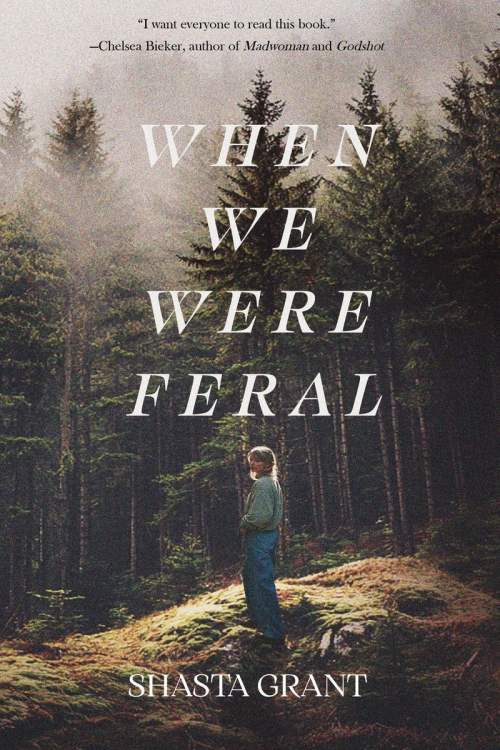
FICTION
When We Were Feral
By Shasta Grant
Regal House Publishing
Published June 9, 2026