The call to acquire a room of one’s own echoed throughout the early twentieth century. Franz Kafka heard it louder than most. To write, he needed the solace of his pokoj—a Czech word meaning “room” but also a sense of tranquility and peace.
Maïa Hruska, in her literary history Kafkaesque, compares these two concepts directly: “The ‘room of one’s own’ imagined by Virginia Woolf was a physical space that separated a woman from the constraints of marriage and family. . . . The pokoj is the place . . . in which we refuse to let ourselves be reduced. In this sense, it is the incubator of all literature.”
Hruska writes that Kafka was willing to endure a life of seclusion and relative anonymity, no matter its social costs, so long as it would afford him the space and time to write; it is what mattered most to him, as revealed in Kafka’s diary entries from 1922: “Everything that is not literature bores me”; “I hate everything that does not relate to literature.”
This makes the pokoj, the space that physically and psychologically enables Kafka to write, an effective narrative throughline for Kafkaesque. In it, Hruska devotes one chapter each to ten notable writers that translated Kafka’s German into their own first language, and she demonstrates how each of these writers came to cultivate a pokoj of their own.
Many writers in the first half of the twentieth century discovered in Kafka’s work something alarmingly familiar. While this sense of recognition came at a distance of reading Kafka’s German in translation or from the perspective of a second, third, or fourth language, they were uncanny resonances all the same. Kafka’s fiction prompted his earliest readers to use “Kafkaesque” as an adjective to describe moments of confusion, alienation, and absurdity in their everyday lives.
Beginning in the 1930s, Kafka’s work was banned by the Soviet government, so the first Russian translations of his stories were necessarily anonymous. Hruska points to this act of subversion as an enduring aspect of what continues to make Kafka’s writing appealing to dissidents: “Totalitarianism requisitions language and living spaces because it wants to extinguish all forms of inner life, of which the pokoj is the shelter and the reflection. It is only in the pokoj, which unites a room of one’s own and a language of one’s own, that an individual can arrange her freedom.”
In 1928, Kafka’s work was first translated into English, by editor and former Chicago Tribune reporter Eugene Jolas. (He was first translated into French by the acclaimed journalist Alexandre Vialatte at the same time.) Hruska writes that Kafka’s first readers in English were often the students and entourage of European intellectuals who had emigrated to the US escaping German Nazism and Soviet communism.
Hruska highlights Vladimir Nabokov, who admires Kafka as a writer and is well known for his lectures on The Metamorphosis, noting how he and other Soviet writer-defectors “became bilingual through circumstances, [and] were doubly sensitive to the transports of the imagination, and to Kafka’s in particular.” She argues that, after experiencing physical and psychological transitions, who better but these writers “[to] understand the metamorphoses at work in Kafka?”
Yet having an acute understanding of Kafka’s most bizarre and alienating fictions could be far from a feeling of comfort. Hruska observes how extreme recognition of the uncanny in Kafka’s work can threaten to disrupt a writer’s pokoj in her chapter on Primo Levi, a Holocaust survivor from Italy. Hruska imagines that Levi’s greatest fear was that the truths attested to in his 1947 book, If This Is a Man, would not be believed by readers in the same way that Kafka’s stories were often rejected by readers for being too outlandish.
Hruska writes: “The testimonies of Holocaust survivors and Kafka’s fiction—‘In the Penal Colony’ in particular—had this in common: what was most disturbing about them was that they did not depict the horror as some aberration or barbaric regression from the norms of modern civilization, but as the very culmination of modernity, its unspeakable apotheosis.” Hruska expands on this insight and more in the two chapters on translating Kafka’s German into Yiddish and Hebrew.

For writers to identify their circumstances as Kafkaesque became more common as translations of his work spread and the pace and scale of modernity increased. Hruska writes in her chapter on Jorge Luis Borges how he admired the endlessly elusive nature of Kafka’s writing: “The labyrinth is the condition of modern humanity: Kafka and Borges agreed on this point. The only way to survive it, they seemed to say, was either to go ever deeper within it or build a counter-labyrinth.” Then, in her chapter on the French journalist Alexandre Vialatte, Hruska sources a letter he wrote to a friend while living in Germany in 1927. At one point in the letter, Vialatte says, “I feel as if I am living in a Kafka novel.” And, like “Orwellian,” “Kafkaesque” is a common descriptor that has continued to inform how we understand the present.
Hruska concludes the book with a reflection on her own pokoj, moments in her life of significant loss and transition, as well as the bond formed between translators, writers, and the work they share together: “What Kafka’s translators have in common with his characters is that they were all, one day, torn from the place that had nurtured their relationship with their language and with the world.”
With Kafkaesque itself being a translated work, from the Czech by Sam Taylor, Hruska is encouraging us to have faith in writing that attempts to bridge the gaps between us, across the chasms of language and lived experience. While Kafka’s fiction may sometimes strike us as alien, it waits for the right reader who knows “deep in the fibre of their being, what it mean[s] to be transported from one language to another.”
NONFICTION
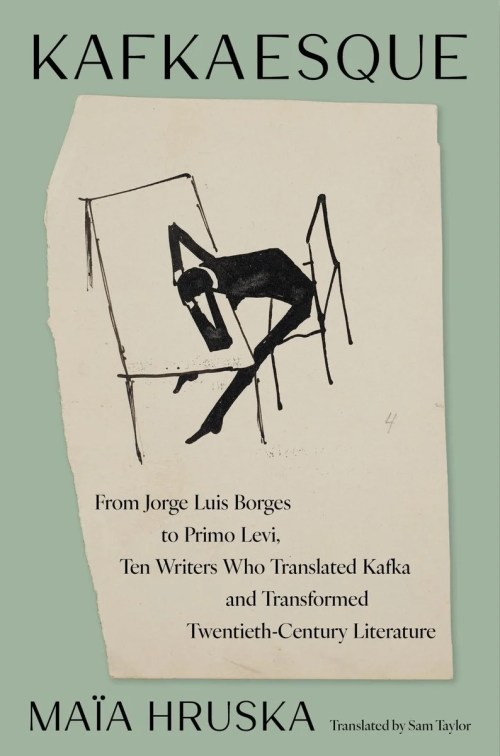
Kafkaesque: From Jorge Luis Borges to Primo Levi, Ten Writers Who Translated Kafka and Transformed Twentieth-Century Literature
By Maïa Hruska
Translated from the Czech by Sam Taylor
Ecco
Published May 12, 2026