


I first met Isaac Fitzgerald at the Bell House in Brooklyn when The Rumpus was co-hosting a holiday party. I had just started writing for the site, and he had previously served as managing editor. A few years later we both read at the Manhattanville Reading Series in Crown Heights where he read an essay, portions of which would appear in Dirtbag, Massachusetts, his coming-of-age memoir where he examines his relationship with his parents and reflects on his childhood. His children’s book, How To Be A Pirate, has also entered the regular rotation of bedtime books I read to our five-year-old.
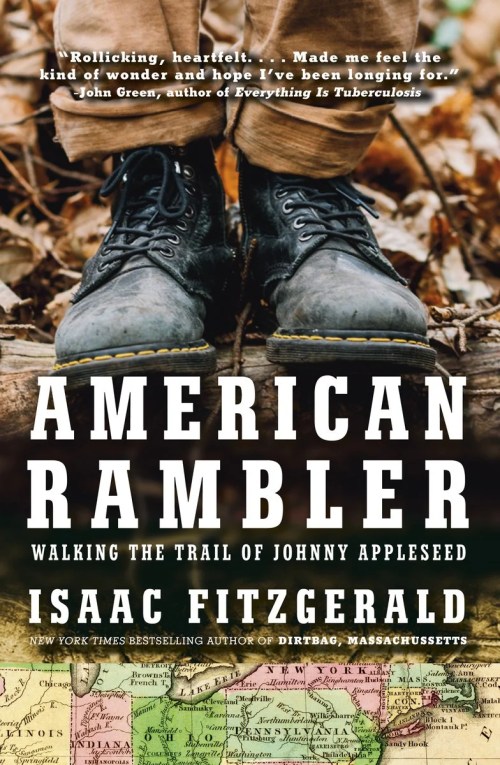
In his latest, American Rambler: Walking the Trail of Johnny Appleseed, Isaac traverses the path of the legendary, and very real, apple enthusiast. The icon was born John Chapman in Leominster, Massachusetts, not far from where Isaac grew up. Chapman wandered westward in the early nineteenth century planting orchards. The fruits were commonly used for brewing hard apple cider rather than eating.
In American Rambler, Isaac takes us on a journey beginning on a snowy spring day in western Massachusetts through heartland cities, passing no trespassing signs, and along dangerous highways. Along the way across five states, he communes with people of all sorts, narrowly escapes near death, and enjoys a few drinks all while discovering more about who he is, and who he wants to become.
We chatted over Zoom earlier this month.

Ian MacAllen
When you were walking around Brooklyn during the pandemic, and then writing Walk It Off, the newsletter, had you conceived that walking would eventually become a book project?
Isaac Fitzgerald
No, 100% it was a natural progression. I was doing 20,000 steps a day, and I had these really clear memories coming back to me of my father, who used to take me for long walks when I was very, very young.
We’d go on these tremendous multiday hikes in the White Mountains up in New Hampshire and other parts of New England. We were part of the Four Thousand Footers club, trying to see how many of the 4,000 footers you could climb. We’d sleep outside or in a tent or if it really rained, we’d try to get back to his truck. I was having these memories of that.
I liked what it did to my brain. It quieted it in this way that I found very soothing. That lonely part of it, I really liked. But then when I started doing Walk It Off and walking with authors and talking to them, I realized how great it was to have a conversation. It’s two people moving through the world. At no point was I thinking about a book.
Then I wrote this piece for The Guardian, and the reaction to it was so strong. And of course, once you think about it, like Cheryl Strayed’s Wild, Bill Bryson’s A Walk in the Woods—there are so many great walking books.
After Dirtbag, which had way more success than I expected, I was thinking about what could the next project be? It was my wife who said: you love walking. You’ve talked about this reaction that The Guardian piece got. Do you have a favorite walker?
Without hesitation, I said, Johnny Appleseed. I grew up near where he was born and had all this knowledge about John Chapman, that he was real. The very Disney-fied version of history that we got was that the apples were for pies or tarts, but it was actually for booze. That’s when I realized I could go on a solo walking journey.
Ian MacAllen
You came across a lot of tangents. Was there a metric for cutting things?
Isaac Fitzgerald
This is where I say: God bless my wife, Kelly Farber; God bless my agent, Meredith Kaffel Simonoff; and God bless my editor, John Freeman. I understand that there are certain writers who have pure vision and they know exactly what they want to get down, and I admire those people. But I am very open to collaboration.
I had a very lonely childhood but I feel better when I’m around people. With this project, I had so many things that I wanted to put in this book that I needed the guidance. There are other writers who are so impressive with their words that they’re like: no problem, and just throw it in the trash and start over.
Each book is very standalone—but if you read Dirtbag, it clicks nicely together with American Rambler. In a way, I’m re-questioning my own stories from my last book. I wanted to give my parents more complexity and more three-dimensionality.
In Dirtbag, imagine if somebody had taken the worst moments of your life and compiled them all in a book. It’s like I’d pick the worst moments without including any of the good moments. I wanted American Rambler to show more of those good moments, those walks with my dad, the canoeing and the camping.
I wanted it to feel vigorous—as your blood starts to pump and as your brain settles down and as you find your rhythm, I really wanted the reader to feel that as they were going through it and then to feel almost that loneliness and then the joy of: oh, wait, here’s some people. Let’s commune with them. Let’s have fellowship.
I still wanted to start in that lonely spot. And then, not giving too much away, the end is supposed to show the importance for me to find balance, especially for the people I love who do find themselves in positions that are too lonely and don’t know how to ask for help.
Ian MacAllen
You do include some of your friends who you stay with in the book. Did you warn them ahead of time that they were going to become part of it?
Isaac Fitzgerald
Everybody that’s in the book knew I was working on the book, friend or stranger.
John Chapman—Johnny Appleseed—walked alone a lot. But then also he slept on strangers’ floors, and they became friends, and he slept on friend’s floors. And all of a sudden, that opened up for me another part of this book, which is, I was never going to sleep in a hotel. I was either going to sleep outside or sleep at a friend’s place.
I reread On the Road before I went out on this journey. You want to talk about a big argument: talk about putting walking on the cover of a book where the guy gets a Jeep fifty pages in.
But when I reread that book, what I hadn’t remembered as much was the Neal Cassady, and Dean Moriarty of it all. Of course, there’s the jobs and the booze and the hanging out with guys, in the trucks or the train. But there were so many moments where he’s just pulled into town with his buddy—this person almost always is Allen Ginsberg—and they were just very clearly just doing speed and talking to each other.
I wanted to incorporate that, maybe not so much with all the speed, but I want to incorporate that my friends have these brilliant conversations, and that is a piece of this story.

Ian MacAllen
In your previous writings and interviews, you talk about walking away—from a job, from a relationship. Did you feel like you were walking away from something or walking towards something while writing American Rambler?
Isaac Fitzgerald
I definitely felt like I was walking away at the beginning. My friend Ada Calhoun has described this book as a grief memoir in reverse, which I thought was really good. This is kind of a coming of middle-age story. Literally, at one point, I am tempted to buy a Corvette, and that’s the most middle-aged man thing you can do in the world. Other people bring their context to it, and they maybe see even more of what you mean than you yourself. At the time, I was grappling with so much.
I didn’t quite know what was going on in my life. There was stuff at home going on that I couldn’t face and that wasn’t being maybe communicated to me as well as it could be. And I just wanted to get out. I wanted to get out into the world a little bit and move around and see the country at an eye level, meet people, but also just figure out who I was. I did feel like I was walking away from it.
Then the relationship that I’d kind of had just started when I started the walk continued to grow more serious. At first, we were both a little bit like: we’ll see what happens.
But then, at a certain point, I’m just thinking of putting myself in her shoes: Oh, where’s your new boyfriend? He’s bumming around somewhere in Indiana.
As I was walking and I started to realize that so many of the books that I was raised with about walking and traveling, and that I admired, were built on this idea of a solo journey traveling throughout the land.
I just had this real romantic idea that I’m always going to be a rambling gambling man. I think what I was walking towards without knowing it was recognizing that I don’t need to let go of that fully. There’s always going to be times to live an adventurous life, but the definition of what adventure is can change. And sometimes an adventure can be allowing yourself to admit you want to settle down with someone and allowing yourself to admit that you’re interested in a home.
Ian MacAllen
You’ve talked about being “time wealthy.” Are you still time rich?
Isaac Fitzgerald
I am lucky in that I’m still wealthy in time, but I think I am more aware of how I want to spend that time than I was before. This book almost tells the story of a man who’s kind of losing his mind, who’s lonely and has a little bit too much time on his hands, figuring out what he wants to do with the precious time that he has left. That is something I am more aware of every day.
Nonfiction
American Rambler: Walking The Trail
of Johnny Appleseed
By Isaac Fitzgerald
Knopf
Published May 12, 2026


