


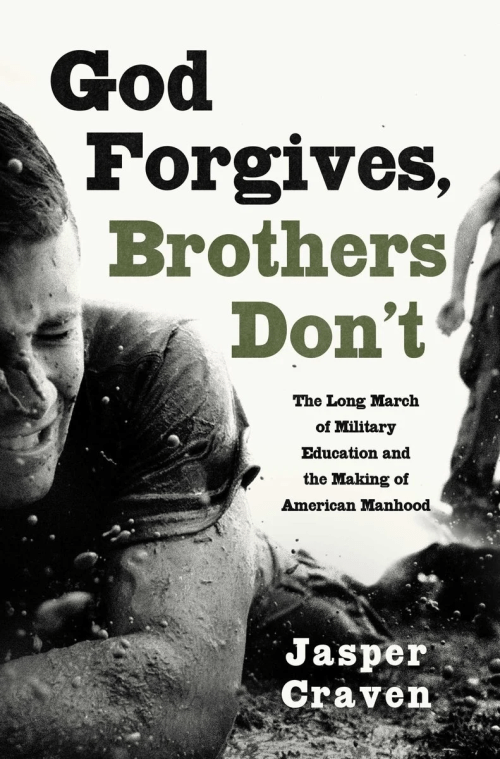
I have a confession to make: my first thought when I saw the title of Jasper Craven’s new book God Forgives, Brothers Don’t was something to the effect of, “Hell yeah.” The words rang true with what I’d learned about being a man during my time as a Marine Corps infantry officer. Then a quick Google search revealed the slogan as originating from White supremacist groups. But there’s a reason the West Point football team was also inadvertently taken in: a rallying cry demanding total in-group loyalty speaks to core tenets of our military education. And its silent associations attest loudly to the underside of that education.
Craven has reported extensively on the military and veterans’ issues, to include exploring political attacks on the VA and the long, dangerous afterlife of decommissioned military equipment. In God Forgives, Brothers Don’t, Craven turns his investigative eye towards American military education, from the Boy Scouts and JROTC, through secondary schools like Valley Forge Military Academy and New York Military Academy (Donald Trump’s alma mater), and onto the senior military colleges and service academies. At each step in this pipeline, Craven uncovers similar abuses: hazing, racism, misogyny, evangelism, and violence. Pervading it all is a narrow-minded, noxious masculinity, leaking out into American society and ultimately infecting the highest levels of Trump’s government.
But the relentless focus on these discouraging problems is in service of an encouraging thesis: violent behaviors are taught, rather than innately known. After all, if men were inherently vicious enough to serve the military’s purposes, no such education would be needed. God Forgives, Brother’s Don’t ends in a Civilian Public Service camp housing conscientious objectors during World War II. There, we see a different view of what it means to be a man, one grounded in principled nonviolence rather than harsh discipline, total togetherness rather than exclusion. But that vision still retains proud hallmarks of the male experience, namely close-knit brotherhood, physical prowess, and service to larger ideals. Through these men we glimpse, perhaps, a different set of possibilities.

Adam Straus
Let’s start at the beginning of your book, chronologically speaking, with a question that’s been around as long as America’s had any form of military education. How do you balance the real or perceived need for a professional standing military with the indisputable downsides of that presence in society? Is that balance even possible?
Jasper Craven
It’s a really good question, and one that I think I grappled with throughout. My feeling is that the military imperatives of loyalty and obedience make it virtually impossible to establish an institution that can police itself, or be accountable for abuse. But I do think that there are benefits to reeling in the worst impulses of any military by creating a professional officer class. In educating those officers, one needs incredible civilian oversight, more civilian oversight than what currently exists. There needs to be an emphasis on the humanities, and ideally some sort of curriculum that aims to rein in the egos of these officers. I don’t know exactly the best way to do that. America writ large has elevated the soldier to this hallowed status, and that translates to an officer class that is often very arrogant and unwilling to stare honestly at the problems in front of them, unwilling to be humble and accept responsibility. If we lived in a society that equally admired other forms of public service, maybe that would be a broad-based approach to reining in the influence of military arrogance in American affairs. In short, while I think it’s important to expose America’s future military leaders to higher education, the current system is dysfunctional. Probably the first place to look for a way forward would be ROTC, which actually embeds future officers as students in civilian colleges.
That said, many whip-smart youngsters matriculate at the service academies, many become Rhodes Scholars even. These are often independent-minded people who have great ideas, and some of them have historically been able to influence the Pentagon in positive ways. The problem, though, is that the smartest among these cadets, the most independent-minded, the people who most purely believe in duty, honor, and country—they often find themselves disillusioned in profound ways. From there, many simply leave the military after their initial commitment. Or they stand up and try to establish accountability, to bring the military in line with its purported mission, only to face intense retaliation. So a lot of really incredible talent, I think, is wasted.
Adam Straus
Even going through ROTC in a civilian college, those campuses still face ballooning costs, STEM’s predominance over the humanities, rampant use of generative AI as a form of cheating, and so on. How do you locate issues with military schooling amidst larger crises in higher education?
Jasper Craven
My most fundamental point would be that a country that dedicates such vast resources to its military will inevitably see degradation in other forms of life. Civilian colleges across the spectrum are reaching this crisis point where, lacking requisite federal support, they’re needing to raise tuition to ungodly levels, while at the same time turning to private corporations and Pentagon contracts to stay afloat. Even at the University of Vermont, my home state, which has this reputation as a hippie haven, they’re receiving millions and millions of dollars every year from Lockheed Martin and other defense contractors. I see the crisis in civilian higher education as inextricable from the gross amount of federal money that’s pouring into the Pentagon and its attendant educational systems.
Adam Straus
It’s tough to see a way out of that under Pete Hegseth, who embodies so many of the worst impulses you identify in this book: misogyny, Christian nationalism, alcoholism, sheer fucking stupidity. And he’s dead set on remaking military education in his image. Do you see Hegseth as a Sylvanus Thayer-like figure who’s going to cast a permanent shadow? Or is he just a temporary intensification of existing trends?
Jasper Craven
I was thinking recently about whether this is a political book. While I was writing it, I didn’t necessarily think it was engaging in American politics in a deep way, but looking back, what became clear is that throughout American history it’s really only been conservative figures who have aggressively looked to mold the military while in power. Democrats, especially over the last half-century, have really just deferred to the status quo and maybe done a few reforms around the edges. There exists a deep fear within the Democratic Party to question this institution, largely because there is a deep fear of emasculation, of being derided as weak on the political stage. So at this point, the Pentagon really is the result of conservative administrations wielding a series of substantial reforms, going back to the end of the draft. At that moment, there was an incredible opportunity to build a new population of service members. Conservative officers within the Pentagon seized that opportunity to begin aggressively recruiting from evangelical, southern, poor places. That has created the military we see today.
So I do think that echoes of Hegseth’s tenure will be felt for a long time. He’s very aggressive and I can’t really see anyone on the left who seems to be thinking through how the Democrats might reform the Pentagon should they reclaim power. There are these liberal service candidates, people like Pat Ryan, who’s a West Pointer, but they don’t really seem to think very imaginatively about the military. The most they’ll do is maybe be somewhat critical of foreign entanglement and feel like they have political cover to go out on a limb because of their veteran status. But there’s not much interesting thinking. I mean, Pete Buttigieg hasn’t spoken in any real compelling way about how he sees a future military. It’s not something the left pays much attention to.
Adam Straus
It’s a catch-22: anyone on the left who was not in the military lacks institutional knowledge and credibility, and anyone on the left who was in the military feels a certain sort of baseline loyalty that precludes engaging in deep reforms.
Jasper Craven
I think that’s totally true.
Adam Straus
I want to stick with Hegseth, focusing on his history with women. In some ways, women are the group maybe most explicitly excluded from the toxic masculinity articulated in and by military schools. Given how grim the picture is from the top down, do you see any changes that are possible from the bottom up to counteract this messaging?
Jasper Craven

The last two and a half decades made it possible for women to prove their mettle in military environments. That period of time has been profoundly important in developing a certain institutional respect for women. There are a lot of guys in the service who, while skeptical at first, came around on serving with women. There is a community of men who respect women and will elevate them if possible. But at this point, so many women are leaving, deeply disillusioned by the rhetoric at the top. The last two decades didn’t get women in enough positions of power to keep a chain of support and promotion going. There was an office the Pentagon started about a decade ago specifically to promote women into positions of leadership; Hegseth abolished that. Some of this can come back, but this has only been a year under Hegseth. I worry that by the end of Trump’s second term there will be a mass exodus, matched by an influx of, you know, looksmaxxing irony-pilled racist white dudes who will wreak havoc on the place and make it so toxic it will be impossible for people with a backbone and a basic moral compass, men or women, to navigate.
Adam Straus
I certainly wanted to ask you about the current generation of teenagers, the narratives of masculinity on which they’re being raised. In your research, have you found any connections between the burgeoning manosphere and military schooling? Do we have enough data to think about what happens when boys raised on Andrew Tate and his ilk put on a uniform and find themselves in positions of power?
Jasper Craven
I don’t have much data, but I have theories. It’s hard to say how Gen Z views the forever wars. But I think they have no real loyalty or patriotism for this country, and I think many of these guys feel fine “stealing valor,” pumping iron and dressing like a cop or an operator and just posing in a soldier-like stance rather than serving. I’m sure many Gen Z kids feel it’s a sucker’s errand to actually sign up and serve. At the same time, though, militia activity is spiking. People who go beyond posturing and misogyny have real dedication to a broader mission of Christian nationalism. In terms of that group enlisting, there was supposed to be data collection and screening initiatives set up after January 6th to combat that, but those were either weak and poorly implemented, or have been scaled back. Exactly how many people with that background are moving into the Pentagon right now is unclear, but I have to believe it’s a significant number.
Adam Straus
So far, we’ve talked exclusively about America. But from the beginning, American military education looked across the ocean to Europe. It was the Napoleonic Era, and we wanted to learn how to professionalize a military from the then-world powers. I’m curious to what extent American military education is unique. Is there hazing at Sandhurst, power struggles between civilian and military faculty at Saint Cyr?
Jasper Craven
The Pentagon has long used military education as a soft power tool. They’re often seeding programs in ally countries. I touch on this with the Afghan Military Academy. Many of the issues that have plagued West Point were also present at this school largely run by the Afghan population outside of Kabul.
I’ve had a Google Alert set for years now on military education, and over the last couple of years, plenty of stories have popped into my inbox alleging terrible hazing, sexual abuse, and cadet-on-cadet violence. Last year, a cadet at the Odessa Military Academy in Ukraine killed himself after facing really extreme hazing. He was forced to drink car oil until he vomited, then he was forced to drink his vomit. Really bad stuff. The Australian Defense Force Academy has struggled with sexual abuse for decades. There was an Eritrean military academy I read about a few months ago that had a terrible sexual misconduct problem. A female cadet at Sandhurst killed herself in 2019 after experiencing sexual misconduct. So going back to the beginning of our conversation, I think that an inherently authoritarian system that is built on breaking people down and building them back up, “preparing them for combat” by dosing out abuse and intense stress—I think that system will inevitably breed violence, domination, and all these things wherever one of these schools is located.
NONFICTION
God Forgives, Brothers Don’t
By Jasper Craven
Atria/One Signal Publishers
Published May 19, 2026


