


What if the God of the Old Testament was still present in the modern world, an emotional deity that walked the earth in physical form, picking out prophets and frightened chosen ones to carry out divine missions? Imagine there are Good Guys and Bad Guys, and God has helpfully picked them out for you ahead of time. To look at His face is to die, so He covers himself up with a veil or mask. He can be humorous and rewarding. But if He’s in a mood, you might become the next Job.
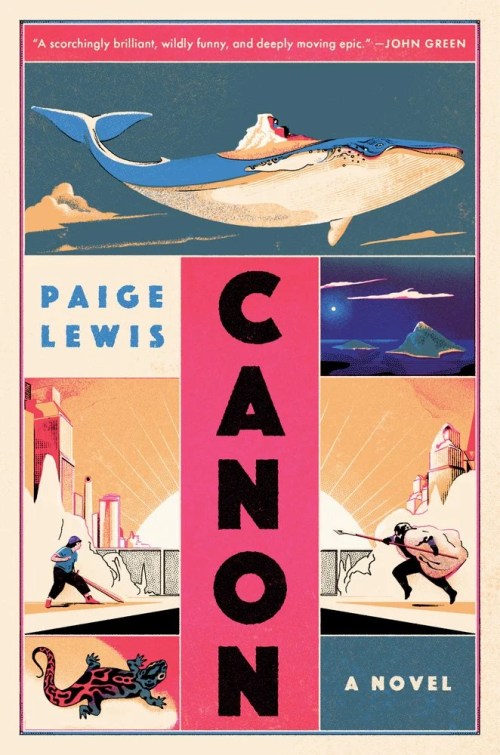
In Paige Lewis’s debut novel, Canon, it’s sometime in the late twentieth century, somewhere on the West Coast. Soundtracks to The Breakfast Club and Full Metal Jacket are still considered fresh, and sold on CD in malls. Talking whales come to greet you at the oceanside. This isn’t too strange—after all, God commanded a whale to eat Jonah. Why shouldn’t they have the intelligence to talk with humans?
The novel is an epic adventure divided between two protagonists: the nervous chosen one, Yara, and the confident prophet, Adrena. God meets Yara by the river one day and commands them to kill Dominic, the leader of an army of “Bad Guys.” Meanwhile Adrena, frustrated at not being the chosen one, joins the army of Good Guys and plans to take out Dominic herself. While Yara goes on God’s training mission, including the aforementioned talking whale and a sea journey reminiscent of the Odyssey, Adrena networks with General Harpo of the Good Guys and searches a shopping mall for war supplies.
Canon is a novel that takes some concepts of Judeo-Christian religion seriously, then explores those concepts in a parodic fashion. A quick comparison is Kevin Smith’s 1999 film Dogma. In Dogma, a similarly unexpected chosen one is sent on a spiritual mission, in a world where Catholic dogma exists with the certainty of physical laws. Canon might be said to be doing similar with the broad strokes of the Old Testament, albeit with hints of reincarnation and a far more progressive God—Leviticus need not apply. (It also seems that Jesus and the Virgin Mary still exist in Canon’s world, as suggested by some offhand exclamations. However, how exactly they fit into the cosmology alongside the short-tempered, more business-like than loving God, is never explored.)
One comes away with the impression that Canon is not a story of hard rules and an inquiry into the nature of religion and spiritual forces, but rather a colorful stage set to explore the feelings and neuroses of the main characters. Yara has an obsession with cleanliness, rooted in various childhood traumas but likely springing from an abusive parental figure. Adrena seeks to live up to the memory of her mother, who was physically assumed into heaven à la Elijah and Mary (the latter depending on who you ask). The sexual lives and hangups of the protagonists are explored from various angles, and Adrena’s adventures at the shopping mall represent modern life as some mixture of Lynchian weirdness and Homeric epic. The overall work is a grand blend, although sometimes distractingly flippant, and the individual reader may wish for more or less emphasis on different aspects of the novel.
Northrop Frye, in his classic Anatomy of Criticism, divides fiction into five classifications based on the relative power of the protagonist compared to the reader. In descending order, they are the mythic, romantic, high mimetic, low mimetic, and ironic. Relevant here are the modes of the romantic and the ironic. In the romantic mode, the protagonist of a story exists in a world where the laws of nature are somewhat suspended. Common types of stories that use the romantic mode include fairy tales, legends, and folk tales, as well as our modern form of the fantasy novel. In the ironic mode, we deal with protagonists who feel weak, stuck, and frustrated—characters who are trapped in an absurd world and disorienting situations. The classic writers of the ironic mode include Kafka and Joyce. Frye, writing in the 1950s, suggested that the ironic had become the most common mode in serious Western fiction. He also noted that with the ironic’s sense of powerlessness against the universe, literature begins to return to the background of the mythic and romantic, where supernatural and godlike forces direct the fates of mortals.

I read here a sort of prophecy: that a form of literature is coming—if it has not already arrived—of ironic, all-too-human, quite neurotic protagonists wrestling with godlike and magical forces. Canon may very well be one of the flags of this ship, coming to port. This is not to say that we are dealing with a wholly new form of literature: just ask Job.
FICTION
Canon
By Paige Lewis
Viking
Published May 19th, 2026


