


I first met Benny in our low-residency MFA program. As fellow fiction writers in the same cohort, we would come together on campus for ten days, then work apart for months at a time. The reunions at the beginning of residency were always full of energy, hope, and excitement for the work to come, and including Benny, some of my most stalwart and profound writing relationships developed from this rhythm of writing work. At residency, I always admired Benny’s readings when we met up as a cohort; at some point, they asked me (as a punk bassist a few lives back), to read a short excerpt of what might become a novel about a broken-up punk band. The scene I read included a former singer who had since left the band and become a mother, nursing a drink at a nightclub, when a scenester dude approached her and asked if she was in this band he used to go see. She said yes, and swelled with the recognition. Then the dude asked her if she had any snacks on her. He guessed she might, since he knew she’d had a kid. That brief scene evoked such a powerful, universal feeling of being misunderstood—and going unseen.
These days, in a writing support group of three, Benny and I exchange tons of texts and hold the occasional Zoom or writing retreat, but we are devoted to our weekly writing accountability and life emails. So it’s been thrilling to watch Benny’s novel emerge from those early pages I read. The Maidenheads is a vivid portrayal of the DC punk scene, replete with crusty punks, up-and-comers, sellouts and has-beens. It’s also a novel about former lovers negotiating their present—and finding yourself, no matter where you are in life. The way Benny writes yearning does a number on me, and there are so many moments and images from The Maidenheads that will stay with me forever.
It was a delight to hold this conversation together in a shared Google doc. And please join us for a StoryStudio Chicago Queer Writers event at Women & Children First on Wednesday, June 17, where Benny and I will be in conversation about The Maidenheads.

JP Solheim
Before we talk about The Maidenheads, or maybe by way of introducing the book, I wanted to give you space to talk about the gender journey you’ve been on since you started drafting this story in 2016, and how that influenced and changed the protagonist Jamie’s story as well.
Benny B. Peterson
So I started this book as a straight-passing cis woman, and finished it as a nonbinary trans guy. Inevitably, although The Maidenheads is far from autobiographical, that experience seeped into the writing of the book, and particularly into how I envisioned Jamie. I think in the somewhat mystical way of fiction writing, so much of my own queerness and my own transition was there on the page before I was able to articulate it to myself. And over many successive revisions, Jamie’s gender nonconformity became more explicit within the book, just as mine was becoming more explicit in my own life.
JP Solheim
The prologue of The Maidenheads is a memory about Jamie’s experience onstage with her bandmate and erstwhile girlfriend Mari. It gave me the best kind of chills. This book is so much about longing, and yearning, and so much of it is embodied in the characters’ sensory experiences. You yourself are not a musician; can you talk about how you came to write this deeply felt work about being in a band?
Benny B. Peterson
That means so much coming from you, thanks! So yes – my only experience as a musician was Suzuki violin as a child, and then a brief period playing electric bass (very poorly) in a high school band whose sole performance was opening for a children’s choir at a Christmas show. I do have very deep experience with yearning though (don’t we all) and in The Maidenheads, as you say, music and performance provide a vehicle to embody the characters’ sense of desire and longing and (occasional) fulfillment.
That said, you can’t approach any part of a novel simply as a vehicle, or the reality of the book frays. I did a massive amount of research for that aspect of the book, which included many conversations with the musicians in my life—including of course you!—reading about and listening to the bands that were important to my characters, watching old concerts on YouTube, spending time in the many real places in DC where the book is set, and so on.
JP Solheim
There is also the question of identity, queerness, and maternity in this novel through Jaime’s pregnancy. How did you think about representing the experience of pregnancy, and the pregnant body, in the novel?
Benny B. Peterson
In writing The Maidenheads, I set out to write a very physical book: one of my goals was to really make you feel this book in your body. And to me, as someone who has been pregnant multiple times, pregnancy is an experience (very much like transition, actually!) that brings with it a very heightened physical self-awareness–it’s also so culturally wrapped up in gender and sexuality in ways that make it fascinating to me. Specifically for Jamie, for all of these reasons and more, pregnancy alienates her from her body. She’s already, at the moment when the book begins, fairly dissociated in daily life, and she becomes very overwhelmed by navigating her sexuality and gender identity while also wrestling with the weirdness of gestating a little life-form. I wanted to convey that weirdness and overwhelm, because I think many pregnant people, whether queer or straight, do feel some version of that.
JP Solheim
For most of your writing career, you’ve been a professional journalist. How does your work in journalism inform your fiction, whether through research practices, writing style, or otherwise?
Benny B. Peterson
Having been a journalist for twenty years informs so much about my fiction. I love research, and do a lot of research for my books. I also really love conducting interviews and have often interviewed people for fiction—I’m truly not shy about calling someone up and saying, Hey, your life is interesting, can you tell me all about it? Also, I believe very strongly in journalism as a community-oriented public service, not too dissimilar from being a public school teacher or a health worker, and some of that carries over to how I approach fiction as well. I’ve struggled less with the “why write our little stories when everything is falling apart” anxiety, I think, because I believe that we write our little stories because everything is falling apart.

JP Solheim
The band in the novel often issues rallying cries, and they center themselves as explicitly queer artists. How do they define queer music? How would you define, or explain, queer writing—or maybe queer art in general? Do you see yourself as a queer novelist and journalist, in terms of your sensibilities as a writer in both fields?
Benny B. Peterson
My characters, who come from a variety of backgrounds, think about queer art in a variety of ways (and argue about it constantly, in the way of all queers!): for some, it’s about explicit political engagement; for others, it’s more about an expression of the deepest unconscious self. For me personally, the only thing that defines queer writing is a stubborn resistance to definitions. I do feel incredibly lucky to be trans, though, and to be a trans writer in conversation with other trans writers. I have so much reverence and gratitude towards other queer and trans writers, alive now and long dead. I’m fascinated by us, by our histories and our futures, and am pulled to write much more about both.
JP Solheim
To bring us back to the opening question: what do you see as the most important and urgent issues in trans writing today? And what other trans authors’ works would you want to hold up and celebrate?
Benny B. Peterson
For me the most urgent question in trans fiction is also the most urgent question in all fiction and maybe just in life: how do we love, and accept love, in a broken world? But probably all trans writers have a different answer to your first question, and that in itself is a wonderful thing! It is so inspiring, especially in a moment when our community is under such brutal threat, to witness the variety and exuberance of trans literature today. Zefyr Lisowski, a writer I really admire, recently published a newsletter about the “frankly, spooky and dire state of trans women’s letters in mainstream publishing”—and, yes. But although the mainstream publishing industry remains risk-averse in all the most self-defeating ways, there are still incredible trans books being published nearly every week. And trans indie presses like Little Puss, Metonymy, and the genius DC lit mag Lilac Peril are regularly putting out boundary-breaking, exciting new work.
For individual authors, Max Delsohn’s short story collection Crawl, which came out last year, is one of the books I’ve most loved over the past couple years; it reminds me a little of Casey Plett’s stories in terms of being just glimpses of trans life told without too much drama, but with deep and tender care. But there are so many others, working across every genre imaginable (and inventing new ones). Just when it comes to novelists and short-story writers with books I’ve loved in the past year, there’s Lydi Conklin, Milo Todd, Denne Michele Norris, Alice Stoehr, Jordy Rosenberg, Patrick Cottrell, Davey Davis, Torrey Peters, Nicola Dinan… ! What a time to be alive, on so many levels!
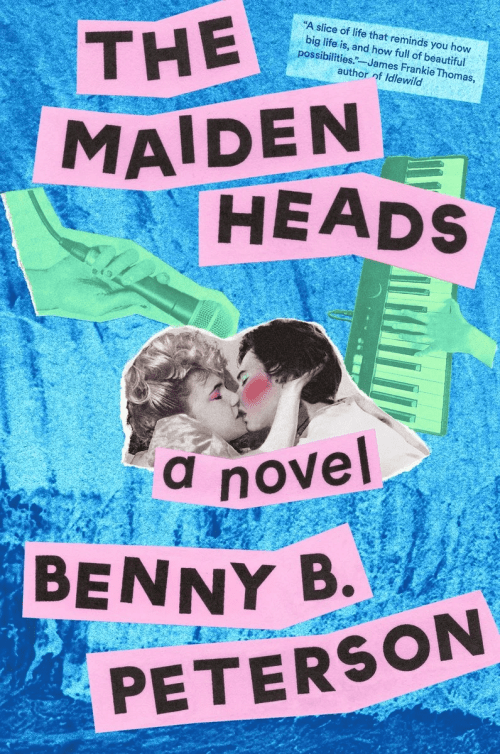
FICTION
The Maidenheads
By Benny B. Peterson
Dutton
Published May 26, 2026


