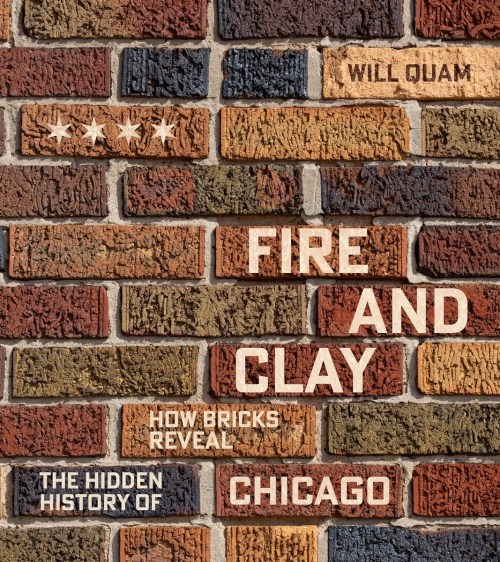
Much like the rich clay deposits that form the quintessential look of Chicago common brick, the city’s brick history is rich and rife with intrigue as told in Will Quam’s Fire and Clay: How Bricks Reveal the Hidden History of Chicago. In Quam’s guiding hands, the reader is taken on a journey from the early days of the city’s brick industry before the infamous Great Chicago Fire of 1871 to the modern day. Even though building materials have changed, the familiar faces of old bricks are still woven throughout the city’s architecture and are considered a core part of Chicago’s visual character.
Quam’s name may strike a memory for those familiar with his Brick of Chicago project, where he provides information about brick and architectural history in the city and leads walking tours on the subject. I had the privilege of taking one of Quam’s tours last year, which is how I first learned of his then-upcoming book. His skill in delivering this information to a wide variety of audiences does make its way into the book, where his humorous asides about the dryness of reading old brick industry magazines and his gentle check-ins for the reader to stay focused after several pages on mortar made the book even more enjoyable to read.
Quam details how Chicago’s historic fire came at a time of great machine innovation in the world of brickmaking. Just as Chicago’s wooden buildings burned to ash and ember, brickmakers were becoming capable of producing greater amounts of brick at faster rates than ever before. The imperfections of the Chicago common brick, with its varied splotches of yellows, pinks, and reds and overall rough texture, meant that many builders preferred to deploy the hardy common brick with discretion. Those who could afford it abandoned the common brick on the front and street-facing walls of a building in favor of more “attractive” face bricks, which were purchased at a higher cost. Common brick was a Chicago staple, but notoriously derided—an excellent tool for strength and structure, but with a face only an alley could love.
Throughout the book, Quam expresses with great passion how brick is more than just a building material. It’s also an artistic tool that, depending on how it’s used and with what techniques, can allow for human expression to take hold of a building. It’s a single brushstroke on a canvas or a gather of flowing fabric. The choices that we make in using our materials are how we can create interest, meaning, spectacle, and beauty around us.
Bricks are certainly a tool of artistic expression, but they are also intended as functional tools to build our homes, our workplaces, our houses of worship, and the structures where we find community. Quam captures the constant push-and-pull architectural tension through the years of whether building design should prioritize highlighting the function of brick and other materials or whether we should use them to create beauty and meaning. The history of this tension, Quam explains, is still visible today, from the Art Deco style and ornate terracotta embellishments in buildings constructed during the 1920s, to the more staid and reserved look of buildings designed in the years following the Great Depression. After a period when a more functional look for brick and stone was in vogue, brick returned to popular consciousness as the new favored building material. This time it had the aura of an old friend, with its familiarity and warmth appreciated as comforts. Quam uses these ebbs and flows in architectural preferences to highlight how brick is in a perpetual state of constantly being rediscovered. Even Chicago common brick, not seen as visually desirable during its heyday, has found love and appreciation today.

Quam leads the reader into our current moment of brick history, detailing how old construction has been maintained, where the once-bustling Chicago brick industry is now, and how shifts in environmental and safety regulations have changed what a brick looks like. How we make a brick has changed and that does mean there is a certain ephemeral quality to the bricks of old—we simply can’t produce these in the exact way we did before. Despite the changes in our tools, the practice of adorning our city directly from the earth itself is the same, and I’ve learned through Quam’s extensive research how to better appreciate the process within my day-to-day life. While I’m sure Fire and Clay will be a delightful addition to my home’s bookshelf to share with Chicago residents and visitors alike, I’m excited for readers to adventure the city this summer with the book as their companion. I’ll keep it on hand and take note of the bricks, the buildings, and how they create a visual wonderland in the usual humdrum of the city.
NONFICTION
Fire and Clay: How Bricks Reveal the Hidden History of Chicago
By Will Quam
University of Chicago Press
Published April 23, 2026