


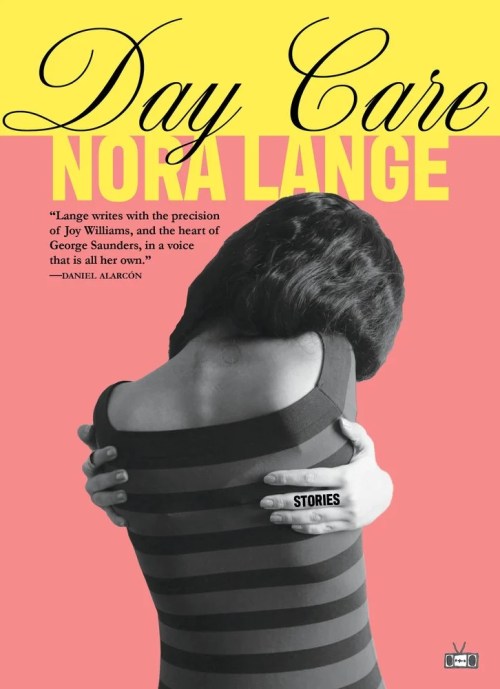
Is a short story allowed to do that? Does everything mean something? Does it matter? These are all questions I asked myself while reading Nora Lange’s newest collection, Day Care.
Through eighteen stories, Lange gives the banality of day-to-day life a second, louder heartbeat. Day Care romanticizes and mocks the simple complexities and forgotten conversations that stumble in and out of an average day. Collectively, these stories balance on the line that separates the mundane from the profound when it comes to a monotonous American existence.
Many of the stories in Day Care plop us right in the middle of a character’s thought or while they are going about their day. It is a feat to write so in-depth about the layers that exist under the ordinary of our bland wants and needs and make it into a “story.” As a reader, we enter in and out of the character’s lives with controlled passivity. Lange does a remarkable job capturing the interim background noise of a floating memory, a passing daydream, a theory, an observation—and then just as quickly as that thought came, moving onto something else, as normal people do.
Lange has a Didion-like ability to recognize nuance, and then strangle it. Her voice is distinct, a style that is ambiguous while all-knowing, and funny. Her characters are both observant and self-aware, many of whom exist within stories that are mostly plotless, but full. With a delicately seasoned sentence for every scenario or feeling, Lange reminds that there is always something to notice, something to smirk at. Whether that be on an airplane with strangers, sharing bananas with coworkers, or through the act of scavenging spare minutes in a day for sex with a sex app lover.
“Dog Star”, a standout piece, tells the story of Honey and her friend Alice, two existentially sentient figurines who live inside of a snow globe. My personal favorite, and the most unlike the rest, this story is as comforting and nostalgic as it is odd and disturbing. I think that nuance is a language, maybe at times, the learning of one. Accessing them is a skill, a high. When you start suddenly seeing stripes and polka dots within the plainness of life, suddenly all you can see are polka dots and stripes. Even for man-made figurines in a snow-globe, the subconscious of these characters need to be actualized by someone or something in order to persist. Misogyny, romance, capitalism, consciousness—they all have a lot of contradictions. The profound must always run parallel to the suggested instructions in order for us to keep going.
In “Last Boob Feed”, we follow a young mother enduring an average day caring for her newborn. This story also does an engaging job of bouncing us along a thought from an otherwise forgetful day. Lange writes:
“I remind myself that this baby does not belong to me. She has been here all along. She is of the forest like trees are of the forest. Her presence comes from every direction like a compass. I am a guest in my life. Where did I put the funnel? I wonder. ”

I think nuance requires intention, you are either in on it or you are not. Lange is a realistic writer, a feel and don’t tell writer. She asks readers to be objective, leave room for many things to be true at once, and sometimes, question whether a line was intended to be poetry, or bullshit—such is life. ‘Can I answer with “All of the Above?”
FICTION
Day Care
By Nora Lange
Two Dollar Radio
Published April 7, 2026


